
Marine Advisory: 04/2013 - BALLAST WATER EXCHANGE- HAZARDS AND PRECAUTIONS
07 November 2013
Marine Advisory 04/2013
SUBJECT: BALLAST WATER EXCHANGE- HAZARDS AND PRECAUTIONS

Ref: (a) Resolution A.868 (20) – Guidelines for the Control and management of Ships’ Ballast Water to Minimize the Transfer of Harmful Aquatic Organisms and Pathogens
- Resolution MEPC.127 (53) – Guidelines for Ballast Water Management and Development of Ballast Water Management Plans (G4)
- Resolution MEPC.124 (53) - Guidelines for Ballast Water Exchange (G6) Dear Shipowner/Operator:
Until the International Ballast Water Management Convention 2004 enters into force and until the date for implementation of Ballast Water Performance Standards in Regulation D-2 of the Convention, ships that carry out Ballast Water Exchange in accordance with the approved Ballast Water Management Plan developed under guidelines in Resolution A.868 (20) and/or MEPC.127 (53), should consider the hazards associated with this procedure and precautions to be taken.
- Sequential method
- Safety procedures for ship and crew
- Minimum stability recommended by the IMO after taking into account free surface effect in partially-filled tanks
- Approved longitudinal and torsional stresses and structural loads due to sloshing action in partially-filled tanks
- Flow-through method
- Safety procedures for ship and crew
- Possible effects of over-pressurization of the tank
- Damage to floating devices in air-pipes
Recent port state control detentions (particularly in Australian waters) have revealed several cases of damages to air pipe heads. The air pipe heads were of the automatic float type, from different manufacturers and used by different new construction shipyards.
Investigation showed that all the air pipe heads had been damaged by being subjected to continuous overflow of the ballast tanks for ballast water exchange – Air-pipes are not designed for continuous ballast water overflow.
Additionally, certain watertight and weather-tight closures (Example: manholes) which may be opened during exchange, should be re-secured.
Questions regarding this Advisory should be directed to Safety Department at +1 703 790 3434 or safety@liscr.com
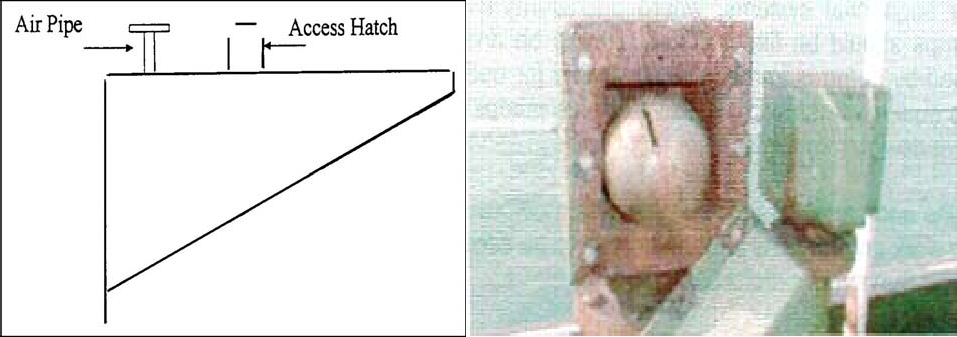
Location and construction of air-pipe and access hatch
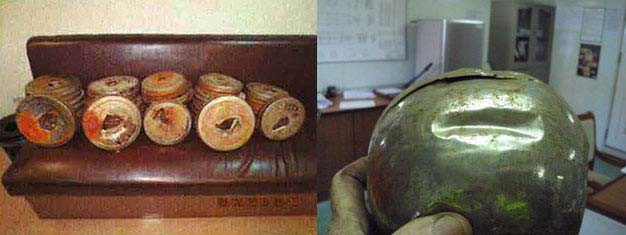
Damaged floating devices in air-pipes heads subjected to continuous overflow
* * * * *
2