
Marine Advisory: 12/2020 - Precautions when Navigating Waters in and around Ningbo-Zhoushan, China
17 March 2020
Marine Advisory 12/2020
Subject: Precautions when Navigating Waters in and around Ningbo-Zhoushan, China TO: ALL OWNERS/OPERATORS AND MASTERS OF LIBERIAN FLAGGED
VESSELS
Dear Shipowners/Operators/Masters:
The Liberian Registry has recognized that the fishing season in the Ningbo-Zhoushan Port area will start soon creating additional vessel traffic and navigation hazards. This guidance is to assist Liberian flagged vessels and provide additional information to assist Master’s in safely navigating highly congested waters off Ningbo-Zhoushan in the East China Sea.
Purpose
The purpose of this Advisory is to provide additional information to assist Master’s in safely navigating highly congested waters off Ningbo-Zhoushan in the East China Sea.
Discussion
The Chinese port of Ningbo-Zhoushan is located in Ningbo and Zhoushan on the coast of the East China Sea, in Zhejiang province and is ranked the busiest cargo port in the world.
Large fleets of fishing junks may be encountered on the coast of China. The junks may not be carrying lights. They are solidly built and serious damage could be incurred by colliding with them. Fishing vessels vary from traditional rowing or sailing craft as little as 3m long to modern trawlers 15m long and over.
Action
We strongly encourage owners to ensure their Masters are familiar with this Advisory and that Master’s take necessary precautions when navigating through areas prone to large concentrations of fishing vessels.
Additional lookouts should be considered, especially at night and during periods of fog. Fishing vessels, in addition to being hampered in their maneuverability while fishing, are liable at times to make unannounced maneuvers, including the custom of crossing the bow of a large vessel for good luck. Care should be taken to keep clear of vessels engaged in fishing. Should a collision occur Master’s should stand by, render aid and immediately report the casualty to the local MSA authority and this Administration.
Please note more detailed information attached.
Please contact the Fleet Performance Department at prevention@liscr.com if you have any questions.
Attachment to Marine Advisory: 12/2020
Advisory on Navigating in Fishing Areas in Ningbo-Zhoushan Port
Dear Captain:
Hello, welcome to Ningbo-Zhoushan port! Ningbo coast is the "T" intersection for China Yangtze River economic belt and China coastal transport. This intersection is a busy maritime highway, rich in fishery resources, and complex meteorological and hydrological conditions. In order to ensure a good maritime transport system, and the safety of ship navigation, we provide special reminders as follows:
Ⅰ. Safe navigation in fishing areas.
- Every year, fishing season for the East China Sea commences on 16th Sep, 12:00 to 1st May, 12:00. This includes trawlers using spar drag method for shrimp, pots cast method, gill nets method and lighting enclosure (cladding) net method, fishing season commencing from at 1st August, 12:00 to 1st May, 12:00.
- The Ningbo coastal route inter-cross with the East China Sea fishing zone, with fishing vessel navigating mostly in formation or operating in concentration. It is common for fishing vessels to operate in pairs using trawling method (Diagram A), long lining and bottom trawling in the night, fishing net cast using buoy or at anchor. In addition, fishing vessels have a custom of crossing the bow of the large vessel for good luck.
- Vessel should as far as possible alter the ship’s course to avoid and maintain safe distance from areas with heavy concentration of fishing vessels. Vessel should not cut across areas where fishing vessels are congregated.
- When navigating in fishing concentrated areas, the vessel should increase the navigation watch team with additional lookouts, maintaining safe speed and with all engines readily available. In close quarter situation, vessel should use ship horn, signaling light, and any means of communication or navigational aid to prevent the risk from further escalation.
- When navigating in fishing concentrated areas, it is advised to pay close attention to signal lights of fishing vessels. The vessel should respond in a timely manner to declare that the watch on the bridge have noticed the fishing vessels when the fishing vessel gives flashing light signals to the bridge of the merchant vessel. (at least 5 times generally). When the flash light of the fishing vessel is directed to any of its sides, it indicates that there are fishing nets on that side. The vessel should avoid passing the same side.
g. When an incident occurs, aside from reporting to the company Designated Person Ashore (DPA), the vessel should report the incident to the nearest China MSA office directly or through the vessel agent and to the Flag Administration.
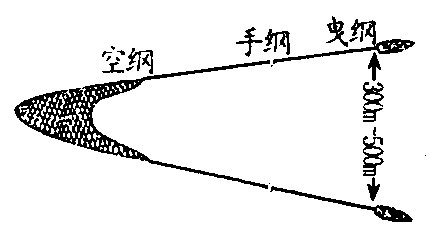
Diagram A – Twin trawler
Ⅱ. Ningbo coastal fishing vessels operating characteristics
Ningbo coastal fishing ground common fishing methods are: light purse, double drag, single drag, drag shrimp, sail net, crab cage, stream net, submarine string and small purse seining net. A brief introduction on the fishing method that has impact to safe navigation:
(1). Trawling
There are mainly two kinds of trawling method, twin trawler and single Trawler.
Twin trawling refers to two separate fishing vessels, dragging in a fixed distance corresponding the hanging fishing nets. The trawl is 400-500 meters in length, deep into the water, trawl speed under normal weather conditions 3-4 knots. When the shooting and hauling the net, usually during night hours or near daybreak, the crew will be busy on the deck, with deck lights shining on them.The lights and shapes for trawling is as follows:
- by daytime, a shape consisting of two cones with their apexes together in a vertical line one above the other near the top of the mast;
- by night, two all-round lights in a vertical line, the upper being green and the lower white, and side navigational lights at the aft masthead, and stern light; In addition to the lights prescribed in paragraph②
- when shooting their net, two white lights in a vertical line;
- when hauling their night, one white light over one red light in a vertical line.
A single trawler is a fishing vessel alone, dragged a fish net using side and stern tow. Trawling speed approximately 4-6 knots. The identification mark coincides with the double trawling method.
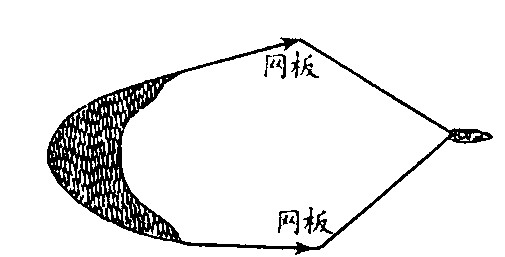
Diagram B – Single trawler Advised action:
For double fishing trawling vessels your vessel is to maintain from their stern no less than 1 nautical mile and by no less than 0.5 nautical mile on each side. Your vessel is to maintain safe distance when crossing the fishing vessel’s bow and is prohibited to cut across the middle of a double fishing trawling vessel operation. For single drag fishing trawling vessel, your vessel should take the same precaution and avoidance action as per double trawling fishing vessels.
The vessel is to pay attention and avoid the side of the fishing trawling vessel, especially when the vessel is retrieving or casting net, do expect sudden and frequent change of course. We recommended your vessel keep a minimum distance of 0.5 nautical mile away from the fishing trawling vessel.
(2). Drift net fishing
Drift net fishing is expanded vertical mesh net cast in water, having a wide area of operation, from one to several nautical miles in diameter. The net is mark with buoys and flags, and flag pole with flashing light for night operation. One end of the net going downstream direction, is attach to the bow of the fishing trawler. The bow of the fishing trawler marks the direction and position of the fishing. The fishing vessel and the fishing net are drifting based on the wind direction. The means to identify driftnet is a column buoy, buoy and/or flag, and flag pole with flash lights at night. In the calmer sea surface. The top surface of the pontoon or buoy, and fishing vessel can be detected by the radar, forming almost into a straight line on the screen.
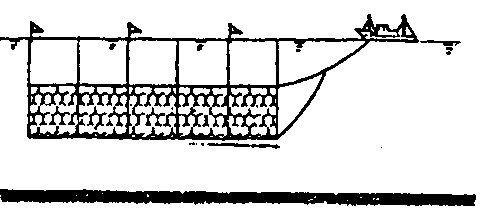
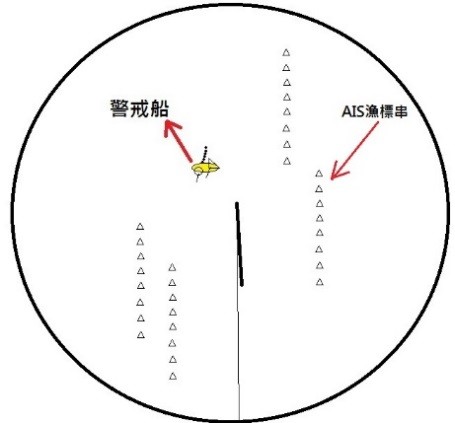
Diagram C – Drift net Advised action:
Your vessel should maintain at least 0.5 nautical mile away from this fishing trawler, and is prohibited from sailing close to the fishing trawler bow, and maintain at least 1.0 nautical mile away from the fishing trawler when the driftnet has been cast.
In the event, that your vessel is in close proximity of the drift net, the vessel should immediately stop all engines to avoid the net being entangled on the propeller, and hopefully allow the vessel to coast across the fishing vessel’s net using inertia. The Master or officer on watch should maneuverer with caution, using the vessel’s inertia to bring the vessel to a stop position.
(3). Purse seine fishing
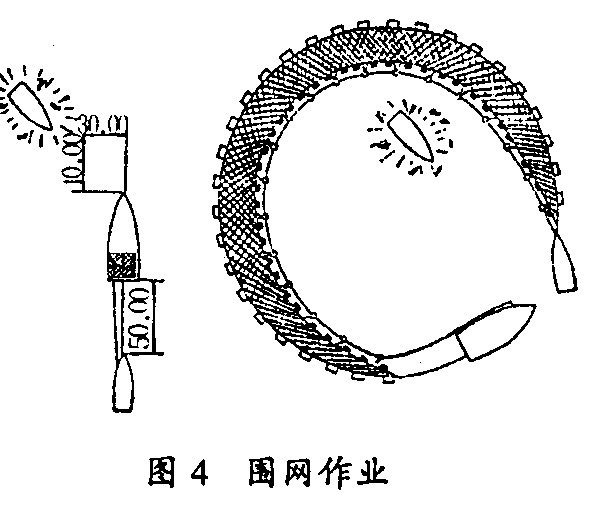
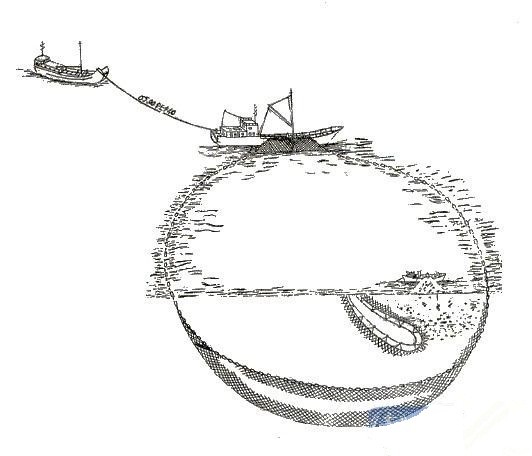
Purse seine fishing is a method using a long strip of net to surround a school of fish. It usually consists of one casting vessel, two lighting vessels and a fishing vessel for transport purpose. The net length ranges from 980-1200 meters, and has a coverage of approximately 350m diameter. Purse seine fishing can be identified with a vertical display of an all-round red light above an all-round white light in vertical, and in the direction of the fishing net, a network shows a white light indicating the net position.
Advised action: Vessel should keep a minimum safe distance 0.5 nautical mile from the upstream direction of the purse seine fishing trawler.
Diagram D – Purse seine
(
4
)
Stretch net fishing
The time of stretch net fishing is determined by the tide and current. In general, fishing vessels place their nets around neap tide and retrieve them around spring tide, the duration lasts about 12 days. Exercise areas of these fishing vessels are not fixed, in the first half of the year they mostly operate in the area from 28°N to 32N,122°E to 124°E, in the second half of the year from 30°N to 32°N, 124°E to 126°E.
Advised action: Cargo vessels should learn the fishing vessels net areas by means of AIS net position indicators. Collision avoidance are to be taken at earliest opportunity. It is suggested to either maintain distance from this type of fishing nets or sail through between the net areas (the width of in between areas will be approximately 1000 meters).
(5)Glaring fishing
There are fishing vessels fit with glare device shining upon the surrounding sea surface to attract catch. This type of fishing vessels operates separately and travel in groups. The illumination can be extremely powerful during group operation. Commonly the fishing vessels stay still or drift with the current, they are easy to be spotted even outside a distance of 12 nm. It may interfere with vessels’ lookout to identify proper lighting signals because of fishing vessel’s glaring light.
Advised action: Cargo vessels should enhance to use long and short range of radar observation. Analysis of fishing vessels’ operation situation is to be made at earliest opportunity. Adjust vessels’ route as appropriate and avoid entering fishing vessels’ concentrated areas.
* * * * *


