
Marine Advisory: 20/2020 - Sanctions Advisory for the Maritime Industry, Energy and Metals Sectors, and Related Communities Guidance to Address Illicit Shipping and Sanctions Evasions Practices
20 May 2020
Marine Advisory 20/2020
SUBJECT: Sanctions Advisory for the Maritime Industry, Energy and Metals Sectors, and Related Communities
Guidance to Address Illicit Shipping and Sanctions Evasions Practices
Reference: (a) Marine Advisory 04/2018
Dear Owner/Operator and Master:
On May 14, 2020, the U.S. Department of the Treasury’s Office of Foreign Assets Control (“OFAC”), with the U.S. Department of State and the U.S. Coast Guard issued a Sanctions Advisory for the Maritime Industry, Energy and Metals Sectors, and Related Communities titled “Guidance to Address Illicit Shipping and Sanctions Evasions Practices” (the “Advisory”). The Advisory provides maritime industry members with specific guidance how to counter current and emerging trends related to illicit shipping and sanctions evasion.
The Advisory updates previous shipping advisories on Iran, North Korea, and Syria, and focuses on parties involved in the supply chains of trade in the energy and metals sectors, including trade in crude oil, refined petroleum, petrochemicals, steel, iron, aluminum, copper, sand and coal. The Advisory should be reviewed in its entirety as it provides specific recommendations to maritime insurance companies; flag registry managers; port state control authorities; shipping industry associations; financial institutions; ship owners, operators, and charterers; classification societies; vessel captains; crewing companies; and regional and global commodity trading, supplier, and brokering companies.
Acknowledging that majority of global trade involves marine transportation, the Advisory warns industry members of the following deceptive tactics that increase the risk of involvement in a sanctionable or illicit activity and call for heightened due diligence measures:
- Disabling or Manipulating AIS on Vessels: the Advisory considers disabling, manipulation and disruption of AIS signal as a major red flag. Industry members are cautioned to be vigilant about engaging with parties or vessels with a history of disabling or manipulating AIS.
- Physically Altering Vessel Identification: the Advisory warns that vessels involved in illicit activities often paint over vessel names and IMO numbers to obscure their identities and pass themselves off as different vessels.
- Falsifying Cargo and Vessel Documents: the Advisory notes that authorities have found that sanction evaders have falsified shipping documentation pertaining to petrochemicals, petroleum, petroleum products, or metals (steel, iron) or sand to disguise their origin. Persons conducting transportation or trade involving the maritime sector are advised to conduct due diligence on cargo origin and shipping documents.
- STS Transfers: the Advisory cautions that STS transfers “especially at night or in areas determined to be high-risk for sanctions evasion or other illicit activity” are often used to disguise cargo origin or evade sanctions.
- Voyage Irregularities: the Advisory recognizes that transit and transshipment are common in the global movement of goods, but encourages those operating in the industry to “scrutinize routes and destinations that deviate from normal business practices.
- False Flag and Flag Hopping: because false flag representations or flag hopping can mask illicit trade, the Advisory recommends that the private sector be aware of and report to competent authorities instances of such behavior.
- Complex Ownership or Management: as complex ownership and management structures are likely to hide ultimate beneficial owners of cargo and commodities, private industry parties should exercise caution. “If private sector entities are unable to reasonably identify the real parties in interest in a transaction, they may wish to consider performing additional due diligence to ensure it is not sanctionable or illicit.”
Further, the Advisory emphasizes that private sector entities should appropriately assess their sanctions risks, and as necessary, implement specific measures to identify sanctions evasions, such as:
- Institutionalizing Sanctions Compliance Programs: the Advisory encourages the private sector to develop and implement sanctions compliance and due diligence programs, provide training to personnel, and consider having the programs routinely audited by qualified third parties as a means of continuous improvement.
- Establishing AIS Best Practices and Contractual Requirements: private industry actors are encouraged to investigate signs and reports of AIS transponder manipulation before entering into new contracts, and include contractual provisions which make the disablement or manipulation of AIS grounds for termination of the contract or refusal to perform or transfer cargo.
- Monitoring Ships Throughout the Entire Transaction Lifecycle: ship owners, managers, and charter companies are advised to continuously monitor vessels, including those leased to third parties, by, i.a., supplementing AIS with Long Range Identification and Tracking (LRIT) signals.
- Know Your Customer and Counterparty: parties conducting due diligence are advised to consider maintaining the names, passport ID numbers, address(es), phone number(s), email address(es), and copies of photo identification of each beneficial owner(s) of legal entities involved in maritime activities.
- Exercising Supply Chain Due Diligence.
- Incorporating Best Practices into the Contractual Language. 7) Sharing of information with other industry members.
2
The Advisory is not intended to be a comprehensive summary of applicable sanction provisions or as imposing requirements under U.S. law. It should nevertheless be reviewed very carefully as it signals the U.S. government’s keen focus on international shipping as a means to implement and enforce sanctions policies.
It is important for both U.S. and non-U.S. maritime actors and other members in the industry to make sanctions compliance a high priority. The recommendations set forth in the Advisory should be considered and implemented where appropriate.
For ease of reference, a copy of the Advisory is attached and is available at the following link: https://www.treasury.gov/resource-
center/sanctions/Programs/Documents/05142020_global_advisory_v1.pdf
Point of Contact
For further information regarding the issuance of this Advisory, contact the Sanctions Compliance Department at +1 (703) 564 7560 or email to inossova@liscr.com. If after business hours, please contact the Duty Officer at + 1 703 963 6216 or Dutyofficer@liscr.com.
Attachment: The U.S. Department of State, the U.S. Department of the Treasury’s OFAC, and the
U.S. Coast Guard Sanctions Advisory for the Maritime Industry, Energy and Metals Sectors, and Related Communities titled Guidance to Address Illicit Shipping and Sanctions Evasions Practices.
* * * * *
3
Department of the Treasury Department of State United States Coast Guard
Sanctions Advisory for the Maritime Industry, Energy and Metals Sectors, and Related Communities
Issued: | May 14, 2020 |
Title: | Guidance to Address Illicit Shipping and Sanctions Evasion Practices |
The U.S. Department of State, the U.S. Department of the Treasury’s Office of Foreign Assets Control (OFAC), and the U.S. Coast Guard are issuing this advisory to provide those engaged or involved in trade in the maritime industry and energy and metals sectors with further information and tools to counter current and emerging trends related to illicit shipping and sanctions evasion. This advisory reflects the U.S. government’s commitment to work with the private sector to prevent sanctions evasion, smuggling, criminal activity, facilitation of terrorist activities, and proliferation of weapons of mass destruction (WMD), with a focus on Iran, North Korea, and Syria. Combined with Annexes A and B, this advisory updates and expands on the North Korea-related shipping advisories OFAC issued on February 23, 2018, and March 21, 2019; the Iran-related shipping advisory OFAC issued on September 4, 2019; and the Syria-related shipping advisories OFAC issued on November 20, 2018, and March 25, 2019. At a later date, OFAC may issue further updates to this advisory, including with respect to the vessel lists that have appeared in previous shipping advisories.
This advisory discusses sanctions risks and contains information on common deceptive shipping practices and general approaches to aid in further tailoring due diligence and sanctions compliance policies and procedures. It is intended primarily to provide guidance to the following: ship owners, managers, operators, brokers, ship chandlers, flag registries, port operators, shipping companies, freight forwarders, classification service providers, commodity traders, insurance companies, and financial institutions.[1],[2] This advisory includes both updated information on the deceptive practices used to evade sanctions and policies and procedures that entities operating in the specific maritime sectors enumerated above may wish to consider adopting as part of a risk-based sanctions compliance program.
It is critical that private sector entities appropriately assess their sanctions risk and, as necessary, implement compliance controls to address any identified gaps in their compliance programs. This is especially important when operating near or in areas they determine to be high-risk, which may include areas frequently used for potentially sanctionable transportation-related activities. The United States also encourages entities and individuals involved in the supply chains of trade in the energy and metals sectors, including trade in crude oil, refined petroleum, petrochemicals, steel, iron, aluminum, copper, sand, and coal, to review this advisory and take appropriate action as deemed necessary or advisable.
Deceptive Shipping Practices
Approximately 90 percent of global trade involves maritime transportation. Malign actors constantly seek novel ways to exploit global supply chains for their benefit. The following list, while not exhaustive, summarizes several tactics utilized to facilitate sanctionable or illicit maritime trade linked to Iran, North Korea, and Syria. We recommend that persons conducting any transportation or trade involving the maritime sector continue to be vigilant against the following tactics in order to limit the risk of involvement with sanctionable or illicit activity, and that they exercise heightened due diligence with respect to shipments that transit areas they determine to present high risk.
1) Disabling or Manipulating the Automatic Identification System (AIS) on Vessels
AIS is an internationally mandated system that transmits a vessel’s identification and navigational positional data via high frequency radio waves. The International Convention for the Safety of Life at Sea (SOLAS) requires that certain classes of vessels traveling on international voyages operate AIS at all times with few exceptions. Although safety issues may at times prompt legitimate disablement of AIS transmission, and poor transmission may otherwise occur, vessels engaged in illicit activities may also intentionally disable their AIS transponders or manipulate the data transmitted in order to mask their movement. The practice of manipulating AIS data, referred to as “spoofing,” allows ships to broadcast a different name, International Maritime Organization (IMO) number (a unique, sevendigit vessel identification code), Maritime Mobile Service Identity (MMSI), or other identifying information. This tactic can also conceal a vessel’s next port of call or other information regarding its voyage.
2) Physically Altering Vessel Identification
Passenger ships of 100 Gross Tonnage (GT) and upwards and cargo ships of 300 GT and upwards are required to display their name and IMO number in a visible location on the vessel’s hull or superstructure. A vessel’s IMO number is intended to be permanent regardless of a change in a vessel’s ownership or name. Vessels involved in illicit activities have often painted over vessel names and IMO numbers to obscure their identities and pass themselves off as different vessels.
3) Falsifying Cargo and Vessel Documents
Complete and accurate shipping documentation is critical to ensure all parties to a transaction understand the entities, recipients, goods, and vessels involved in a given shipment. Bills of lading, certificates of origin, invoices, packing lists, proof of insurance, and lists of last ports of call are examples of documentation that typically accompanies a shipping transaction. Authorities have found that sanctions evaders have falsified shipping documentation pertaining to petrochemicals, petroleum, petroleum products, or metals (steel, iron) or sand in order to disguise their origin. Falsifying certain documents (including customs and export control documents) is illegal in most countries, and irregularities may provide a basis to hold a shipment until its contents are validated. In addition, persons conducting transportation or trade involving the maritime sector are encouraged to conduct due diligence, as necessary, on documents that indicate or suggest that cargo is from an area they determine to be high-risk for sanctions evasion, notwithstanding any purported low-risk place of origin.
4) Ship-to-Ship (STS) Transfers
While ship-to-ship transfers (the transfer of cargo between ships at sea) can be conducted for legitimate purposes, STS transfers—especially at night or in areas determined to be high-risk for sanctions evasion or other illicit activity—are frequently used to evade sanctions by concealing the origin or destination of surreptitiously transferred petroleum, coal, and other material.
5) Voyage Irregularities
Malign actors may attempt to disguise the ultimate destination or origin of cargo or recipients by using indirect routing, unscheduled detours, or transit or transshipment of cargo through third countries. Although transit and transshipment are common in the global movement of goods, private sector entities, including flag registry management companies, port operators, shipping industry associations, ship owners, operators, and charterers, ship captains, and crewing companies are encouraged to scrutinize routes and destinations that deviate from normal business practices, as appropriate.
6) False Flags and Flag Hopping
Bad actors may falsify the flag of their vessels to mask illicit trade. They may also repeatedly register with new flag states (“flag hopping”) to avoid detection. We recommend that the private sector be aware of and report to competent authorities any instances of a vessel owner or manager who continues to use a country’s flag after it has been removed from a registry (i.e., “deregistered”), occurrences of a ship claiming a country flag without proper authorization, or instances when a vessel has changed flags frequently in a short period of time in a suspicious manner consistent with flag hopping. Specific measures for different parts of the private sector are included in the industry guidance accompanying this report as Annex A.
7) Complex Ownership or Management
Global shipping is inherently complex and involves multiple interactions with both government and private sector entities. Bad actors attempt to take advantage of this complexity through the use of complex business structures, including those involving shell companies and/or multiple levels of ownership and management, to disguise the ultimate beneficial owner of cargo or commodities in order to avoid sanctions or other enforcement action, among other reasons. Bad actors also may engage in a pattern of changes in the ownership or management of companies or in the International Safety Management Code (ISM) management companies used. If private sector entities are unable to reasonably identify the real parties in interest in a transaction, they may wish to consider performing additional due diligence to ensure it is not sanctionable or illicit.
General Practices for Effective Identification of Sanctions Evasion
As industry actors implement appropriate due diligence and compliance programs based on their risk assessments, we recommend that they continually adopt business practices to address red flags and other anomalies that may indicate illicit or sanctionable behavior. Detailed below are specific practices that may assist in more effectively identifying potential sanctions evasion. However, these are not intended to be, nor should they be interpreted as, comprehensive, as imposing any specific requirements under U.S.
law, or as otherwise addressing any particular requirements under applicable laws or regulations.
1) Institutionalize Sanctions Compliance Programs
We recommend that, as appropriate, private sector entities assess their sanctions risk, implement sanctions compliance and due diligence programs, and provide training and resources to personnel in order to best execute those programs. Entities may wish to consider communicating with their counterparties, partners, subsidiaries, and affiliates to articulate their compliance expectations in a manner consistent with applicable local requirements.
As appropriate, private sector entities continue to be encouraged to develop, implement, and adhere to written standardized operational compliance policies, procedures, standards of conduct, and safeguards. These compliance programs may establish that engaging in sanctionable conduct is cause for immediate termination of business or employment, or could determine that appropriate controls have been adopted that adequately mitigate potential risks associated with the activity. Further, it is a compliance best practice that employees who disclose illicit behavior be protected from retaliation and that a confidential mechanism exist to report suspected or actual illicit or sanctionable activity. To the extent appropriate, private sector entities may wish to have their sanctions compliance programs routinely audited by qualified third parties as a means of continuous improvement.
Additionally, sanctions compliance programs may include communicating to counterparts, including but not limited to ship owners, managers, charterers, and operators, an expectation that they have adequate and appropriate compliance policies that respond to their internal risk assessments. In addition to doing so themselves, and when appropriate, private sector entities are encouraged to communicate to their counterparts an expectation that they: 1) conduct their activities in a manner consistent with U.S. and United Nations (UN) sanctions, as applicable; 2) have sufficient resources in place to ensure execution of and compliance with their own sanctions policies by their personnel, e.g., direct hires, contractors, and staff; 3) ensure subsidiaries and affiliates comply with the relevant policies, as applicable; 4) have relevant controls in place to monitor AIS; 5) have controls in place to screen and assess onboarding or offloading cargo in areas they determine to present a high risk; 6) have controls to assess authenticity of bills of lading, as necessary; and 7) have controls in place consistent with this advisory.
2) Establish AIS Best Practices and Contractual Requirements
AIS manipulation and disruption may indicate potential illicit or sanctionable activities. Entities in the maritime industry may wish to consider, based on their individual risk assessments, researching a ship’s history to identify previous AIS manipulation and monitoring AIS manipulation and disablement when cargo is in transit. As appropriate, maritime industry participants, flag registries, and other private sector entities to include insurers and financial institutions that conduct business with ship owners, charterers, and managers are encouraged to promote continuous broadcasting of AIS throughout the life of the transaction, consistent with SOLAS, especially in those areas determined to pose a high risk for sanctions evasion.
Private industry, including those industries referenced in Annex A, are encouraged to investigate signs and reports of AIS transponder manipulation before entering into new contracts involving problematic vessels or when engaging in ongoing business. Financial institutions may continue to assess this activity pursuant to a risk-based approach and—as appropriate—implement relevant controls for their maritime industry clients, particularly those that own, operate, and/or provide services to ships operating in areas determined to pose a high risk for sanctions evasion. Service providers may wish to consider amending contracts to make disabling or manipulating AIS for illegitimate reasons, grounds for termination of contracts or investigation, which could lead to termination of services or contracts if illicit or sanctionable activity is identified. Additionally, parties could consider incorporating contractual language that prohibits transfers of cargo to client vessels that are not broadcasting AIS in accordance with SOLAS or have AIS history that indicates manipulation or termination for illegitimate reasons.
Additionally, port state control and vessel traffic services authorities are encouraged to reiterate the requirement to maintain AIS broadcasts to tankers and bulk containers arriving in and leaving their jurisdictions. If a vessel cannot account for its AIS history consistent with SOLAS, port authorities may wish to consider investigating the underlying activity to ensure that it is not sanctionable or otherwise illicit. If determined to be illicit, the port authorities may wish to consider prohibiting that vessel from entering their ports or taking other appropriate actions.
3) Monitor Ships Throughout the Entire Transaction Lifecycle
As appropriate, consistent with their risk assessments, ship owners, managers, and charter companies are encouraged to continuously monitor vessels, including those leased to third parties. This could include supplementing AIS with Long Range Identification and Tracking (LRIT) and receiving periodic LRIT signals on a frequency informed by the entity’s risk assessment. Port authorities in areas that present a high risk related to sanctions evasion may wish to consider monitoring ships using LRIT within their areas of operation as a risk mitigation strategy. Ship owners and managers may wish to consider raising awareness of common deceptive practices among vessel operators that conduct STS transfers in areas determined to be high-risk. Prior to any such transfers, vessel operators may wish to consider verifying the other vessel’s name, IMO number, and flag, and checking that it is currently broadcasting AIS. As part of identifying red flags, industry actors may also consider looking for situations where ownership of a vessel is transferred between companies controlled by the same beneficial owner and where there is no discernable legitimate purpose for the transfer.
4) Know Your Customer and Counterparty
Flag registry administrations, insurers, financial institutions, managers, and charterers should continue to conduct risk-based due diligence as appropriate. This due diligence might include maintaining the names, passport ID numbers, address(es), phone number(s), email address(es), and copies of photo identification of each customer’s beneficial owner(s). For example, if a legal entity is seeking to register a vessel with a flag or seeking insurance or financing for a vessel, each of these parties could request documentation regarding the ultimate beneficial owner(s) of the vessel, and seek to verify this with the documentation above, as appropriate and on a risk-basis.
5) Exercise Supply Chain Due Diligence
As appropriate, exporters and entities across the maritime supply chain are encouraged to conduct appropriate due diligence as relevant to ensure that recipients and counterparties to a transaction are not sending or receiving commodities that may trigger sanctions, such as Iranian petroleum or North Korea-origin coal. They may also consider implementing controls that allow for verification-oforigin and recipient checks for ships that conduct STS transfers, particularly in high-risk areas. As necessary, they should consider requesting copies of export licenses (where applicable) and complete, accurate shipping documentation, including bills of lading that identify the origin or destination of cargo.
As appropriate, private sector maritime entities are encouraged to review the details of the underlying voyage, including the vessel, cargo, origin, destination, and parties to the transaction. In particular, and in line with their internal risk assessment, parties are encouraged to review the relevant documents in order to demonstrate that the underlying goods were delivered to the port listed in the documentation and not diverted in an illicit or sanctions-evading scheme.
6) Contractual Language
Members of the industry are encouraged to incorporate these best practices in contracts related to their commercial trade, financial, and other business relationships in the maritime industry.
7) Industry Information Sharing
Successful sanctions compliance programs often rely on fostering industry-wide awareness of challenges, threats, and risk mitigation measures. The Department of State, OFAC, and the U.S. Coast Guard recommend that industry groups encourage members to provide relevant information and share it broadly with partners, other members, and colleagues consistent with applicable laws and regulations. For example, when a protection and indemnity (P&I) club insurance company becomes aware of illicit or sanctionable activity or new tactics in sanctions evasion, it may wish to consider notifying other P&I clubs, as appropriate, redacting personally identifiable information that cannot be shared with third parties where necessary. Similarly, vessel owners and clubs are encouraged to share information with the financial industry, potentially working though competent authorities where required, and flag administrations should routinely pass information to the IMO and parties to the Registry Information Sharing Compact.
Additional Resources
For additional resources, parties are encouraged to consult previous guidance from OFAC and the UN on these topics.[3] The United States encourages all interested parties to register for OFAC sanctions updates at https://public.govdelivery.com/accounts/USTREAS/subscriber/new?topic_id=USTREAS_61. They may also register for routine updates from the Department of State’s Counter Threat Finance and
Sanctions Division at https://www.state.gov/subscribe-to-sanctions-alerts/ or contact the office by email at sanctions@state.gov.[4]
For additional questions or concerns related to OFAC sanctions regulations and requirements, including to disclose a potential violation of U.S. sanctions, please contact OFAC’s Compliance Hotline at 1-800540-6322 or via OFAC_Feedback@treasury.gov. Parties may also submit a request for a specific OFAC license on its website at https://licensing.ofac.treas.gov/Apply/Introduction.aspx.
In order to support international efforts to enforce UN Security Council sanctions on North Korea, the U.S. Department of State’s Rewards for Justice (RFJ) Program offers rewards of up to $5 million for information that leads to the disruption of financial mechanisms of persons engaged in certain activities that support North Korea and its efforts to evade sanctions, including illicit shipping activities, money laundering, cyber-crime, and WMD proliferation. For more information, or to submit a tip, visit https://rewardsforjustice.net/english/about-rfj/north_korea.html.
The RFJ Program also offers rewards of up to $15 million for information leading to the disruption of the financial mechanisms of Iran’s Islamic Revolutionary Guard Corps (IRGC) and its branches, including the IRGC-Qods Force (IRGC-QF). The IRGC, which is a Specially Designated Global Terrorist and was designated as a Foreign Terrorist Organization by the U.S. government in April 2019, has financed numerous terrorist attacks and activities globally. The IRGC-QF supports terrorist operations outside Iran via militant groups, such as Hizballah and Hamas. For more information, or to submit a tip, visit https://rewardsforjustice.net/english/irgc.html.
For verification of IMO numbers, you can consult the IMO's database of IMO numbers at https://gisis.imo.org/Public/SHIPS/Default.aspx. To report vessel deregistrations or other actions, please directly contact the IMO (or private parties nominated by the IMO to update the IMO's database at the IMO's direction).
Department of the Treasury Department of State United States Coast Guard
ANNEX A: Additional Guidance and Information to Assist Sanctions Compliance Efforts in the
Maritime Industry
The U.S. Department of State, the U.S. Department of the Treasury’s Office of Foreign Assets Control (OFAC), and the United States Coast Guard strongly encourage persons subject to U.S. jurisdiction, as well as foreign persons that conduct transactions with or involving the United States or U.S. persons, to employ a risk-based approach to sanctions compliance. This approach may include the development, implementation, and routine updating of a sanctions compliance program for such persons’ particular business models. While each risk-based sanctions compliance program will vary depending on a variety of factors—including the company’s size and sophistication, products and services, customers and counterparties, and geographic locations—each program that is implemented should be predicated on and incorporate at least five essential components of compliance: (1) management commitment; (2) risk assessment; (3) internal controls; (4) testing and auditing; and (5) training. See A Framework for OFAC Compliance Commitments for more details.
Set forth below is additional guidance and information intended to assist organizations involved in the maritime industry in developing and implementing an effective sanctions compliance program, consistent with these five components. Specifically, this annex provides such guidance and information for:
- maritime insurance companies – page 9;
- flag registry managers – page 11;
- port state control authorities – page 13;
- shipping industry associations – page 14;
- regional and global commodity trading, supplier, and brokering companies – page 15;
- financial institutions – page 17;
- ship owners, operators, and charterers – page 18;
- classification societies – page 20; vessel captains – page 22; and
- crewing companies – page 23.
Each organization should assess its own risk and adopt the elements included in this guidance as it deems appropriate.[5]
Guidance for Maritime Insurance Companies
A maritime insurance company may wish to consider implementing the following diligence practices as appropriate in assessing and mitigating sanctions risks.
| Monitoring Automatic Identification System (AIS) transmissions and investigating the following occurrences when involving an insured vessel: any significant time period with non-transmission that is not consistent with the International Convention for the Safety of Life at Sea (SOLAS); navigation of suspicious deviations in routes (e.g., changes without what appears to be a legitimate reason to go off-route, such as unsafe ports, extreme weather, or emergencies); a pattern of turning off AIS in a manner inconsistent with SOLAS; and engaging in trade to or from vessels that are not transmitting AIS consistent with SOLAS. |
| Including in pre-coverage and claims presentment, due diligence procedures that assess the AIS history of vessels that engage in potentially illegal activities and operate in areas determined to be high-risk areas for sanctions evasion, both of which may be indicators of possible involvement in illicit activity and may warrant further investigation of the ship’s voyage, charter, ownership, and other factors. |
| Ensuring that insurers that provide coverage for ship owners, suppliers, buyers, charterers, and ship managers could research the AIS history for all the vessels under the ownership or control of such parties. Insurers may wish to consider further communicating to clients that any signs of AIS transponder manipulation inconsistent with SOLAS could be considered a red flag and investigated prior to entering into contracts with, continuing to provide services to, or engaging in other activities with such vessels (including engaging in financial transactions in connection with the vessel’s activities). |
| Incorporating contractual language and explicitly notifying clients that AIS disablement or manipulation inconsistent with SOLAS is possible grounds for investigation by the insurer of the ship’s activities and could result in cancellation of insurance. |
| Incorporating a contractual provision that prohibits transfers of cargo to or from clients with other vessels that are not broadcasting AIS consistent with SOLAS or have a history of AIS transponder manipulation inconsistent with SOLAS. |
| Informing legal regulators/competent authorities, other insurers, commercial databases, the International Maritime Organization (IMO), and when relevant, the United Nations (UN) Security Council 1718 Committee Panel of Experts (the UN DPRK Panel of Experts) in the event of insurance denial or cancellation of services of a vessel in relation to illicit activity. |
| Informing registrants (including owners of vessels) that activity inconsistent with relevant U.S. or UN sanctions may be cause for immediate termination of business and that the underlying due diligence and registration documents revealing information on ownership structure may be sent to the relevant U.S. government and/or UN body at the discretion of the insurer. |
| Ensuring, as appropriate and allowed by applicable laws and regulations, due diligence documents (e.g., registration documents for flag registries) include a color photocopy of the passports, names, business and residential addresses, phone numbers, email of all individual owners of the vessel(s), and the names and IMO numbers of all the vessels in the fleet of the individual ship owner, for ships operating near areas determined to be high risk for sanctions |
evasion or violations. Where necessary, include in forms collecting personally identifiable information (PII) that the insurers and re-insurers may share the PII with competent authorities if the vessel conducts unlawful activities, as allowed by applicable laws and regulations.
| Ensuring clear communication with international partners, as shipping business arrangements may involve parties subject to the laws of different jurisdictions. Clearly explaining relevant restrictions under and the steps required to comply with U.S. and UN sanctions regimes and encouraging all parties involved in the shipping industry to share this advisory with others in their supply chain. |
| Incorporating data such as historical ship location, ship registry information, and ship flagging information, along with available information from the U.S. Department of the Treasury, the UN, and the U.S. Coast Guard into due diligence practices. |
Guidance for Flag Registry Managers[6]
A flag registry manager may wish to consider implementing the following diligence practices to the extent it deems such practices appropriate and helpful in assessing and mitigating sanctions risks.
| Verifying the IMO number of each vessel when receiving an application for registration through the IMO’s Global Integrated Shipping Information System (GISIS) Ship and Company Particulars module. If the IMO and ship name do not clearly match, additional investigation could be conducted prior to the registration of the vessel, and the manager should contact the previous Flag State to confirm the application and its intended release from the previous registry. |
| Transmitting to the receiving Flag Sate administration a copy of the Continuous Synopsis Record, consistent with SOLAS regulation X1-1/5, covering the period during which the ship was under their jurisdiction, together with any Continuous Synopsis Records previously issued to the ship by other states. |
| Reviewing and confirming the Continuous Synopsis Record with the current Flag State before completing registration. |
| Conducting research on the AIS history of vessels that transport oil, refined petroleum, petrochemicals, steel, aluminum, copper, other metals, sand, and coal to determine if such vessels have a pattern of AIS disablement or manipulation inconsistent with SOLAS, which could indicate involvement in illicit activities. Any signs of AIS transponder disablement or manipulation inconsistent with SOLAS should be considered a red flag and investigated fully prior to engaging in other activities with such vessels. |
| Sharing with other flag registries, commercial databases, and the IMO the names and IMO numbers of vessels that have been denied registration, or deregistered related to involvement in sanctionable or illicit shipping activities, so that other flag registries can be made aware and act in a manner consistent with relevant U.S. and UN sanctions. Inform the UN DPRK Panel of Experts in the event of registration denial or deregistration for North Korea-related reasons. |
| Noting the reason for a vessel’s deregistration on the certificate of deletion, particularly in cases of UN-prohibited activity. |
| Acquiring, as appropriate, the capability to monitor AIS transmissions continuously for signs of AIS disablement or manipulation and supplement AIS tracking by using Long Range Identification and Tracking (LRIT). |
| Communicating to all ships and related clients that suspicious AIS disablement and manipulation inconsistent with SOLAS may be investigated and qualify them for possible deregistration. |
| Assessing AIS history of vessels on the registry in order to identify a pattern of AIS disablement or manipulation inconsistent with SOLAS and then cease or deny flag-registry services to those vessels. |
| Requesting to join the Registry Information Sharing Compact (currently led by Liberia, Panama, and the Marshall Islands) via a memorandum of understanding. |
| Organizing trainings and seminars on UN and U.S. sanctions implications for the owners and managers of vessels they have flagged that could potentially be facilitating sanctionable or illicit activities. |
| Considering the adoption of a system of QR codes or barcoding of documents in order to easily check for authenticity, validity, or cancellation of registry documents using a mobile phone app or by accessing the website of the former Flag State. |
| Conducting cyclical checks on vessel companies to determine if the companies are still registered. This would ensure that the companies are not dissolved. |
| Cooperating with classification societies to provide a soft lock on AIS equipment that does not interfere with SOLAS requirements’ allowance for disablement in emergency situations, to ensure the integrity of vessel identification and positional data. A soft lock would not allow manual changes during voyages but would allow disablement when necessary for safety or in the event of emergency, while permitting classification societies to check the change log and report any manipulation of this data during the mandated annual equipment checks. |
| Utilizing relevant bodies to report possible illicit activity to the Flag State to help mitigate risk. |
| Suggesting owners train all vessel masters that may engage in ship-to-ship transfers on maritime implications of relevant sanctions programs prior to their first voyage. |
| Requiring notification within 24 hours of the LRIT being switched off or otherwise disabled and require an investigation of such incidents. |
| Informing registrants and owners of vessels that sanctionable or illicit conduct would be cause for immediate removal of flags and that the underlying due diligence and registration documents revealing ownership information may be sent to the United States and relevant UN body at the discretion of the registry and consistent with applicable laws and regulations. |
| Ensuring employees who reveal illegal or sanctionable behavior are protected from retaliation, and ensuring there is a confidential mechanism to report suspected or actual violations of law or sanctionable conduct. |
| Incorporating data such as historical ship location, ship registry information, and ship flagging information, along with available information from the U.S. Department of the Treasury, the UN, and the U.S. Coast Guard, into due diligence practices. |
| Providing that AIS disablement and manipulation inconsistent with SOLAS and illegal conduct as of the registration date are grounds for deregistration and/or denial of services, including the ability to dock at ports of the flag state. Additionally, other grounds for deregistration could include transfers of cargo to clients that are not broadcasting AIS consistent with SOLAS or have an AIS history that indicates manipulation and disablement inconsistent with SOLAS. |
Guidance for Port State Control Authorities[7]
Port state control authorities and relevant customs authorities may wish to consider implementing the following due diligence practices to the extent they deem such practices appropriate and helpful in assessing and mitigating sanctions risks and consistent with local laws and regulations.
| Requiring vessels arriving in port to maintain AIS broadcasts, as provided for in SOLAS. |
| Notifying relevant parties, including ship captains, managers, and others, that disablement or manipulation of AIS inconsistent with SOLAS is an indicator of possible illicit activity and could be investigated by competent authorities. |
| Denying port entry to ships with a history of AIS disablement or manipulation inconsistent with SOLAS. |
| Reviewing bills of lading to confirm origin of the cargo. Bills alleging oil, petrochemicals, fuel, and metals from areas determined to be high-risk for sanctions evasion should be reviewed with particular due diligence. |
| Requesting and reviewing complete and accurate shipping documentation, including bills of lading identifying the origin of cargo for individuals and entities processing transactions pertaining to shipments involving products going to or from Iran, North Korea, and Syria. As is generally the case, such shipping documentation should reflect the details of the underlying voyage, including the vessel(s), cargo, origin, destination, and parties to the transaction. Any indication of manipulated shipping documentation, whether in connection with these or other areas, may be a red flag for potential illicit activity and should be investigated fully prior to providing services. |
| Ensuring employees of the port state authority who reveal illegal or sanctionable behavior are protected from retaliation, and ensuring there is a confidential mechanism to report suspected or actual violations of law or sanctionable conduct. |
| Incorporating data such as historical ship location, ship registry information, and ship flagging information, along with available information from the U.S. Department of the Treasury, the UN, and the U.S. Coast Guard, into due diligence practices. |
| Circulating information about an award offered through the Rewards for Justice (RFJ) program that offers rewards of up to $5 million for information that leads to the disruption of financial mechanisms of persons engaged in certain activities that support North Korea, including illicit shipping activities, money laundering, sanctions evasion, cyber-crime, or weapons of mass destruction (WMD) proliferation. For more information, or to submit a tip, visit www.rewardsforjustice.net or e-mail northkorea@dosinfo.com. |
| Circulating information about an award offered from the RFJ Program of up to $15 million for information leading to the disruption of the financial mechanisms of Iran’s Islamic Revolutionary Guard Corps (IRGC) and its branches, including the IRGC-Qods Force (IRGC-QF). For more information, or to submit a tip, visit https://rewardsforjustice.net/english/irgc.html. |
Guidance for Shipping Industry Associations[8]
Shipping industry associations may wish to consider implementing the following due diligence practices to the extent they deem such practices appropriate and helpful in assessing and mitigating sanctions risks.
Disseminating this advisory, or creating their own advisory addressing these issues, and providing it to members in order to raise awareness of global deceptive shipping practices and identify the ways that members can mitigate the risks of involvement in illicit shipping activities.
Providing regular case studies and updates regarding illicit activity in industry-wide circulars, particularly in relation to shipping oil and petroleum products.
Guidance for Regional and Global Commodity Trading, Supplier, and Brokering Companies[9]
Regional and global commodity trading, supplier, and brokering companies may wish to consider implementing the following due diligence practices as appropriate in assessing and mitigating sanctions risks.
| Monitoring AIS transmissions of chartered clients, especially in the case of vessels in areas determined to be at high-risk for sanctions evasion via ship-to-ship transfers. |
| Identifying the vessels which, in the past two years, have a pattern of AIS disablement or manipulation inconsistent with SOLAS and potentially terminating business relationships with clients that continue to use those vessels. |
| Adopting contractual language with chartered clients that incorporate an “AIS switch-off” clause, allowing for contract termination if the chartered clients demonstrates a pattern of multiple instances of AIS disablement or manipulation that is inconsistent with SOLAS. |
| Incorporating contractual language that prohibits transfers of cargo to vessels that are not broadcasting AIS for reasons inconsistent with SOLAS. |
| Adopting a contractual provision that incorporates a mechanism to monitor whether commodity transactions occur as outlined under the original contract and any addenda to the contract. |
| Ensuring that, in transactions involving ship-to-ship transfers, transacting parties should endeavor to note all involved vessels’ IMO numbers and conduct reviews of vessel logs and cargo certificate of origin to establish a relevant chain of custody for the commodity in question. |
| Sensitizing clients to potential sanctions risk related to activities involving Iranian, North Korean, or Syrian ports. |
| Providing regular case studies and updates regarding illicit activity in industry-wide circulars, particularly in relation to shipping oil and petroleum products. This should include the specific North Korea-related UN Security Council resolutions provisions regarding ship-to-ship transfers (UNSCR 2375, OP 11), as well as UNSCR 2397 (OP 13), which expresses concern that North Korea-associated vessels intentionally disregard requirements to operate AIS to evade UNSCR sanctions monitoring. |
| Recognizing that purchases of crude and refined petroleum, petrochemicals, and metals at rates significantly below market prices may be red flags indicating illicit behavior. |
| Requesting and reviewing complete and accurate shipping documentation, including bills of lading identifying the origin of cargo where individuals and entities are processing transactions pertaining to shipments potentially involving products to or from Iran, North Korea, or Syria. Such shipping documentation should reflect the details of the underlying voyage, including the vessel(s), cargo, origin, destination, and parties to the transaction. Any indication of manipulated shipping documentation is a red flag for potential illicit activity and should be investigated fully prior to continuing with the transaction. |
| Ensuring employees who reveal illegal or sanctionable behavior are protected from retaliation, and ensuring there is a confidential mechanism to report suspected or actual violations of law or sanctionable conduct. |
| Communicating with international partners, as shipping business arrangements may involve parties subject to the laws of different jurisdictions. Explaining relevant restrictions under U.S. and UN sanctions regimes to parties involved in a transaction can facilitate more effective compliance with them. The United States encourages all parties involved in the shipping industry to share this advisory with those in your supply chain. |
| Incorporating data into due diligence practices from several organizations that provide commercial shipping data, such as ship location, ship registry information, and ship flagging information, along with available information from the U.S. Department of the Treasury, the UN, and the U.S. Coast Guard. |
| Requiring contractual language that describes AIS disablement and manipulation inconsistent with SOLAS and sanctionable conduct as of the contract date as potential grounds for termination of the contract and removal and denial of services. Additionally, parties could incorporate contractual language that prohibits transfers of cargo to clients that are not broadcasting AIS consistent with SOLAS or have an AIS history that indicates manipulation inconsistent with SOLAS. |
Information Helpful to Financial Institutions to Assess the Risks of their Maritime Industry Customers[10]
Similar to the customer due diligence approach conducted for any customer, financial institutions should rely on their internal risk assessments for customers in the maritime industry, in order to employ appropriate risk mitigation measures consistent with applicable existing U.S. laws and regulations designed to combat money laundering and terrorist and proliferation financing.[11] This approach to compliance may include appropriate due diligence policies and procedures as required by law and regulation, such as, where applicable, FinCEN’s customer due diligence and beneficial ownership requirements.[12]
Risk factors that financial institutions may wish to consider as a part of that assessment include, but are not limited to:
| Identifying commodities and trade corridors susceptible to transshipment and ship-to-ship transfers and the extent of their use by an institution’s maritime industry customer. |
| Results from an assessment of the nature of each client’s business, including the type of service(s) offered and geographical presence. |
| Client activity for transactions inconsistent with the client’s typical business practices, to include when clients acquire new vessels. |
| Client acquisition or sale of vessels to determine that the client’s assets do not include blocked property. |
Guidance for Ship Owners, Operators, and Charterers[13]
Ship owners, operators, and charterers may wish to consider implementing the following due diligence practices to the extent they deem such practices appropriate and helpful in assessing and mitigating sanctions risks.
| As appropriate, continuously monitoring ships, including ships leased to third parties, and ensuring that the AIS is continuously operated consistent with SOLAS and not manipulated. Parties could also consider using LRIT in addition to AIS and receiving LRIT signals every 3 hours. |
| Monitoring AIS transmissions of vessels, especially in the case of vessels capable of transporting cargoes and that are susceptible to ship-to-ship transfers that are known to be used in the evasion of sanctions (e.g., coal, petroleum and petroleum products, and petrochemical products). |
| Emphasizing to clients that all ships will be monitored for AIS manipulation, and instances of AIS disablement inconsistent with SOLAS will be investigated and reported. |
| Identifying the vessels which, in the past two years, have a pattern of AIS manipulation not consistent with SOLAS and terminate business relationships with clients that continue to use those vessels. |
| Assessing the AIS history of all new clients and refusing to conduct business with vessels that have a history of AIS manipulation not consistent with SOLAS. |
| Adopting contractual language with clients, in the form of an “AIS switch-off” clause, allowing ship owners, charterers and operators to terminate work with any clients that demonstrate a pattern of multiple instances of AIS manipulation that is inconsistent with SOLAS. |
| Keeping and analyzing records, including, where possible, photographs, of delivery and recipient vessels and/or recipients located at ports when possible, to enhance end-use verification. |
| Providing regular case studies and updates regarding illicit activity in industry-wide circulars, particularly in relation to shipping and chartering oil and petroleum products. This should include the specific North Korea-related UN Security Council resolutions provisions regarding ship-to-ship transfers (UNSCR 2375, OP 11), as well as UNSCR 2397 (OP 13), which express concern that North Korea-associated vessels intentionally disregard requirements to operate AIS to evade UNSCR sanctions monitoring. |
| Communicating to counterparts as necessary and appropriate (e.g., ship owners, managers, charterers, operators) an expectation that they have adequate and appropriate compliance policies, which could include: 1) conducting their activities in a manner consistent with U.S. and UN sanctions, as applicable; 2) having sufficient resources in place to ensure execution of and compliance with their own sanctions policies by their personnel, e.g., direct hires, contractors, and staff; 3) to the extent applicable, ensuring subsidiaries and affiliates comply with the relevant policies; 4) having relevant controls in place to monitor AIS; 5) having controls in place to screen and assess onboarding or offloading cargo in areas they determine to present a high risk; 6) having |
controls to assess authenticity of bills of lading, as necessary; and 7) having controls in place consistent with this guidance.
| Ensuring employees who reveal illegal or sanctionable behavior are protected from retaliation, and ensure there is a confidential mechanism to report suspected or actual sanctionable conduct. |
| As shipping business arrangements may involve parties subject to the laws of different jurisdictions, communicating relevant restrictions under U.S. and UN sanctions regimes to parties involved in a transaction can facilitate more effective compliance. The United States encourages all parties involved in the shipping industry to share this advisory with those in your supply chain. |
| Incorporating data into due diligence practices from several organizations that provide commercial shipping data, such as ship location, ship registry information, and ship flagging information, along with available information from the U.S. Department of the Treasury, the UN, and the U.S. Coast Guard. |
| Requiring explicit contractual language that describes AIS disablement and manipulation inconsistent with SOLAS and sanctionable activity as of the contract date as grounds for termination of the contract and removal and denial of services. Additionally, parties could incorporate contractual language that prohibits transfers of cargo to clients that are not broadcasting AIS or have an AIS history that indicates manipulation inconsistent with SOLAS. |
| Circulating information about an award offered through the Rewards for Justice (RFJ) program that offers rewards of up to $5 million for information that leads to the disruption of financial mechanisms of persons engaged in certain activities that support North Korea, including illicit shipping activities, money laundering, sanctions evasion, cyber-crime, or weapons of mass destruction (WMD) proliferation. For more information, or to submit a tip, visit www.rewardsforjustice.net or e-mail northkorea@dosinfo.com. |
| Circulating information about an award offered from the RFJ Program of up to $15 million for information leading to the disruption of the financial mechanisms of Iran’s Islamic Revolutionary Guard Corps (IRGC) and its branches, including the IRGC-Qods Force (IRGC-QF). For more |
information, or to submit a tip, visit https://rewardsforjustice.net/english/irgc.html.
Guidance for Classification Societies[14]
Classification societies may wish to consider implementing the following due diligence practices to the extent they deem such practices appropriate and helpful in assessing and mitigating sanctions risks.
| Keeping records, including photographs, of recipient vessels and/or recipients located at ports when possible, to enhance end use verification. |
| Adopting Know Your Customer (KYC) due diligence measures to the extent appropriate. |
| Sensitizing clients to potential sanctions risks related to activities involving Iranian, North Korean, or Syrian, ports. |
| Providing regular case studies and updates regarding illicit activity in industry-wide circulars. This should include specific UN Security Council sanctions regarding ship-to-ship transfers with North Korean flagged vessels and AIS disablement or manipulation inconsistent with SOLAS under “Terms and Conditions” on the company’s website, particularly in relation to shipping and chartering oil and petroleum products. |
| Informing registrants and owners of vessels that sanctionable conduct may be cause for immediate termination of business and that the underlying due diligence/registration documents revealing information of the owners may be sent to the U.S. and any relevant UN body at the discretion of the classification society and consistent with applicable laws and regulations. |
| Communicating to counterparts as necessary and appropriate (e.g., ship owners, managers, charterers, operators) an expectation that they have adequate and appropriate compliance policies, which could include: 1) conducting their activities in a manner consistent with U.S. and UN sanctions, as applicable; 2) having sufficient resources in place to ensure execution of and compliance with their own sanctions policies by their personnel, e.g., direct hires, contractors, and staff; 3) to the extent applicable, ensuring subsidiaries and affiliates comply with the relevant policies; 4) having relevant controls in place to monitor AIS; 5) having controls in place to screen and assess onboarding or offloading cargo in areas they determine to present a high risk; 6) having controls to assess authenticity of bills of lading, as necessary; and 7) having controls in place consistent with this guidance. |
| Ensuring due diligence documents (e.g., registration documents for flag registries) include a color photocopy of the passports, names, business and residential addresses, passport numbers and country of issuance, phone numbers, and email of all individual owners of the vessel(s) and the names and IMO of all the vessels in the fleet of such ship owner, when appropriate. |
| Ensuring employees who reveal illegal or sanctionable behavior are protected from retaliation, and ensuring there is a confidential mechanism to report suspected or actual violations of law or sanctionable conduct. |
| As shipping business arrangements may involve parties subject to the laws of different jurisdictions, communicating relevant restrictions under U.S. and UN sanctions regimes to parties |
involved in a transaction can facilitate more effective compliance. The United States encourages all parties involved in the shipping industry to share this advisory with those in your supply chain.
| Incorporating data into due diligence practices from several organizations that provide commercial shipping data, such as ship location, ship registry information, and ship flagging information, along with available information from the U.S. Department of the Treasury, the UN, and the U.S. Coast Guard. |
| Requiring contractual language that describes AIS disablement and manipulation inconsistent with SOLAS and activity prohibited by sanctions as of the contract date as grounds for termination of the contract and removal and denial of services. Additionally, parties could incorporate contractual language that prohibits transfers of cargo to clients that are not broadcasting AIS or have an AIS history that indicates manipulation inconsistent with SOLAS. |
Guidance for Vessel Captains[15]
Seafarers may wish to consider implementing the following due diligence practices to the extent they deem such practices appropriate and helpful in assessing and mitigating sanctions risks.
| Understanding, and ensuring your deck officers are aware of, the IMO required AIS regulations, which include consistently broadcasting AIS transmissions consistent with SOLAS. |
| Practicing awareness of the IMO circulated guidance in relation to illicit shipping. |
| Communicating to ship owners and charterers that the ship you are operating/crewing will be monitored for AIS disablement, and instances of AIS disablement will be investigated. |
| Researching your vessel’s AIS history to help determine whether the vessel may have been involved in illicit activities. |
| Ensuring that vessel captains conducting ship-to-ship transfers in high risk areas for sanctions evasion are aware of the potential for blocked vessels or vessels carrying cargo the transport of which is prohibited by U.S. and UN sanctions to use deceptive practices to hide their identities, including by using false vessel names or IMO numbers. To the extent appropriate, vessel captains should ensure that they have verified the vessel name, IMO number, and flag prior to engaging in such a transfer and ensure there is a legitimate business purpose for the ship-to-ship transfer. |
| Circulating information about an award offered through the Rewards for Justice (RFJ) program that offers rewards of up to $5 million for information that leads to the disruption of financial mechanisms of persons engaged in certain activities that support North Korea, including illicit shipping activities, money laundering, sanctions evasion, cyber-crime, or weapons of mass destruction (WMD) proliferation. For more information, or to submit a tip, visit www.rewardsforjustice.net or e-mail northkorea@dosinfo.com. |
| Circulating information about an award offered from the RFJ Program of up to $15 million for information leading to the disruption of the financial mechanisms of Iran’s Islamic Revolutionary Guard Corps (IRGC) and its branches, including the IRGC-Qods Force (IRGC-QF). For more information, or to submit a tip, visit https://rewardsforjustice.net/english/irgc.html. |
Guidance for Crewing Companies[16]
Crewing companies may wish to consider implementing the following due diligence practices to the extent they deem such practices appropriate and helpful in assessing and mitigating sanctions risks.
| Being aware of, and ensuring your crewmembers are aware of, the IMO circulated guidance in relation to illicit shipping and why these practices are unsafe. |
| Communicating to clients that the ships your crews will be operating will be monitored for AIS disablement and manipulation, and that such instances will be investigated. |
| Researching your prospective vessel’s AIS history to help determine whether the vessel may be involved in illicit activities. |
| Ensuring employees who reveal illegal or sanctionable behavior are protected from retaliation, and ensuring there is a confidential mechanism to report suspected or actual violations of law or sanctionable conduct. |
| Circulating information about an award offered through the Rewards for Justice (RFJ) Program that offers rewards of up to $5 million for information that leads to the disruption of financial mechanisms of persons engaged in certain activities that support North Korea, including illicit shipping activities, money laundering, sanctions evasion, cyber-crime, or weapons of mass destruction (WMD) proliferation. For more information, or to submit a tip, visit www.rewardsforjustice.net or e-mail northkorea@dosinfo.com. |
| Circulating information about an award offered from the RFJ Program of up to $15 million for information leading to the disruption of the financial mechanisms of Iran’s Islamic Revolutionary Guard Corps (IRGC) and its branches, including the IRGC-Qods Force (IRGC-QF). For more information, or to submit a tip, visit https://rewardsforjustice.net/english/irgc.html. |
Department of the Treasury Department of State United States Coast Guard
ANNEX B: Information on North Korea-, Iran-, and Syria-related Sanctions Relevant to the Maritime Industry[17]
NORTH KOREA
This section provides information about North Korea-related U.S. and UN sanctions relevant to the maritime industry, including a non-exhaustive list of bases for which persons could be sanctioned by the U.S. government. It also provides supplemental information about North Korea’s deceptive shipping practices. Combined with the other documents in this global maritime advisory, this annex updates and expands on the North Korea-related shipping advisories issued by the U.S. Department of the Treasury’s Office of Foreign Assets Control (OFAC) on February 23, 2018, and March 21, 2019. This information is current as of the date of this advisory, but parties should regularly check OFAC’s’ website for comprehensive information on North Korea-related sanctions programs. 18 At a later date, OFAC may issue further updates to this advisory, including with respect to the vessel lists that have appeared in previous shipping advisories. OFAC maintains a comprehensive, consolidated, and searchable list of sanctioned persons, as well as vessels identified as blocked property, on the List of Specially Designated Nationals and Persons (SDN List). [18]
U.S. Government and UN Prohibitions on North Korea-related Conduct
The United States generally prohibits[19] any transactions or dealings involving the property or interests in property of the Government of North Korea or the Workers’ Party of Korea and the direct or indirect export to and import from North Korea of nearly all goods, services, and technology. Vessels in which a foreign person has an interest that have called at a port in North Korea in the previous 180 days, and vessels in which a foreign person has an interest that have engaged in a ship-to-ship (STS) transfer with such a vessel in the previous 180 days, are prohibited from calling at a port in the United States. U.S. persons are also prohibited from registering a vessel in North Korea, obtaining authorization for a vessel to fly the North Korea flag, and owning, leasing, operating, and insuring any vessel flagged by North Korea.
Relevant UN Security Council resolutions (UNSCRs) require Member States to prohibit, among other things, owning, leasing, operating, or providing vessel classification, certification or associated service and insurance to any North Korean-flagged vessel; providing classification services to any vessel that Member States have reasonable grounds to believe were involved in activities prohibited by relevant UNSCRs; and providing insurance or re-insurance services to vessels owned, controlled, or operated by North Korea or vessels that Member States have reasonable grounds to believe were involved in activities or the transport of items prohibited by the relevant UNSCRs.[20] Additionally, Member States are required to prohibit the provision of bunkering or other services to North Korean vessels if they have information that provides reasonable grounds to believe that such vessels are carrying prohibited items. The UNSCRs also limit port entry of any vessel that is designated for a port entry ban by the UN Security Council (UNSC) or if a State has information that provides reasonable grounds to believe that a vessel is owned, controlled, or operated by persons or entities designated by the UNSC, subject to limited exceptions.
The U.S. government prohibits the importation of goods from North Korea to the United States absent exemption or authorization. Meanwhile, UNSCRs require Member States to prohibit the importation of a broad range of goods from North Korea, including the following:
|
|
|
Absent an applicable exemption or authorization, the U.S. government prohibits the exportation or reexportation of goods to North Korea from the United States or by U.S. persons, wherever located. The relevant UNSCRs require Member States to prohibit the exportation to North Korea of a range of goods, including the following:
- Refined petroleum* • Rocket fuel •Iron, steel, and other (beyond 500,000 • Condensates and natural gas metals
barrels/year) liquids • Conventional arms
- Crude oil* (beyond • Industrial machinery • Ballistic missiles 4,000,000 barrels/year)
- Aviation fuel (except • All transportation vehicles • Weapons of mass fuel required for civilian (including motor vehicles, destruction and
passenger aircraft to fly to trucks, trains, ships, aircraft, components
and return from North helicopters) • Luxury goods
Korea) • Vessels
*Transfers below the annual cap established by the UNSC are permissible but must: (a) be reported to the Sanctions Committee established pursuant to UNSCR 1718 (1718 Committee) within 30 days; (b) not involve any individual or entity associated with North
Korea’s nuclear or ballistic missile programs or other UNSC-prohibited activities; and (c) be exclusively for livelihood purposes of North Korean nationals and unrelated to generating revenue for North Korea’s nuclear or ballistic missile programs or other UNSC-prohibited activities. If any of these three conditions are not met, then transactions below the authorized annual cap are in violation of UNSCR 2397.
UNSC measures to be implemented by UN Member States:
Actions on the high seas:
- Member State to inspect vessels with consent of the Flag State if inspecting Member State has information that provides reasonable grounds to believe that the vessel carries certain prohibited cargo (discretionary).
- Flag State to cooperate with such inspections (discretionary).
- Flag State to direct suspected vessels to proceed to an appropriate and convenient port for the required inspection by local authorities if the Flag State refuses to permit inspection on the high seas (mandatory).
Actions in territorial seas or within ports:
- Member State to seize, inspect, and freeze (impound) any vessel in a Member State’s ports when there are reasonable grounds to believe that a vessel is transporting prohibited items or was involved in prohibited activities involving North Korea (mandatory).
- Member State to seize, inspect, and freeze (impound) any vessel subject to a Member
State’s jurisdiction in its territorial waters if there are reasonable grounds to believe that the vessel transported prohibited items or was involved in prohibited activities involving North Korea (discretionary).
- Member State to inspect cargo that is going to or coming from North Korea that has been brokered or facilitated by North Korea or by designated individuals or entities, or that is being transported on North Korea-flagged vessels (mandatory).
Actions on high seas or in territorial waters/ports:
- Member State to seize and dispose of any items the supply, sale, transfer, or export of which is prohibited by relevant UNSCRs that are discovered in inspections (mandatory).
Registration and other Flag State responsibilities:
- Flag States to deregister and prohibit classification services for any vessel that the Flag State has reasonable grounds to believe was involved in activities or transported items prohibited by relevant UNSCRs, and to deregister any vessel that is owned, operated, or controlled by North Korea as well as deny registration of vessels deregistered by other Member States or flag registries pursuant to the UNSCRs relating to North Korea (mandatory).
- Flag States to immediately deregister any vessel designated for deregistration by the 1718 Committee (mandatory).
U.S. Government Sanctions Authorities
As relevant for purposes of this advisory, U.S. law requires the U.S. government to impose sanctions on any person that is determined to knowingly, directly or indirectly:
- Provide significant amounts of fuel or supplies, provide bunkering services, or facilitate a significant transaction or transactions to operate or maintain a vessel or aircraft that is designated under a North Korea-related Executive Order (E.O.)[21] or UNSCR23, or that is owned or controlled by a person designated under a North Korea-related E.O. or UNSCR.
- Insure, register, facilitate the registration of, or maintain insurance or a registration for, a vessel owned or controlled by the Government of North Korea.
- Sell or transfer a significant number of vessels to North Korea, except as specifically approved by the UNSC.
- Engage in a significant activity to charter, insure, register, facilitate the registration of, or maintain insurance or a registration for, a vessel owned, controlled, commanded, or crewed by a North Korean person.
- Engage in the importation from or exportation to North Korea of significant quantities of coal, textiles, seafood, iron, iron ore, or refined petroleum products or crude oil above limits set by the UNSC, and with which the United States concurs.
- Engage in importation from, or exportation or re-exportation to or into, North Korea of luxury goods.
U.S. law also requires the U.S. government to impose sanctions on any foreign financial institution that is determined by the Secretary of the Treasury, in consultation with the Secretary of State, to have knowingly, on or after April 18, 2020, provided significant financial services to any person designated for the imposition of sanctions with respect to North Korea under North Korea-related E.O.s, UNSCRs, or the North Korea Sanctions and Policy Enhancement Act, as amended. These sanctions may include asset blocking or restrictions on correspondent or payable-through accounts.
Among others, the U.S. government also aggressively targets for designation any person that has engaged in at least one significant exportation to or importation from North Korea of any goods, services or technology, as well as any person that operates in certain North Korean industries, including transportation, mining, energy, and financial services.
UN Sanctions Authorities
The UNSC or the 1718 Committee may designate for targeted sanctions (asset freeze and, for individuals, travel ban) any individual or entity engaged in or providing support for, including through other illicit means, North Korea’s nuclear-related, other weapons of mass destructionrelated, and ballistic missile-related programs, or engaged in certain other UNSCR-prohibited activity.
The 1718 Committee may also designate vessels for which it has information that indicates they are, or have been, engaged in activities prohibited by relevant UNSCRs. For example, the 1718 Committee, as authorized by paragraph 12 of UNSCR 2321 (2016), may designate vessels that have engaged in certain prohibited activities, requiring Member States to take any or all of the following actions: (a) deflagging, (b) direction to a designated port for inspection and follow-on actions, (c) a global port entry ban, and/or (d) an asset freeze.
In addition, when Member States have information about vessels on the high seas that provides reasonable grounds to believe that the cargos of such vessels contain items the supply, sale, transfer, or export of which is prohibited by relevant UNSCRs, and the vessels or Flag States are uncooperative, the 1718 Committee may take a variety of actions. If the Flag State of the vessel neither consents to inspection on the high seas nor directs the vessel to proceed to an appropriate and convenient port for the required inspection, or if the vessel in question refuses to comply with Flag State direction to permit inspection on the high seas or to proceed to such a port, then the 1718 Committee may designate the vessel for an asset freeze and other measures authorized in paragraph 12 of UNSCR 2321. Further, when the 1718 Committee makes the designation, the relevant Flag State must immediately deregister that vessel. Any State that does not receive the cooperation of a Flag State of a vessel suspected of carrying illicit cargo on the high seas must promptly submit a report to the 1718 Committee containing relevant details regarding the incident, the vessel, and the Flag State, which the 1718 Committee will publish on its website on a regular basis.
Deceptive Practices
Exports of Coal and Sand:
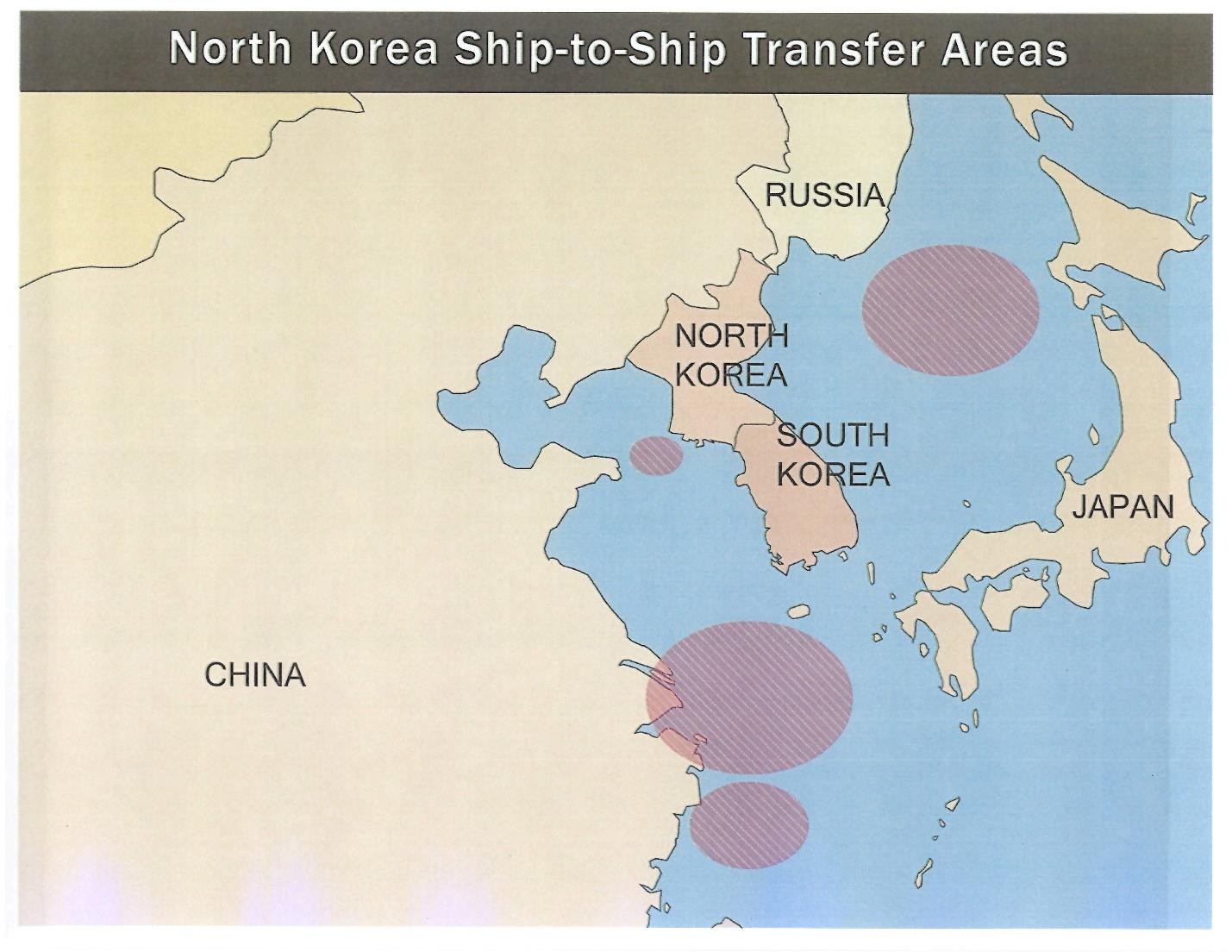
Coal: According to the 2020 UN DPRK Panel of Experts Final Report (PoE Report), North Korea exported 3.7 million metric tons of coal between January and August 2019, primarily in and around the Ningbo-Zhoushan Port area. The majority of these exports have occurred via STS transfers from North Korea-flagged vessels to local barges in Chinese territorial sea. Selfpropelled barges, likely delivering to China, constitute the second-largest method of North Korean coal exports. This includes direct deliveries originating from North Korea to three ports in Hangzhou Bay, China.
Sand: Since at least April 2019, non-North Korean self-propelled barges and other non-North Korea-flagged cargo vessels have been loading sand in or near Haeju (Hwanghae Province), and Sinchang (South Hamgyong Province), to be exported to China.
Imports of Refined Petroleum:
UNSCR 2397 limits North Korea’s refined petroleum imports to a maximum of 500,000 barrels per calendar year. From January 2019 through October 2019, North Korean ports received at least 221 tanker deliveries of refined petroleum, including at least 157 deliveries procured from illicit STS transfers involving North Korean vessels. If these tankers were fully laden when they made their deliveries, North Korea would have imported 3.89 million barrels from these transactions alone, or more than seven-and-a-half times the allowable amount of refined petroleum under UNSCR 2397.
North Korea Ship-to-Ship Transfer Areas:
Acquisition of Old Vessels:
According to the 2020 UN DPRK Panel of Experts Final Report, North Korea is acquiring old vessels destined for scrapping and incorporating them into its fleet of vessels transporting coal and other goods.
Use of Non-Ocean-Going Barges:
According to the 2020 UN DPRK Panel of Experts Final Report, North Korea sometimes utilizes non-ocean-going barges that do not transmit an AIS signal to illicitly transport North Koreaorigin goods to China. These barges may not be safe to operate on the high seas.
For additional details and descriptions of known sanctions evasion techniques, please refer to the main text of the “Sanctions Advisory for Maritime Industry, Energy and Metals Sectors, and Related Communities,” to “Annex A: Additional Guidance and Information to Assist Sanctions Compliance Efforts in the Maritime Industry” for good due diligence practices to counter sanctions evasion in the maritime industry, and to “A Framework for OFAC Compliance Commitments,” a document provided by OFAC that provides industry with good overall practices regarding sanctions compliance.
IRAN
This section provides information about Iran-related U.S. sanctions relevant to the maritime industry, including a non-exhaustive list of bases for which persons could be sanctioned by the U.S. government. Combined with the other documents in this global maritime advisory, this annex updates and expands on the Iran-related shipping advisory issued by the U.S. Department of the Treasury’s Office of Foreign Assets Control (OFAC) on September 4, 2019. This information is current as of the date of this advisory, but parties should regularly check OFAC’s website for comprehensive information on Iran-related sanctions programs.[22] At a later date, OFAC may issue further updates to this advisory, including with respect to the vessel lists that have appeared in previous shipping advisories. OFAC maintains a comprehensive, consolidated, and searchable list of sanctioned persons, as well as vessels identified as blocked property, on the List of Specially Designated Nationals and Blocked Persons (SDN List).[23]
U.S. Prohibitions on Iran-related Activities
OFAC administers and enforces comprehensive sanctions and a government blocking program against Iran, as set forth in the Iranian Transactions and Sanctions Regulations, 31 C.F.R. part 560 (ITSR). The ITSR prohibits most direct and indirect transactions involving Iran or the
Government of Iran by U.S. persons or U.S.-owned or -controlled foreign entities or within the United States, unless authorized by OFAC or exempted by statute. In addition, the ITSR blocks the property and interests in property that are in the United States, that hereafter come within the United States, or that are or hereafter come within the possession or control of any United States person, of the Government of Iran, as defined in section 560.304 of the ITSR, including any entities owned or controlled by the Government of Iran. Further, absent an applicable exemption or OFAC authorization, foreign persons, including foreign financial institutions, are prohibited from processing transactions to or through the United States in violation of these prohibitions, including transactions through U.S. correspondent accounts for or on behalf of Iranian financial institutions, other persons located in Iran, or where the benefit of those services is otherwise received in Iran.
U.S. Government Sanctions Authorities
In addition, non-U.S. persons — including foreign financial institutions — risk exposure to U.S. sanctions for knowingly facilitating significant transactions for or providing certain material support to Iranian persons on the SDN List, such as the National Iranian Oil Company (NIOC), the National Iranian Tanker Company (NITC), and the Islamic Republic of Iran Shipping Lines (IRISL), with the exception of non-designated Iranian depository institutions.[24] These authorities are generally subject to certain waivers and exceptions, including (i) an exception for the export to Iran of food, medicine, medical devices, and agricultural products, and (ii) an exception for reconstruction assistance and economic development for Afghanistan. Even if an exception or waiver applies, certain transactions involving Iran’s Islamic Revolutionary Guard Corps (IRGC) or any other person designated in connection with Iran’s support for international terrorism or its proliferation of weapons of mass destruction or their means of delivery may be exposed to U.S. sanctions.
Petroleum, Petroleum Products, and Petrochemical Products:
On or after November 5, 2018, persons knowingly engaged in a significant transaction for the purchase, acquisition, sale, transport, or marketing of petroleum, petroleum products (e.g., aviation gasoline, motor gasoline, distillate fuel oil), or petrochemical products from Iran, and certain persons affiliated with vessels that transport Iranian crude oil, risk being sanctioned under U.S. sanctions authorities relating to Iran, unless a waiver or an exception applies.[25] For more information on the definitions of petroleum, petroleum products, and petrochemical products, please see Section 16 of E.O. 13846.
Metals and Additional Identified Sectors of Iran’s Economy:
Persons who operate in the iron, steel, aluminum, or copper sectors of Iran, or who knowingly engage in a significant transaction for the sale, supply, or transfer to Iran of significant goods or services used in connection with those sectors or for the purchase, acquisition, sale, or transport, or marketing of iron, steel, aluminum, or copper from Iran, risk being sanctioned pursuant to E.O. 13871, unless a waiver or an exception applies. Similarly, persons who knowingly sell, supply, or transfer, directly or indirectly, to or from Iran, precious metals or certain materials, including coal, graphite, or certain raw or semi-finished metals such as aluminum and steel, risk being sanctioned if such metals or materials are provided for certain end-uses or end-users.[26] Additionally, persons who operate in the construction, mining, manufacturing, and textile sectors of the Iranian economy, or who knowingly engage in a significant transaction for the sale, supply, or transfer to or from Iran of significant goods or services used in connection with those sectors, risk being sanctioned pursuant to E.O. 13902, unless a waiver or exception applies.
The maritime industry is advised to review the Iranian Sector and Human Rights Abuses Sanctions Regulations, 31 C.F.R. part 562, as well as guidance on OFAC’s website pertaining to the iron, steel, aluminum, copper, construction, mining, manufacturing, and textile sectors of Iran for additional guidance on the scope of these new authorities. Of note, the wind-down period for activities described in E.O. 13871 expired on August 6, 2019; the wind-down period for activities described in E.O. 13902 expired on April 9, 2020. Failure to conclude, within the specific wind-down periods, any existing sanctionable transactions related to these sectors may result in sanctions exposure unless covered by an applicable waiver or exception.
Services to Vessels:
Persons risk exposure to sanctions if they knowingly provide certain bunkering services to Iranian vessels or to non-Iranian vessels transporting cargo, including petroleum or petroleum products from Iran, for Iranian persons on the SDN List, unless an applicable waiver or exception applies. In addition, persons risk exposure to sanctions if they knowingly provide underwriting services or insurance or reinsurance to or for Iranian persons on the SDN List, including IRISL, NIOC, NITC, or to or for any person with respect to or for the benefit of any activity in the energy, shipping, or shipbuilding sectors of Iran, for which certain U.S. sanctions against Iran have been imposed, unless a waiver or exception applies.[27] For additional guidance, please review OFAC’s Frequently Asked Questions on the OFAC website.
Deceptive Shipping Practices
As the global community increases its pressure on the Iranian regime, some persons associated with the petroleum shipping industry continue to deploy deceptive practices to facilitate Iranian transactions. As evidenced by Treasury designations and actions taken by partners around the world, actors, such as Iran’s IRGC-QF, attempt to evade U.S. sanctions by obfuscating the origin, destination, and recipient of oil shipments. Note that the use of such deceptive tactics is unique neither to Iran nor to Iran’s petroleum industry.
Please refer to the main text of the “Sanctions Advisory for Maritime Industry, Energy and Metals Sectors, and Related Communities” for descriptions of known sanctions evasion techniques, to “Annex A: Additional Guidance and Information to Assist Sanctions Compliance
Efforts in the Maritime Industry” for potential due diligence practices to counter sanctions evasion in the shipping industry, and to “A Framework for OFAC Compliance Commitments,” a document provided by OFAC that provides industry with good overall practices regarding sanctions compliance.
SYRIA
This section provides information about Syria-related U.S. sanctions relevant to the maritime industry, including a non-exhaustive list of bases for which persons could be sanctioned by the U.S. government. Combined with the other documents in this global maritime advisory, this annex updates and expands on the Syria-related shipping advisories issued by the U.S. Department of the Treasury’s Office of Foreign Assets Control (OFAC) on November 20, 2018 and March 25, 2019. This information is current as of the date of this advisory, but parties should regularly check OFAC’s website for comprehensive information on Syria-related sanctions programs. At a later date, OFAC may issue further updates to this advisory, including with respect to the vessel lists that have appeared in previous shipping advisories. OFAC maintains a comprehensive, consolidated, and searchable list of sanctioned persons, as well as vessels identified as blocked property, on the List of Specially Designated Nationals and Blocked Persons (SDN List).
U.S. Government Syria-related Prohibited Conduct
The United States generally prohibits transactions by U.S. persons or within the United States that, directly or indirectly, involve the Government of Syria, or other entities sanctioned under the Syrian Sanctions Regulations, 31 C.F.R. Part 542. The term Government of Syria includes:
(a) the state and the Government of the Syrian Arab Republic, as well as any political subdivision, agency, or instrumentality thereof, including the Central Bank of Syria; (b) any entity owned or controlled, directly or indirectly, by the foregoing, including any corporation, partnership, association, or other entity in which the Government of Syria owns a 50 percent or greater interest or a controlling interest, and any entity which is otherwise controlled by that government; (c) any person that is, or has been, acting or purporting to act, directly or indirectly, for or on behalf of any of the foregoing; and (d) any other person determined by OFAC to be included within (a) through (c).
The United States also prohibits the importation of petroleum or petroleum products of Syrian origin into the United States and any transaction dealing in, or related to, petroleum or a petroleum product of Syrian origin by a United States person or any facilitation thereof, pursuant to E.O. 13582.
Additionally, the United States understands that due to the complex and fluid environment in Syria, other illicit actors operate in the maritime sector, to include persons related to terrorism and illicit Iranian- or Russian-related activity.[28]
Sanctions Risks and U.S. Government Syria-related Sanctions Authorities
U.S. law provides for mandatory sanctions on foreign persons that are determined to have knowingly provided significant financial, material, or technological support to, or knowingly engaged in a significant transaction with, the Government of Syria; or who have knowingly sold or provided significant goods, services, technology, information, or other support that significantly facilitates the maintenance or expansion of the Government of Syria’s domestic production of natural gas, petroleum, or petroleum products. This could include entities or individuals who deliver or finance petroleum shipments to the Government of Syria or government-owned entities, such as the U.S.-designated Syrian Company for Oil Transport or Banias Refinery Company.
Deceptive Shipping Practices
The United States is committed to holding the Government of Syria, the Bashar al-Assad regime, and those who continue to support them accountable for their brutality and killing of Syrian civilians. To this end, the supply chain and petroleum-related shipments create significant sanctions risk for those in the maritime industry. Countries such as Iran and Russia have been involved in providing the Government of Syria with petroleum and other goods. In connection with this activity, in September 2019, OFAC sanctioned Maritime Assistance LLC and three individuals for facilitating the sale and delivery of jet fuel to Russian military forces operating in Banias, Syria. Separately, in November 2018, OFAC sanctioned Iranian and Russian private and public sector entities involved in a scheme to procure Iranian oil for Syria. This scheme used a payment offsetting arrangement in which the sale and shipment of Iranian oil to Syria provided hundreds of millions of dollars to Iran’s terror proxy groups, including Hizballah, HAMAS, and the IRGC-QF.
For additional details and descriptions of known sanctions evasion techniques, please refer to the main text of the “Sanctions Advisory for Maritime Industry, Energy and Metals Sectors, and
Related Communities,” to “Annex A: Additional Guidance and Information to Assist Sanctions Compliance Efforts in the Maritime Industry” for good due diligence practices to counter sanctions evasion in the shipping industry, and to “A Framework for OFAC Compliance Commitments,” a document provided by OFAC that provides industry with good overall practices regarding sanctions compliance.
While this advisory primarily addresses sanctions risks, U.S. financial institutions should also be aware that, consistent with suspicious activity reporting requirements in 31 CFR Chapter X, if a financial institution knows, suspects, or has reason to suspect that a transaction has no business or apparent lawful purpose or is not the sort in which the particular customer would normally be expected to engage, and the financial institution knows of no reasonable explanation for the transaction after examining the available facts, including the background and possible purpose of the transaction, the financial institution should file a Suspicious Activity Report (SAR). See 31 CFR §§ 1020.320, 1021.320, 1022.320, 1023.320, 1024.320, 1025.320, 1026.320, 1029.320, and 1030.320. ↑
The guidance in this document is not intended to be, nor should it be interpreted as, comprehensive or as imposing requirements under U.S. law or otherwise addressing any particular requirements under applicable laws or regulations. ↑
UNSC Sanctions Compliance for the Maritime Sector, January 2015 <https://undocs.org/S/2015/28>. ↑
The division’s website is located here: <https://www.state.gov/economic-sanctions-policy-and-implementation/>. ↑
This guidance is not intended to be, nor should it be interpreted as, comprehensive or as imposing requirements under U.S. law or otherwise addressing any particular requirements under applicable law. Its sole intent is to provide information to companies operating in the maritime industry that they may wish to consider in assessing their sanctions exposure as part of a risk-based compliance program. ↑
This guidance is not intended to be, nor should it be interpreted as, comprehensive or as imposing requirements under U.S. law or otherwise addressing any particular requirements under applicable law. ↑
This guidance is not intended to be, nor should it be interpreted as, comprehensive or as imposing requirements under U.S. law or otherwise addressing any particular requirements under applicable law. ↑
This guidance is not intended to be, nor should it be interpreted as, comprehensive or as imposing requirements under U.S. law or otherwise addressing any particular requirements under applicable law. ↑
This guidance is not intended to be, nor should it be interpreted as, comprehensive or as imposing requirements under U.S. law or otherwise addressing any particular requirements under applicable law. ↑
This information is not intended to be, nor should it be interpreted as, comprehensive or as imposing requirements under U.S. law or otherwise addressing any particular requirements under applicable law. ↑
See anti-money laundering program requirements established in 31 CFR 1010.210 as applicable to specific types of financial institutions in 31 CFR 1020.210 (banks), 1021.210 (casinos), 1022.210 (money services businesses), 1023.210 (securities), 1024.210 (mutual funds), 1025.210 (insurance), 1026.210 (futures), 1027.210 (precious metals), 1028.210 (credit card systems), 1029.210 (loan or finance), and 1030.210 (housing government sponsored entities), ↑
See customer identification program requirements established in 31 CFR 1010.220 as applicable to specific types of financial institutions in 31 CFR 1020.220 (banks), 1023.220 (securities), 1024.220 (mutual funds), and 1026.220 (futures). See also the beneficial ownership requirements for legal entity customers established in 31 CFR 1010.230. ↑
This guidance is not intended to be, nor should it be interpreted as, comprehensive or as imposing requirements ↑
This guidance is not intended to be, nor should it be interpreted as, comprehensive or as imposing requirements ↑
This guidance is not intended to be, nor should it be interpreted as, comprehensive or as imposing requirements ↑
This guidance is not intended to be, nor should it be interpreted as, comprehensive or as imposing requirements under U.S. law or otherwise addressing any particular requirements under applicable law. ↑
This document is explanatory only and does not have the force of law. This document does not supplement or modify statutory authorities, Executive orders, or regulations. 18 OFAC, “North Korea Sanctions,” https://www.treasury.gov/resourcecenter/sanctions/Programs/pages/nkorea.aspx. ↑
OFAC, “List of Specially Designated Nationals and Blocked Persons (SDN List),” https://www.treasury.gov/resource-center/sanctions/sdn-list/pages/default.aspx. ↑
These prohibitions apply to transactions by a U.S. person or within the United States, including those that are processed through or involve the U.S. financial system. For additional details on OFAC prohibitions related to North Korea, see www.treasury.gov/ofac. ↑
All UN Member States have an obligation to implement the binding sanctions measures contained in UNSCRs. North Korea-related UNSCRs can be found at the 1718 Sanctions Committee website at https://www.un.org/securitycouncil/sanctions/1718. ↑
North Korea-related sanctions E.O.s include E.O.s 13382, 13466, 13551, 13570, 13687, 13722, and 13810. 23 Relevant UNSCRs include 1695 (2006), 1718 (2006), 1874 (2009), 2087 (2013), 2094 (2013), 2270 (2016), 2321 (2016), 2356 (2017), 2375 (2017), and 2397 (2017). ↑
OFAC, “Iran Sanctions,” https://www.treasury.gov/resource-center/sanctions/programs/pages/iran.aspx. ↑
OFAC, “List of Specially Designated Nationals and Blocked Persons (SDN List),” https://www.treasury.gov/resource-center/sanctions/sdn-list/pages/default.aspx. ↑
See Iran Freedom and Counter-Proliferation Act (IFCA), §§ 1244(c) and 1247(a); Comprehensive Iran Sanctions, Accountability, and Divestment Act (CISADA), § 104; E.O. 13846, §§ 1 and 2. ↑
See E.O. 13846, §§ 2 and 3; Iran Sanctions Act (ISA), § 5(a)(7) and (7) . ↑
See, e.g., IFCA § 1245. ↑
See, e.g., IFCA § 1246. ↑
For additional details on OFAC prohibitions related to counter-terrorism, Iran, or Russia, see https://www.treasury.gov/resource-center/sanctions/Pages/default.aspx ↑


