
Marine Advisory: 09/2021 - Joint Concentrated Inspection Campaign (CIC) on Stability (General)
05 August 2021
Marine Advisory 09/2021
Subject: Joint Concentrated Inspection Campaign (CIC) on Stability (General)
Reference: a) Paris MoU and Tokyo MoU Press Release 23 July 2021
Dear Shipowner/Operator/Master;
Paris MoU and Tokyo MoU have announced a joint three-month Concentrated Inspection Campaign (CIC), commencing 1 September and running through to 30 November 2021. Port State Control Officers (PSCOs) will use a pre-defined questionnaire to assess that information and equipment provided onboard complies with the relevant conventions, that the master and officers are familiar with operations relating to stability (in general) and that equipment is properly maintained and functioning.
The purpose of the campaign on ship’s stability in general is:
- to confirm that the ship’s crew are familiar with assessing the actual stability condition on completion of cargo operations before departure of the ship and on all stages of the voyage;
- to create awareness among the ship’s crew and owners about the importance of calculating the actual stability condition of the ship on completion of cargo operations and before departure of the ship;
- to verify that the ship complies with intact stability requirements (and damage stability requirements, if applicable) under the relevant IMO instruments
We have attached the questionnaire and additional guidance addressing questions 1 through 6 of the same. The entire press release can be found at https://www.parismou.org/launch-joint-concentrated-inspectioncampaign-stability-general
Please contact the Fleet Prevention Department at prevention@liscr.com if you have any questions.
* * * * *
Guidance to Owners, Operators and Masters in preparing for the CIC on Stability
Question 1: Has the ship been provided with approved stability information which can be understood and easily used by the Master and loading officer?
In accordance with SOLAS II-1 regulation 5-1.1, the master shall be provided with the stability information necessary to obtain accurate guidance related to the stability of the ship under different conditions of service.
Similarly, 1988 LL Protocol, regulation 10.1 requires that the Master be supplied with information to arrange for the loading and ballasting of his ship in such a way as to avoid the creation of any unacceptable stresses in the ship’s structure. Additionally, as specified on regulation 10.2, the information provided is to be approved by the Administration or a recognized organization. A list of recognized organizations can be accessed at https://www.liscr.com/recognized-organizations.
Similar requirements are also specified under MARPOL Annex I/28.5. The regulation requires the Master shall be provided with the information relative to loading and distribution of cargo, and data on the ability of the ship to comply with damage stability criteria.
Question 2: Is the data used in the stability check for departure complete and correct?
Usually, the correctness of the data is verified by comparting the Loadicator information to the vessel’s Trim & Stability Booklet which is approved by a Recognized Organization. This comparison usually happens in the loadicator itself as it contains both information. The departure condition must be kept for each voyage.
Question 3: Does the ship comply with the stability criteria as applicable to the ship type?
In addition to the SOLAS requirements, please be reminded that there are other IMO instruments which contain subdivision and damage stability requirements:
- Annex I to MARPOL, except that combination carriers (as defined in SOLAS regulation II 2/3.14) with type B freeboards shall be in compliance with regulation 6 to regulation 7-3*;
- the International Code for the Construction and Equipment of Ships Carrying Dangerous Chemicals in Bulk (IBC Code)*;
- the International Code for the Construction and Equipment of Ships Carrying Liquefied Gases in Bulk (IGC Code)*;
- the damage stability requirements of regulation 27 of the 1966 Load Lines Convention as applied in compliance with resolutions A.320(IX)andA.514(13), provided that in the case of cargo ships to which regulation 27(9) applies, main transverse watertight bulkheads, to be considered effective, are spaced according to paragraph (12)(f) of resolution A.320(IX), except that ships intended for the carriage of deck cargo shall be in compliance with regulation 6 to regulation 7-3;
- the damage stability requirements of regulation 27 of the 1988 Load Lines Protocol, except that ships intended for the carriage of deck cargo shall be in compliance with regulation 6 to regulation 7-3;
- the subdivision and damage stability standards in other instruments** developed by the Organization
* Refer to Guidelines for verification of damage stability requirements for tankers (MSC.1/Circ.1461).
** For offshore supply vessels of not more than 100 m in length (L), the Guidelines for the design and
construction of offshore supply vessels, 2006 (resolution MSC.235(82), as amended by resolution MSC.335(90)); or for special purpose ships, the Code of safety for special purpose ships, 2008 (resolution MSC.266(84), as amended)."
Question 4: Is there evidence to show that the Master or responsible officer can determine the stability of the ship under varying conditions of service using the approved stability information provided on board?
Upon completion of the verification that the vessel meets the applicable stability requirements, the master must ensure that the vessel's draft, trim, and stability as necessary; and any stability calculations made to support the verification are retain onboard the vessel, at least, for the duration of the voyage.
Question 5: If the ship is provided with a Stability Instrument, is it approved by the Administration?
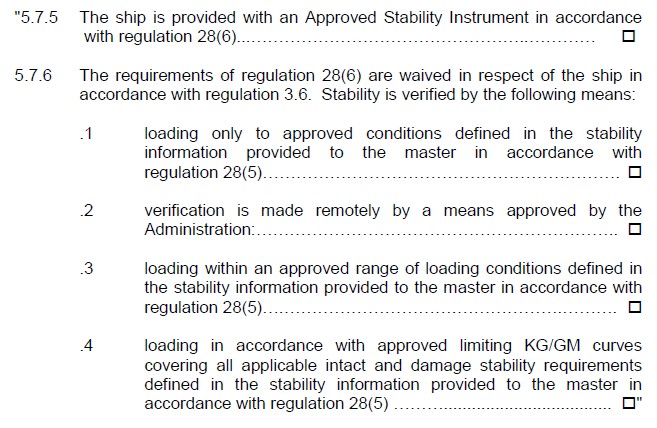
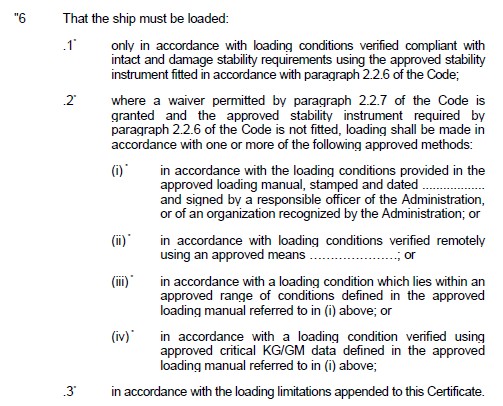
MARPOL I/28.6, IBC Code 2.2.6, and IGC Code 2.2.6 require stability instruments to be approved by the Administration. The recording of the approval is documented as follows:
Oil Tankers
Item 5.7.5 of the Supplement to the International Oil Pollution Prevention Certificate (IOPP Certificate) – Form B. Any waivers are recorded under item 5.7.6.
Chemical Tankers
Item 6.1 of the Certificate of Fitness. Any waivers are recorded under item 6.2.
Gas Carriers
Similar to chemical tankers, item 6.1 of the Certificate of Fitness and waivers are recorded under item 6.2.
Question 6: If the ship is provided with a Stability Instrument, does the type of stability software in use meet the requirements for the relevant ship type?
Oil Tankers
In accordance with MARPOL I/28.6, all oil tankers shall be fitted with a stability instrument, capable of verifying compliance with intact and damage stability requirements approved by the Administration having regard to the performance standards recommended by the Organization*.
MARPOL I/3.6 allows the Administration to waive the requirements of regulation 28.6 for the oil tankers listed below if loaded in accordance with the conditions approved by the Administration taking into account the guidelines developed by the Organization.** Any such waiver shall be duly noted on the International Oil Pollution Prevention Certificate.
- oil tankers which are on a dedicated service, with a limited number of permutations of loading such that all anticipated conditions have been approved in the stability information provided to the master in accordance with regulation 28(5);
- oil tankers where stability verification is made remotely by a means approved by the Administration;
- oil tankers which are loaded within an approved range of loading conditions; or
- oil tankers constructed before 1 January 2016 provided with approved limiting KG/GM curves covering all applicable intact and damage stability requirements.
Chemical Tankers
In accordance with IBC Code 2.2.6, all ships, subject to the Code, shall be fitted with a stability instrument, capable of verifying compliance with intact and damage stability requirements, approved by the Administration having regard to the performance standards recommended by the Organization.*
IBC Code 2.2.7 allows the Administration to waive the requirements of paragraph 2.2.6 to all ships meeting similar conditions as MARPOL I/3.6 provided that the procedures employed for intact and damage stability verification maintain the same degree of safety, as being loaded in accordance with the approved conditions.** Any such waiver shall be duly noted on the International Certificate of Fitness.
Gas Carriers
In accordance with IGC Code 2.2.6, all ships, subject to the Code shall be fitted with a stability instrument, capable of verifying compliance with intact and damage stability requirements, approved by the Administration having regard to the performance standards recommended by the Organization.*
IGC Code 2.2.7 allows the Administration to waive the requirements of paragraph 2.2.6 to all ships meeting similar conditions as MARPOL I/3.6 provided that the procedures employed for intact and damage stability verification maintain the same degree of safety, as being loaded in accordance with the approved conditions.** Any such waiver shall be duly noted on the International Certificate of Fitness.
References:
*(a) part B, chapter 4, of the International Code on Intact Stability, 2008 (2008 IS Code), as amended;
- the Guidelines for the Approval of Stability Instruments (MSC.1/Circ.1229), annex, section 4, as amended;
- the technical standards defined in part 1 of the Guidelines for verification of damage stability requirements for tankers (MSC.1/Circ.1461).
** Refer to operational guidance provided in part 2 of the Guidelines for verification of damage stability requirements for tankers (MSC.1/Circ.1461)."
Bulk Carriers
In accordance with SOLAS XII/11, bulk carriers of 150 m in length and upwards shall be fitted with a loading instrument capable of providing information on hull girder shear forces and bending moments, taking into account the recommendation adopted by the Organization. +
Additionally, bulk carriers of less than 150 m in length constructed on or after 1 July 2006 shall be fitted with a loading instrument capable of providing information on the ship's stability in the intact condition. The computer software shall be approved for stability calculations by the Administration and shall be provided with standard conditions for testing purposes relating to the approved stability information. ++
+ Refer to the Recommendation on loading instruments, adopted by resolution 5 of the 1997 SOLAS Conference.
++ Refer to the relevant parts of the appendix to the Guidelines for the on-board use and application of computers (MSC/Circ.891).
Additional Guidance
Computer-based systems should be protected against unintentional or unauthorized modification of programs and data. Where a computer-based system is part of an essential function, such as cargo loading, discharging and control, back-up or emergency means of operation shall be provided, which to the largest extent possible shall be independent of the normal control system, with its user interface; and computers serving essential and important functions shall only be used for purposes relevant to vessel operation.
* * * * *

Rijnstraat 8 Telephone: +31 70 456 1508
P.O. Box 16191 E-mail: secretariat@parismou.org 2500 BD The Hague Internet : www.parismou.org
The Netherlands
Questionnaire for the 2020 CIC on Ship’s Stability in general
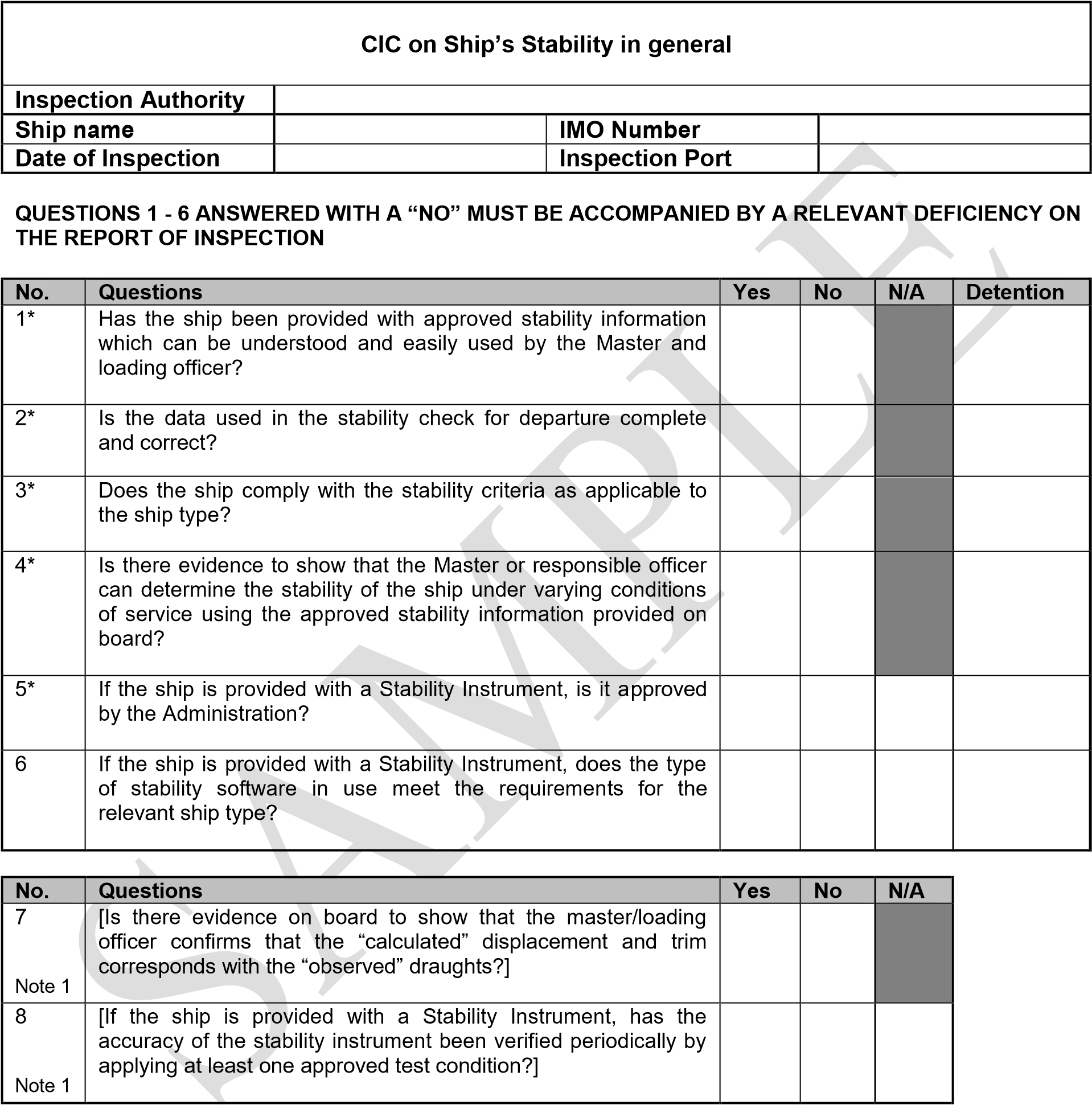
If “No” is ticked for questions marked with an asterisk “*”, the ship may be considered for detention
Note 1: Questions 7 and 8 are for information purposes only.


