
POL-009 - Implementation Of The 2021 Revised MARPOL Annex VI, Regulationsfor The Prevention Of Air Pollution From Ships
18 September 2025
Marine Notice 09/2025
TO: ALL SHIPOWNERS, OPERATORS, AND MASTERS OF LIBERIAN FLAG VESSELS, AND RECOGNIZED ORGANIZATIONS
SUBJECT: Implementation of the 2021 Revised MARPOL Annex VI, Regulations for the Prevention of Air Pollution from Ships
Reference: (a) Maritime Regulation 2.37
(b) MARPOL Convention
Supersedes: Marine Notice POL-009, dated 02/25
The following changes have been included:
- Section 1.29.3 has been amended to incorporate the amendments to the NOX Technical Code 2008 by Resolution MEPC.397(83).
- Sections 4.2.1 and 4.3 amended to indicate “MEPC.1/Circ.855, as amended” and note amendments to the 2022 Guidelines on EEDI Survey and Certification by Resolution MEPC.403(83).
- Section 12.2.24 amended to note that this Administration may allow early implementation of the amendments contained in Resolution MEPC.398(83).
- New Section 12.2.10 inserted on Selective Catalytic Reduction (SCR) System and associated guidelines.
- Section 14.2 amended to refer to the instructions in 12.2.10 and 12.2.11 on biofuels.
- Section 14.9.3 amended to include Resolution MSC.520(106) requirements for reporting when oil fuel is supplied not meeting the minimum required flashpoint.
- Annex IV (Sample CONFIRMATION OF COMPLIANCE - SEEMP PART II) and Annex V (Sample CONFIRMATION OF COMPLIANCE - SEEMP PART III) amended to reflect latest SEEMP Guidelines.
PURPOSE:
The purpose of this Marine Notice is to provide guidance on the implementation of the 2021
Revised MARPOL Annex VI, Regulations for the Prevention of Air Pollution from Ships as
Inquiries concerning the subject of this Notice should be directed to the Office of the Deputy Commissioner, Republic of
Liberia, the Liberian International Ship & Corporate Registry, 22980 Indian Creek Drive., Suite 200, Dulles, VA 20166, USA. The most current version of all Marine Notices are available in the Online Library at: http://www.liscr.com
amended by Resolution MEPC.385(81).
MARPOL Annex VI was ratified by Liberia on 27 August 2002. Annex VI entered into force and became effective on 19 May 2005. The revised MARPOL Annex VI was adopted by the Maritime Environment Protection Committee (MEPC) of the IMO in October 2008 by Resolution MEPC.176(58), and entered into force on 1 July,2010. The revised Annex VI has been further amended by Resolution MEPC.328(76), the 2021 Revised MARPOL Annex VI, which entered into force on 1 November 2022.
APPLICABILITY:
The 2021 Revised Annex VI applies to all ships, except where expressly provided otherwise in Regulations 3, 5, 6, 13, 15, 16, 18, 19, 22, 23, 24, 25, 26, 27 and 28 of this Annex. As examples:
- Under Regulation 13, the control of emissions of Nitrogen Oxides (NOx) only applies to each marine diesel engine of more than 130 kW installed on a ship; and each marine diesel engine or more than 130 kW that undergoes a major conversion on or after 1 January 2000;
- Under Regulation 13, the control of emissions of NOx applies to a marine diesel engine of more than 5,000 kW and a per cylinder displacement at or above 90 L installed on a ship constructed on or after 1 January 1990 but prior to 1 January 2000, provided that an approved method for that engine has been certified by an Administration of a Party;
- Under Regulation 3, the 2021 Revised Annex VI does not apply to any emission necessary for the purpose of securing the safety of a ship or saving life at sea; or any emission resulting from damage to a ship or its equipment, after all reasonable precautions have been taken to prevent or minimize the emission;
- Under Regulation 3, emissions directly arising from the exploration, exploitation and associated offshore processing of sea-bed mineral resources are exempted from this Annex;
- Under Regulation 3, UNSP barges are exempted from certification and related survey requirements provided the barges carry no oil; has neither persons nor living animals on board and no system, equipment and/or machinery is fitted that may generate emissions;
- Under Regulation 5, the survey requirements for issuance of an IAPP Certificate apply to ships of 400 gross tons and above and every fixed and floating drilling rig and other platforms;
- Under Regulation 5 and 19, the requirements for Energy Efficiency and survey requirements for issuance of an IEE Certificate apply to ships of 400 gross tons and above;
- Under Regulation 15, the requirement to have on board and implement a VOC Management Plan is only applicable to oil tankers carrying crude oil;
- Under Regulations 22 and 24, the calculation of Attained and Required EEDI applies to new ships; and new and existing ships which have undergone a major conversion which is so extensive, that the ship is regarded by the Administration as a newly constructed ship.
- Under Regulations 23 and 25, the calculation of Attained and Required EEXI applies to each ship; and each ship which has undergone a major conversion, which falls into one of the categories in Regulations 2.2.5, 2.2.7, 2.2.9, 2.2.11, 2.2.14 to 2.2.16, 2.2.22, and 2.2.26 to 2.2.29 and to which chapter IV of MARPOL Annex VI is applicable.
Rev. 09/25
The Republic of Liberia
- Under Regulations 22, 23, 24 and 25, the calculation of Attained and Required EEDI and EEXI does not apply to ships which have non-conventional propulsion, except that regulations 22 and 24 shall apply to cruise passenger ships having non- conventional propulsion and LNG carriers having conventional or non-conventional propulsion, delivered after 1 September 2019 and Regulations 23 and 25 shall apply to cruise passenger ships having non-conventional propulsion and LNG carriers having conventional or nonconventional propulsion.
- Regulations 22, 23, 24, 25 and 28 do not apply to category A ships as defined in the Polar Code.
- Under Regulations 26.2 and 27, SEEMP Part I and collection and reporting of ship fuel oil consumption data applies to ships 5,000 gross tonnage and above.
- Under Regulations 26.3.1 and 28, the Operational Carbon Intensity Plan (SEEMP Part III) and attained annual operational CII applies to ships 5,000 gross tonnage and above and which fall into one or more categories in Regulations 2.2.5, 2.2.7, 2.2.9, 2.2.11, 2.2.14 to 2.2.16, 2.2.22, and 2.2.26 to 2.2.29.
- Under Regulation 19, Chapter 4 of the 2021 Revised Annex VI does not apply to ships not propelled by mechanical means, and platforms including FPSOs and FSUs and drilling rigs, regardless of their propulsion.
- Under Regulation 19.2, taking into account recommendation in MEPC.1/Circ.863, a ship 400 gross tons and above which is not normally engaged on international voyages but which, in exceptional circumstances, is required to undertake a single international voyage, may be exempted by the Administration from any of the requirements in chapter 4 of MARPOL Annex VI.
Ships are defined in Article 2 of MARPOL as a vessel of any type whatsoever operating in the marine environment and includes hydrofoil boats, air-cushion vehicles, submersibles, floating craft and fixed or floating platforms.
Each diesel engine which is required to comply with Regulation 13 (Nitrogen Oxides) of the 2021 Revised Annex VI must be issued an Engine International Air Pollution Prevention (EIAPP) Certificate and a NOx Technical File.
Each ship which is required to comply with chapter 4 (Energy Efficiency) of the 2021 Revised Annex VI must be issued with an IEE Certificate and, for new ships, an EEDI Technical File.
Each ship which is required to calculate its attained EEXI shall carry on board an EEXI Technical file that contains the information necessary for the calculation of the attained EEXI and that shows the process of the calculation.
Annex VI applies to any type of fuel used on board, including gas, heavy fuel oil, diesel oil and gas oil for main and auxiliary engines, boilers, diesel engines, and gas turbines.
Rev. 09/25
The Republic of Liberia
1.0 Definitions
For the purpose of the 2021 Revised MARPOL Annex VI the following definitions apply, as amended by Resolution MEPC 385 (81).
1.1 A similar stage of construction: The stage at which:
.1 construction identifiable with a specific ship begins; and
.2 assembly of that ship has commenced comprising at least 50 tons or one per cent of the estimated mass of all structural material, whichever is less.
1.2 A ship delivered on or after 1 September 2019 means a ship:
.1 for which the building contract is placed on or after 1 September 2015; or
.2 in the absence of a building contract, the keel of which is laid, or which is at a similar stage of construction, on or after 1 March 2016; or
.3 the delivery of which is on or after 1 September 2019.
1.3 Attained EEDI: The EEDI value achieved by an individual ship in accordance with regulation 22 of the 2021 Revised Annex VI.
1.4 Attained EEXI: The EEXI value achieved by an individual ship in accordance with regulation 23 of the 2021 Revised Annex VI.
1.5 Attained annual operational CII: The operational carbon intensity indicator value achieved by an individual ship in accordance with regulations 26 and 28 of the 2021 Revised Annex VI.
1.6 Bulk carrier: A ship which is intended primarily to carry dry cargo in bulk, including such types as ore carriers as defined in Regulation 1 of chapter XII of SOLAS 74 (as amended) but excluding combination carriers.
1.7 Calendar year: The period from 1 January until 31 December inclusive.
1.8 Category A ship: A ship designed for operation in polar waters in at least means a ship designed for operation in polar waters in at least.
1.9 Container ship: A ship designed exclusively for the carriage of containers in holds and on deck.
1.10 Combination carrier: A ship designed to load 100% deadweight with both liquid and dry cargo in bulk.
1.11 Company: The owner of the ship or any other organization or person such as the manager, or the bareboat charterer, who has assumed the responsibility for operation of the ship from
the owner of the ship and who on assuming such responsibility has agreed to take over all the duties and responsibilities imposed by the International Management Code for the Safe Operation of Ships and for Pollution Prevention, as amended.
1.12 Conventional propulsion: A method of propulsion where a main reciprocating internal combustion engine(s) is the prime mover and coupled to a propulsion shaft either directly or through a gear box.
1.13 Continuous feeding: The process whereby waste is fed into a combustion chamber without human assistance while the incinerator is in normal operating conditions with the combustion chamber operative temperature between 850°C and 1200°C.
1.14 Cruise passenger ship: A passenger ship not having a cargo deck, designed exclusively for commercial transportation of passengers in overnight accommodations on a sea voyage.
1.15 Distance travelled: Distance travelled over ground.
1.16 Electronic Record Book: A device or system, approved by the Administration, used to electronically record the required entries for discharges, transfers and other operations as required under this Annex in lieu of a hard copy record book.
1.17 Emission: Any release of substances, subject to control by the 2021 Revised Annex VI from ships into the atmosphere or sea (includes ODS, NOx, SOx, VOC and shipboard incineration).
1.18 Emission Control Area: An area where the adoption of special mandatory measures for emissions from ships is required to prevent, reduce and control air pollution from NOx or SOx and particulate matter or all three types of emissions, and their attendant adverse impacts on human health and the environment. Emission control areas include those listed in, or designated under, Regulations 13 and 14 of the 2021 Revised Annex VI and under this Marine Notice.
1.19 Existing ship: A ship which is not a new ship.
1.20 Fuel Oil: Any fuel delivered to and intended for use on board a ship.
1.21 Gas carrier: A cargo ship, other than an LNG carrier constructed or adapted and used for the carriage in bulk of any liquefied gas.
1.22 General cargo ship: A ship with a multi-deck or single deck hull designed primarily for the carriage of general cargo. This definition excludes specialized dry cargo ships, which are not included in the calculation of reference lines for general cargo ships, namely livestock carrier, barge carrier, heavy load carrier, yacht carrier, nuclear fuel carrier. (Refer to MEPC.1/Circ.795 as amended for the interpretation of heavy load carrier.
1.23 Gas fuel: means a fuel oil with a vapour pressure exceeding 0.28 MPa absolute at a temperature of 37.8°C.* (Refer to paragraph 2.2.18 of the International Code of Safety for
Ships using Gases or other Low-flashpoint Fuels (IGF Code).
1.24 In-use sample: A sample of fuel oil in use on a ship.
1.25 Installations: In relation to Regulation 12 of 2021 Revised Annex VI (Ozone-depleting substances), means the installation of systems, equipment, including portable fire- extinguishing units, insulation, or other material on a ship, but excludes the repair or recharge of previously installed systems, equipment, insulation, or other material, or recharge of portable fire-extinguishing units.
1.26 Installed: a marine diesel engine that is or is intended to be fitted on a ship, including a portable auxiliary marine diesel engine, only if its fueling, cooling, or exhaust system is an integral part of the ship. A fueling system is considered integral to the ship only if it is permanently affixed to the ship. This definition includes a marine diesel engine that is used to supplement or augment the installed power capacity of the ship and is intended to be an integral part of the ship.
1.27 LNG carrier: A cargo ship constructed or adapted and used for the carriage in bulk of liquefied natural gas (LNG).
1.28 Low-flashpoint fuel: Gaseous or liquid fuel oil having a flashpoint lower than otherwise permitted under paragraph 2.1.1 of regulation 4 of chapter II-2 of the International Convention for the Safety of Life at Sea (SOLAS), 1974, as amended.
1.29 Major conversion in relation to Regulation 13 of the 2021 Revised Annex VI (Nitrogen oxides), means a modification on or after 1 January 2000 of a marine diesel engine that has not already been certified to the standards set forth in paragraph 3 (Tier I), 4 (Tier II), or 5.1.1 (Tier III) of this Regulation where:
.1 the engine is replaced by a marine diesel engine or an additional marine diesel engine is installed, or
.2 any substantial modification*, as defined in the NOx Technical Code 2008, as amended, is made to the engine, or
.3 the maximum continuous rating of the engine is increased by more than 10% compared to the maximum continuous rating of the original certification of the engine.
*Substantial modification:
• For engines installed on ships constructed on or after 1 January 2000, substantial modification means any modification to an engine that could potentially cause the engine to exceed the applicable emission limit set out in Regulation 13 of the 2021 Revised Annex VI. Routine replacement of engine components by parts specified in the Technical File that do not alter emission characteristics shall not be considered a “substantial modification” regardless of whether one part or many parts are replaced. For the recertification of such an engine following a substantial modification, the version of NOx Technical Code 2008, as amended, that was used for the original certification shall apply except if the engine was or is now equipped with an auxiliary control device or has multiple engine operational profiles. Where an auxiliary control device is fitted, the requirements of 2.5 and 3.3 of the Code shall apply. Where there are multiple engine operating profiles, the requirements of chapter 8 of the Code, as amended by Resolution MEPC.397(83) shall apply.
For engines installed on ships constructed before 1 January 2000, substantial modification means any modification made to an engine which increases its existing emission characteristics established by the Simplified Measurement method as described in 6.3 of the NOx Technical Code 2008, as amended, in excess of the allowances set out in 6.3.11of that Code. These changes include, but are not limited to, changes in its operations or in its technical parameters (e.g., changing camshafts, fuel injection systems, air systems, combustion chamber configuration, or timing calibration of the engine). The installation of a certified Approved Method pursuant to Regulation 13.7.1.1 or certification pursuant to Regulation 13.7.1.2 of the 2021 Revised Annex VI
is not considered to be a substantial modification for the purpose of the application of Regulation 13.2 of the 2021 Revised Annex VI. For recertification of such an engine following a substantial modification, 2.5, 3.3 and, where that engine has multiple engine operating profiles, chapter 8 of NOx Technical Code 2008, as amended by Resolution MEPC.397(83), shall apply
1.30 Major conversion in relation to chapter 4 of the 2021 Revised Annex VI (Energy Efficiency), means a conversion of a ship:
.1 which substantially alters the dimensions, carrying capacity or engine power of the ship; or
.2 which changes the type of the ship; or
.3 the intent of which in the opinion of the Administration is substantially to prolong the life of the ship; or
.4 which otherwise so alters the ship that, if it were a new ship, it would become subject to relevant provisions of the present Convention not applicable to it as an existing ship; or
.5 which substantially alters the energy efficiency of the ship and includes any modifications that could cause the ship to exceed the applicable required EEDI as set out in Regulation 21 of the 2021 Revised Annex VI.
1.31 Marine diesel engine: Any reciprocating internal combustion engine operating on liquid or dual fuel, to which Regulation 13 of the 2021 Revised Annex VI (Nitrogen Oxides) applies, including booster/compound systems if applied. In addition, a gas fueled engine installed on a ship constructed on or after 1 March 2016 or a gas fueled additional or nonidentical replacement engine installed on or after that date is also considered as a marine diesel engine.
1.32 MARPOL delivered sample: The sample of fuel oil delivered in accordance with
regulation 18.8.1 of this Annex.
1.33 New ship: A ship:
.1 for which the building contract is placed on or after 1 January 2013; or
.2 in the absence of a building contract, the keel of which is laid or which is at a similar stage of construction on or after 1 July2013; or
.3 the delivery of which is on or after 1 July 2015.
1.34 NOx Technical Code: The Technical Code on Control of Emission of Nitrogen Oxides from Marine Diesel Engines adopted by Conference resolution 2, as may be amended by the Organization, provided that such amendments are adopted and brought into force in accordance with the provisions of article 16 of the present Convention concerning amendment procedures applicable to an appendix to an Annex.
1.35 Non-conventional propulsion: A method of propulsion, other than conventional propulsion, including diesel-electric propulsion, turbine propulsion, and hybrid propulsion systems.
1.36 Onboard sample: A sample of fuel oil intended to be used or carried for use on board that ship.
1.37 Ozone-depleting substances: Controlled substances defined in paragraph 4 of article 1 of the Montreal Protocol on Substances that Deplete the Ozone Layer, 1987, listed in Annexes A, B, C or E to the said Protocol in force at the time of application or interpretation of this annex.
Ozone-depleting substances that may be found on board ship include, but are not limited to:
Halon 1211 Bromochlorodifluoromethane


Halon 1301 Bromotrifluoromethane
Halon 2402 1,2-Dibromo-1,1,2,2-tetrafluoroethane (a/k/a Halon 114B2)
CFC-11 Trichlorofluoromethane
CFC-12 Dichlorodifluoromethane
CFC-113 1,1,2-Trichloro-1,2,2-trifluoroethane
CFC-114 1,2-Dichloro-1,1,2,2-tetrafluoroethane
CFC-115 Chloropentafluoroethane
1.38 Passenger ship: A ship which carries more than 12 passengers.
1.39 Refrigerated cargo carrier: A ship designed exclusively for the carriage of refrigerated cargoes in holds and includes ships dedicated to the carriage of fruit juice in refrigerated cargo tanks.
1.40 Required EEDI: The maximum value of attained EEDI that is allowed by regulation 24 of the 2021 Revised Annex VI for the specific ship type and size.
1.41 Required annual operational CII: The target value of attained annual operational CII in accordance with regulations 26 and 28 of the 2021 Revised Annex VI for the specific ship
type and size.
1.42 Ro-ro cargo ship (vehicle carrier): A multi deck roll-on-roll-off cargo ship designed for the carriage of empty cars and trucks.
1.43 Ro-ro cargo ship: A ship designed for the carriage of roll-on-roll-off cargo transportation units.
1.44 Required EEXI: The maximum value of attained EEXI that is allowed by regulation 25 of the 2021 Revised Annex VI for the specific ship type and size.
1.45 Ships constructed: Ships the keels of which are laid or that are at a similar stage of construction.
1.46 Shipboard incinerator: A shipboard facility designed for the primary purpose of incineration.
1.47 Shipboard incineration: The incineration of wastes or other matter on board a ship, if such wastes or other matter were generated during the normal operation of that ship.
1.48 Sludge oil: Sludge from the fuel or lubricating oil separators, waste lubricating oil from main or auxiliary machinery, or waste oil from bilge water separators, oil filtering equipment or drip trays.
1.49 Sulphur content of fuel: The concentration of sulphur in a fuel oil, measured in % m/m as tested in accordance with a standard acceptable to the Organization.4
1.50 Tanker: In relation to Regulation 15 (VOC’s) of the 2021 Revised Annex VI is an oil tanker as defined in Regulation 1 of Annex I of MARPOL or a chemical tanker as defined in Regulation I of Annex II of MARPOL.
1.51 Tanker: In relation to chapter 4 (Energy Efficiency) of the 2021 Revised Annex VI is an oil tanker as defined in Regulation 1 of Annex I of MARPOL or a chemical tanker or an NLS tanker as defined in Regulation 1 of Annex II of MARPOL.
1.52 Unmanned non-self-propelled (UNSP) barge means a barge that:
.1 is not propelled by mechanical means;
.2 has no system, equipment and/or machinery fitted that may generate emissions regulated by this Annex; and
.3 has neither persons nor living animals on board.
1.53 Verifier: The classification society or non-classification society authorized by the Administration to provide IMO DCS, SEEMP Parts II and III and CII verifications services for Liberian flagged ships.
2.0 Approval of equivalents/alternatives; notification to IMO
2.1 The Administration will consider proposals to permit any fitting, material, appliance or apparatus to be fitted in a ship or other procedures, alternative fuel oils, or compliance methods used as an alternative to that required by the 2021 Revised Annex VI if such fitting, material, appliance or apparatus or other procedures, alternative fuel oils, or compliance methods are at least as effective in terms of emissions reductions as that required by the 2021 Revised Annex VI, including any of the standards set forth in Regulations 13 (Nitrogen Oxides), 14 (Sulphur Oxides) and 18 (Fuel Oil Quality). The ship’s Classification Society must confirm to this Administration that the proposed alternative fitting, material, appliance or apparatus is at least as effective as that required by Annex VI.
2.2 The Administration will take into account 2021 Guidelines for Exhaust Gas Cleaning Systems (EGCS), pertaining to equivalent for complying with the standard in Regulation 14 (Sulphur Oxides).
2.3 The Administration will communicate the particulars of the equivalent/alternative arrangement to the International Maritime Organization in accordance with the 2021 Revised Annex VI.
3.0 Trials for Ship Emission Reduction and Control Technology Research
The Administration may, in co-operation with other Administrations as appropriate, issue an exemption from specific provisions of the 2021 Revised Annex VI for a ship to conduct trials for the development of ship emission reduction and control technologies and engine design programs. Such an exemption shall only be provided if the applications of specific provisions of the Annex or the 2021 Revised NOx Technical Code 2008 could impede research into the development of such technologies or programs. A permit issued under this regulation shall not exempt a ship from the reporting requirement under regulation 27 and shall not alter the type and scope of data required to be reported under regulation 27. A permit for such an exemption shall only be provided to the minimum number of ships necessary.
4.0 Surveys
4.1 Every Liberian flag ship of 400 gross tons and above and every fixed and floating drilling rig (including mobile offshore drilling units) and other platforms (including floating production and/or storage units) shall be subject to the following periodic surveys by an authorized (Recognized Organization) RO (see section 4.1.7) to ensure that the equipment, systems, fittings, arrangements and material fully comply with applicable requirements of chapter 3 (Control of Emissions) of the 2021 Revised Annex VI:
.1 An initial survey before the ship is put into service or before the IAPP Certificate is issued for the first time;
.2 An annual survey within three months before or after each anniversary date of the certificate;
.3 A renewal survey at intervals not exceeding five years, except where Regulation 9.2,
9.5, 9.6 or 9.7 of the 2021 Revised Annex VI is applicable.
The Administration notes there is no requirement in Regulation 9 of MARPOL
ANNEX VI or the Survey Guidelines under the Harmonized System of Survey and Certification (HSSC), Assembly Resolution 1186(33) that prohibits a shipowner or operator from completing an IAPP renewal survey early or to de-harmonize the IAPP certificate from other statutory certificates.
The Administration encourages shipowners and operators to maintain the harmonization of all statutory certificates in accordance with the HSSC, however, recognizes that there may be circumstances where the shipowner or operator determines de-harmonization is necessary and decides on this course of action. In such cases, the owner should inform the Administration and the vessel’s classification society that issued the affected HSSC certificates.
.4 | An intermediate survey within three months before or after the second anniversary date or within three months before or after the third anniversary date of the certificate which shall take the place of one of the annual surveys specified in .2 of this paragraph. |
.5 | An additional survey either general or partial, according to the circumstances, shall be made whenever any important repairs or renewals are made that conform with the provisions of the 2021 Revised Annex VI or after a repair resulting from an accident or a defect that substantially affects the efficiency or completeness of the equipment covered under the 2021 Revised Annex VI. |
.6 | Surveys of engines and equipment for compliance with Regulation 13, Nitrogen Oxides, shall be conducted in accordance with the NOx Technical Code 2008, as amended (see section 4.2 below). |
.7 | Liberia has authorized certain classification societies as Recognized Organizations (RO) for conducting surveys and issuing certificates on its behalf under the 2021 Revised Annex VI. The list of RO’s is available on the Registry’s web site: Recognized Organizations. |
.8 | When an RO determines that the condition of the equipment does not correspond substantially with the particulars of the certificate, they shall ensure that corrective action is taken and shall immediately notify the Administration. If such corrective action is not taken, the certification will be withdrawn by the Administration. |
If the IAPP certificate is de-harmonized, the shipowner or operator should ensure action is taken for its future harmonization with all statutory certificates under the HSSC at the earliest practical opportunity.
4.2 Every Liberian flag ship to which chapter 4 (Energy Efficiency) of the 2021 Revised Annex VI applies shall also be subject to the surveys specified below, taking into account Guidelines on Survey and certification of the EEDI, EEXI and relevant MEPC Circulars:
.1 an initial survey before a new ship (defined in 1.32 above) is put into service and before the IEE Certificate is issued. The survey shall verify that the ship’s attained
.2 | a general or partial survey, according to the circumstances, after a major conversion of a new ship, to ensure that the attained EEDI is recalculated as necessary and meets the requirements of the 2021 Revised Annex VI with the reduction factor applicable to the ship type and size of the converted ship in the phase (MEPC.1/Circ.795, as amended, Interpretation 2) corresponding to the date of contract or keel laying or delivery determined for the original ship in accordance with 1.32 above. |
.3 | in cases where the major conversion of a new or existing ship is so extensive that the ship is regarded by the Administration as a newly constructed ship, the Administration shall determine the necessity of an initial survey on attained EEDI. Such a survey, if determined necessary, shall ensure that the attained EEDI is calculated and meets the requirements of the 2021 Revised Annex VI, with the reduction factor applicable corresponding to the ship type and size of the converted ship at the date of the contract of the conversion, or in the absence of a contract, the commencement date of the conversion. The survey shall also verify that the SEEMP is on board and for a ship of 5,000 gross tonnage and above engaged on international voyages which is required to collect and report ship fuel oil consumption data, has been revised appropriately, to reflect a major conversion in those cases where the major conversion affects data collection methodology and/or reporting processes; |
.4 | for existing ships, the verification of the requirement to have a SEEMP on board shall take place at the first intermediate or renewal survey identified in 4.1 above, whichever is first, on or after 1 January 2013; and |
.5 | The Administration shall ensure that for each ship of 5,000 gross tonnage and above engaged on international voyages which is required to collect and report fuel oil consumption data, Part II of the SEEMP includes a description of the methodology that will be used to collect fuel oil consumption data and the processes that will be used to report the data to the ship's Administration. A Confirmation of Compliance (in the format in Annex IV) shall be provided to and retained on board the ship. See section 15.12 for guidance. |
.6 | The Administration shall ensure that for each ship of 5,000 gross tonnage and above engaged on international voyages which is required to calculate the attained annual operational CII, Part III of the SEEMP shall be developed prior to 1 January 2023 to include:
|
EEDI , taking into account, as applicable, Resolution MEPC.254(67), as amended (consolidated in MEPC.1/Circ.855, as amended); or Resolution MEPC.365(79), as amended by Resolution MEPC.374(80) and Resolution MEPC.403(83), is in accordance with the requirements in chapter 4 (Energy Efficiency) of the 2021 Revised Annex VI, and that the SEEMP is on board;
A Confirmation of Compliance (in the format in Annex V) shall be provided to and retained on board the ship. See section 15.12 for guidance.
.7 | Verification that the ship’s attained EEXI is in accordance with the requirements in Chapter 4 (Energy Efficiency) of the 2021 Revised Annex VI, taking into account Guidelines in Resolution MEPC.351(78), shall take place at the first annual, intermediate or renewal survey identified in 4.1 above or the initial survey identified in 4.2.1 and 4.2.3 above, whichever is the first, on or after 1 January 2023. |
.8 | Notwithstanding 4.2.7 above, a general or partial survey, according to the circumstances, after a major conversion of a ship which is required to calculate the attained EEXI. The survey shall ensure that the attained EEXI is recalculated as necessary and meets the requirements of the 2021 Revised Annex VI necessary and meets the requirements of the 2021 Revised Annex VI |
.1 | Pre-certification survey for issuance of Engine International Air Pollution Prevention (EIAPP) Certificate to marine diesel engines to which Regulation 13 (Nitrogen Oxides) of the 2021 Revised Annex VI applies. |
.2 | Preliminary certification of the attained EEDI at the design stage. |
.3 | Final verification of the attained EEDI at sea trials. |
.4 | Verification of the attained EEDI for a new or existing ship that has undergone a major conversion, so extensive, that it is regarded by the Administration as a new ship. |
.5 | Initial certification survey after an engine is installed on a ship but before it is placed into service. |
.6 | Periodical/intermediate surveys conducted as part of surveys referred to in 4.1 and 4.2. |
.7 | Approval of engine NOx Technical Files and validation of ship’s EEDI Technical Files. |
.8 | Verification of ship’s EEXI Technical Files and in cases where the overridable Shaft/Engine Power Limitation System (SHaPoLi) is installed, verification of Onboard Management Manuals and confirmation that the system is appropriately installed and sealed in accordance with Resolution MEPC.351(78). |
4.3 In addition to surveys referred to in 4.1 and 4.2, this Administration may also authorize ROs to carry out the following surveys and other related functions relating:
- to marine diesel engines in accordance with the NOx Technical Code 2008, as amended; and
- to ships in accordance with the Guidelines on Survey and Certification of the EEDI in MEPC Resolution 254(67), as amended (consolidated in MEPC.1/Circ.855, as amended), or Resolution MEPC.365(79), as amended by Resolution MEPC.374(80) and Resolution MEPC.403(83);
- to ships in accordance with the Guidelines on Survey and Certification of the Attained EEXI in Resolution MEPC.351(78).
.9 Verification of in-service performance measurement for calculation of ship’s speed Vref, in accordance with MEPC.1/Circ.901, in cases where the speed-power curve is not available or the sea trial report does not contain the EEDI or design load draught condition.
5.0 Alterations to equipment
5.1 Equipment shall be maintained to conform to the provisions of the 2021 Revised Annex VI. No changes shall be made in equipment, systems, fittings, arrangements or material covered by the surveys under section 4.0 without the express approval of this Administration or an authorized RO acting on behalf of this Administration. However, the direct replacement of such equipment and fittings with equipment and fittings that conform with the provisions of the 2021 Revised Annex VI is permitted, subject to an additional survey prescribed in 4.1 and 4.2 above.
6.0 Reporting accidents or defects
6.1 The Master or owner of a Liberia flag ship shall report any accident to a ship or a defect which substantially affects the efficiency or completeness of its equipment covered by the 2021 Revised Annex VI of MARPOL, at the earliest opportunity to this Administration or the RO responsible for issuing the relevant certificate on its behalf. A corrective action plan acceptable to the Administration or its authorized RO shall also be developed.
7.0 Agreements with other Administrations
7.1 The Liberian Administration may establish agreements with other Administrations for mutual acceptance of EIAPP, IAPP and IEE Certificates. In general, EIAPP certificates issued by a major maritime authority, such as the Ministries of Transport, Maritime Safety Agencies, or Maritime Directorates of Australia, Brazil, Canada, China, France, Germany, Italy, South Korea, Norway, Russian Federation, the UK, the USA or by an IACS member, recognized by Liberia, on behalf of a National Maritime Authority, are acceptable for vessels registered with the Republic of Liberia.
Additionally, EIAPP certificates are not to be re-issued upon a vessel’s transfer of registry to the Republic of Liberia if the vessel already has acceptable EIAPP certificates.
8.0 Issuance and form of International Air Pollution Prevention (IAPP) Certificate, International Energy Efficiency (IEE) Certificate and Statement of Compliance related to fuel oil consumption reporting and operational carbon intensity rating.
8.1 An IAPP Certificate shall be issued after the successful completion of initial and renewal surveys in 4.1 above to:
.1 any ship of 400 gross tons and above engaged in voyages to ports or offshore terminals under the jurisdiction of other Parties; and
.2 platforms and drilling rigs engaged in voyages to waters under the sovereignty or jurisdiction of other Parties.
8.2 An IEE Certificate for the ship shall be issued after a survey in accordance with 4.2 above to any ships of 400 gross tons and above before that ship may engage in voyages to ports or offshore terminals under the jurisdiction of other parties.
8.3 Upon receipt of reported data pursuant to regulation 27.3 of the 2021 Revised Annex VI of MARPOL in accordance with part II of the SEEMP and the standardized format prescribed in
Attachment 5; and attained operational CII pursuant to regulation 28.2 of the 2021 Revised Annex VI of MARPOL in accordance with part III of the SEEMP in the standardized format prescribed in Attachment 5, the Verifier shall:
.1 verify the reported fuel oil consumption data and attained annual operational CII is based on the reported fuel oil consumption data and CII Guidelines, G1 and G5 in Resolution MEPC.352(78) and Resolution MEPC.355(78) respectively, taking into account the Guidelines in Resolution MEPC.348(78), as amended by Resolution MEPC.389(81);
.2 verify the attained operational carbon intensity rating based on the verified attained annual operational CII taking into account Guidelines in Resolution MEPC.354(78). Upon satisfactory review of the verified data and attained operational carbon intensity rating, the Administration will issue a Statement of Compliance (in the format in Annex III) related to fuel oil consumption reporting and operational carbon intensity rating to the ship no later than five months from the beginning of the calendar year.
8.4 Upon receipt of reported data pursuant to regulations 27.4, 27.5 or 27.6 of the 2021 Revised MARPOL Annex VI in accordance with part II of the SEEMP and the standardized format prescribed in Attachment 5, the Verifier shall promptly determine whether the data has been reported in accordance with Resolution MEPC.348(78) as amended by Resolution MEPC.389(81) and, upon satisfactory review, the Administration will issue a Statement of Compliance (in the format in Annex III) related to fuel oil consumption to the ship at that time.
8.5 Notwithstanding paragraph 8.3 above, a ship rated as D for 3 consecutive years or rated as E in accordance with regulation 28 of the 2021 Revised Annex VI of MARPOL shall not be issued a Statement of Compliance unless a plan of corrective actions is duly developed and reflected in the SEEMP and verified by the Verifier in accordance with regulations 28.7 and 28.8 of the 2021 Revised Annex VI of MARPOL.
8.6 Authorized ROs and other Parties with which this Administration has an agreement may issue the IAPP and IEE Certificates.
8.7 Upon transfer of the ship to the Liberian flag, a new certificate shall only be issued when the RO issuing the new certificate or the Administration is fully satisfied that the ship is in compliance with the requirements to chapter 3 (Control of Emissions) and chapter 4 (Energy Efficiency) of the 2021 Revised MARPOL Annex VI.
8.8 The forms of the IAPP and IEE Certificates, Statement of Compliance related to fuel oil consumption reporting and operational carbon intensity rating and International Air Pollution Prevention Exemption Certificate for UNSP is specified in Appendix I, Appendix VIII, Appendix X and Appendix XI to the 2021 Revised MARPOL Annex VI, which is also included in the Annexes to this Notice.
9.0 Duration and validity of the IAPP and IEE Certificates, and Statement of Compliance related to fuel oil consumption reporting and attained operational carbon intensity rating
9.1 IAPP Certificates shall remain valid for a period not exceeding five (5) years unless otherwise withdrawn for non-compliance. No extension of the IAPP Certificate is permitted except that if a ship is not in port at the time of expiry of the IAPP Certificate or in the port state in which it is to be surveyed, this Administration may extend the Certificate for a period of not more than three (3) months. Such extension shall be granted only for the purpose of allowing the ship to complete its voyage to the port State in which it is to be surveyed, and then only in cases where it is deemed proper and reasonable to do so. After arrival at the place at which the ship is to be surveyed, it shall not be entitled by virtue of such extension to leave that port without having obtained a new IAPP Certificate.
9.2 An IAPP Certificate shall cease to be valid in any of the following circumstances:
.1 if the surveys and inspections are not carried out within the periods specified in 4.1 above;
.2 if an additional survey has not been carried out after significant alterations have taken place to the equipment, systems, fittings, arrangements or material to which Annex VI applies without the express approval of the Administration, except that direct replacement is permitted; or
.3 upon transfer of the ship to the flag of another State. Within three (3) months after the transfer has taken place, the RO or the previous Administration shall, as soon as possible, transmit to the new Administration copies of the Certificate carried by the ship before the transfer and, if available, copies of the relevant survey reports.
9.3 The IEE Certificate shall be valid throughout the life of the ship, subject to 9.4 below.
9.4 An IEE Certificate issued under the 2021 Revised Annex VI shall cease to be valid in any of the following circumstances:
.1 if the ship is withdrawn from service or if a new certificate is issued following major conversion of the ship; or
.2 upon transfer of the ship to the flag of another State. Within three (3) months after the transfer has taken place, the RO or the previous Administration shall, as soon as possible, transmit to the new Administration copies of the Certificate carried by the ship before the transfer and, if available, copies of the relevant survey reports.
9.5 The Statement of Compliance pursuant to paragraph 8.3 above shall be valid for the calendar year in which it is issued and for the first five months of the following calendar year. The Statement of Compliance pursuant to paragraph 8.4 above shall be valid for the calendar year in which it is issued, for the following calendar year, and for the first five months of the subsequent calendar year. All Statements of Compliance shall be kept on board for at least five (5) years.
10.0 Port State control on operational requirements Assembly Resolution 1185(33)
10.1 A ship, when in a port or an offshore terminal under the jurisdiction of another Party to the 2021 Revised Annex VI, is subject to the inspection by officers duly authorized by such Party concerning operational requirements under the 2021 Revised Annex VI, where there are clear grounds for believing that the master or crew are not familiar with essential shipboard procedures relating to the prevention of air pollution from ships.
10.2 Owners, operators and Masters of Liberian flag ships shall report port State control actions to this Administration forthwith so as to arrange the attendance of a Liberian Nautical Inspector or to take other appropriate action in a timely manner.
10.3 In relation to chapter 4 (Energy Efficiency) of the 2021 Revised Annex VI, any port State inspection is limited to verifying, when appropriate, that there is a valid Statement of Compliance related to fuel oil consumption reporting and operational carbon intensity rating, an IEE Certificate and a SEEMP is on board.
11.0 Emission Control Areas (ECA)
The 2021 Revised annex VI introduced the concept of Emission Control Areas (ECA) for more stringent NOx reductions, similar to those previously established for SOx Emission Control Areas (SECA) found in the previous version of Annex VI. An ECA may be designated for SOx and PM, or NOx, or all three types of emissions from ships. That is, an ECA can be defined as one that regulates SOx and PM – commonly referred to as a SOx- ECA, or one that regulates NOx – commonly referred to as a NOx-ECA, or one that regulates both SOx/PM and NOx emissions – commonly referred to as an ECA.
11.1 As defined in the 2021 Revised Annex VI, an ECA means an area where the adoption of special mandatory measures for emissions from ships is required to prevent, reduce and control air pollution from NOx or SOx and PM or all three types of emissions and their attendant adverse impacts on human health and the environment.
11.2 Current ECA’s are those listed in, or designated under Regulations 13 and 14 of the 2021 Revised Annex VI as amended and include:
.1 the North American ECA (refer to Appendix VII of the 2021 Revised Annex VI for coordinates) which entered into effect on 01 August 2012;
.2 the United States Caribbean Sea ECA (refer to amended Appendix VII of the 2021 Revised Annex VI for coordinates) which entered into force on 1 January 2013 and into effect from 1 January 2014;
.3 ships constructed on or after 1 January 2016 shall comply with the NOx emission limits specified in Regulation 13.5.1.1 of the 2021 Revised MARPOL Annex VI, when operating within the North American and United States Caribbean Sea ECA’s;
.4 the Baltic Sea and North Sea SECAs established under the previous Annex VI of MARPOL continue to remain in effect, designated as SOx-ECAs; and will be designated as ECAs with effect from 1 January 2021; and
.5 the Mediterranean Sea SECA designated as SOx-ECA with effect from 1 May 2025.
.6 ships constructed on or after 1 January 2021 shall comply with the NOx emission limits specified in Regulation 13.5.1.1 of the 2021 Revised MARPOL Annex VI, when in the Baltic Sea or the North Sea ECAs.
.7 ships constructed on or after 1 January 2025 and operating in the Canadian Arctic Emission Control Area, which means the area described by the coordinates provided in appendix VII to this Annex;
.8 the Norwegian Sea as defined in regulation 13.9.4 of Annex II of the present Convention. Ships constructed on or after 1 March 2026 and operating in the Norwegian Sea Emission Control Area:
- for which the building contract is placed on or after 1 March 2026; or
- in the absence of a building contract, the keel of which is laid or which is at a similar stage of construction on or after 1 September 2026; or
- the delivery of which is on or after 1 March 2030.
12.0 Control of emissions
The following emissions from Liberian flag ships are controlled under the 2021 Revised Annex VI:
12.1 Ozone-Depleting Substances
.1 Deliberate emissions of ozone-depleting substances are prohibited. Deliberate emissions include emissions occurring in the course of maintenance, servicing, repairing or disposing of systems or equipment. Deliberate emissions do not include minimal releases associated with the recapture or recycling of an ozone-depleting substance.
.2 Installations that contain ozone-depleting substances, other than hydrochlorofluorocarbons (HCFCs), are prohibited:
- on ships constructed on or after 19 May 2005; or
- in the case of ships constructed before 19 May 2005, which have a contractual delivery date of the equipment to the ship on or after 19
May 2005 or, in the absence of a contractual delivery date, the actual delivery of the equipment to the ship on or after 19 May 2005.
.3 Installations that contain HCFCs shall be prohibited:
a) on ships constructed on or after 1 January 2020; or in the case of ships constructed before 1 January 2020, which have a contractual delivery date of the equipment to the ship on or after 1 January 2020 or, in the absence of a contractual delivery date, the actual delivery of the equipment to the ship on or after 1 January 2020.
.4 The substances referred to in .2 and .3 above and equipment containing such
substances shall be delivered to appropriate reception facilities when removed from
ships.
.5 Each ship which is required to have an IAPP certificate shall maintain a list of
equipment containing ozone-depleting substances.
.6 Each ship which is required to have an IAPP Certificate that has rechargeable systems
that contain ozone-depleting substances shall maintain an ozone-depleting substances
(ODS) record book or electronic record book approved by the Administration. The
ODS record book with instructions shall be officially issued by the Administration or
as an electronic record book (ERB) approved by the Administration. To order the
books, please complete the publications order form using the link:
Order Publications.
For ERBs approved by the Administration, please refer to
List of Approved Electronic Record Books (ERBs)
.7 Entries in the ozone-depleting substances record book shall be recorded in terms of
mass (kg) of substance and shall be completed without delay on each occasion, in
respect of the following: a) recharge, full or partial, of equipment containing ozone-depleting
substances; b) repair or maintenance of equipment containing ozone-depleting
substances; c) discharge of ozone-depleting substances to the atmosphere:
- deliberate; and
- non-deliberate d) discharge of ozone-depleting substances to land-based reception
facilities; and e) supply of ozone-depleting substances to the ship.
12.2 Nitrogen Oxides (NOx)
.1 Regulation 13 of the 2021 Revised Annex VI concerns NOx emissions from marine diesel engines and shall apply to (Refer to Attachment 1):
- each marine diesel engine with a power output of more than 130 kW installed on a ship;
- each marine diesel engine with a power output of more than 130 kW which undergoes a major conversion on or after 1 January 2000 except when demonstrated to the satisfaction of the Administration that such engine is an identical replacement to the engine that it is replacing; and
- each marine diesel engine with a power output of more than 5000 kW and a per cylinder displacement at or above 90 L which is installed on a ship constructed on or after 1 January 1990 but prior to 1 January 2000, provided that an approved method for that engine has been certified by an Administration of a Party.
.2 | This Regulation does not apply to:
| |
.3 | The 2021 Revised Annex VI provides for progressive reductions in NOx emissions from marine diesel engines. The new limits represent a reduction of approximately 20% over the previous Annex VI limit (Tier I) and apply to ships constructed on or after 1 January 2011 (Tier II limits). For ships constructed on or after 1 January 2016 operating in the North American ECA or the United States Caribbean Sea ECA, for ships constructed on or after 1 January 2021 operating in the Baltic Sea or the North Sea ECAs and for ships operating in a NOx ECA constructed on or after the date of adoption of such an emission control area, or a later date as may be specified in the amendment designating the NOx ECA a further reduction of around 80% will apply (Tier III limits). Outside a designated ECA, the Tier II limits apply. This three tier approach is set out below: | |
• | Tier I for marine diesel engines installed on a ship constructed on or after 1 January 2000 and prior to 1 January 2011, the allowable NOx emissions are:
2000 rpm; o 9.8 g/kWh when n is 2,000 rpm or more. | |
• | Tier II for marine diesel engines installed on a ship constructed on or after 1 January 2011, the allowable NOx emissions are:
2,000 rpm; o 7.7 g/kWh when n is 2,000 rpm or more. | |
- Tier III for marine diesel engines, the allowable NOx emissions while operating in NOx-ECAs are:
- 3.4 g/kWh when n is less than 130 rpm;
- 9.0 n (-0.2) g/kWh when n is 130 rpm or more but less than 2,000 rpm;
- 2.0 g/kWh when n is 2,000 rpm or more
.4 | For a major conversion as defined in paragraph 1.29 of this notice involving the replacement of a marine diesel engine with a non- identical marine diesel engine or the installation of an additional marine diesel engine, the standards in Regulation 13 in force at the time of the replacement or addition of the engine shall apply. For the purpose of this regulation, the installation of a marine diesel engine replacing a steam system shall be considered a replacement engine. In the case of non-identical replacement engines only, if it is not possible for such a replacement engine to meet the Tier III limits, when operating in an area designated under regulation 13.6 of the 2021 Revised MARPOL Annex VI, then that replacement engine shall meet the Tier II limits with the endorsement of the Administration Resolution MEPC.386 (81), sets forth the criteria which the Administration will use to determine when it is not possible for a non-identical replacement engine to meet the Tier III limits. On or after 1 August 2025, the Administration shall notify the IMO where a Tier II rather than a Tier III replacement engine has been installed in accordance with the provisions of regulation 13.2.2 (refer to the standardized format in Attachment 9 to this Marine Notice). Guidance on the term "time of the replacement or addition" of the engine in regulation 13.2.2 is provided in MEPC.1/Circ .795, as amended. From 1 September 2026, a marine diesel engine subject to substantial modification, as defined in paragraph 1.29 of this notice, or being certified to a Tier to which the engine was not certified at the time of installation shall be certified in accordance with the NOx Technical Code 2008 as amended by Resolution MEPC.398(83). The Administration may allow early implementation of the amendments contained in Resolution MEPC.398(83). |
.5 | Beginning 1 September 2017, the tier and on/off status of marine diesel engines installed on board a ship which are certified to both Tier II and Tier III or which are certified to Tier II only shall be recorded in the engineering log book or electronic record book approved by the Administration, suitable for that purpose at entry into and exit from an emission control area designated under regulation 13.6 of MARPOL Annex VI, or when the on/off status changes within such an area, together with the date, time and position of the ship. Guidance on the application of this requirement is provided in MEPC.1/Circ.795, as amended. Recreational vessels under 24 meters in length, vessels with a combined nameplate propulsion power of less than 750 kW with design or construction limitations that would prohibit compliance, or recreational vessels constructed prior to 1 January 2021 of less than 500 GT and 24 meters or more in length may be exempted by the Administration from compliance with the Tier III standards. |
.6 | Notwithstanding 12.2.1 a) of this section, a marine diesel engine with a power output of more than 5,000 kW and a per cylinder displacement at or 90 L installed on a ship constructed on or after 1 January 1990 but prior to 1 January 2000 shall comply with the emission limits set under Tier I standards, provided that an approved method for that engine has been certified by an Administration of a Party and notification of such certification has been submitted to the IMO by the certifying Administration. |
.7 | The approved method is required to be applied no later than the first renewal survey that occurs 12 months or more after the deposit of the notification to the IMO. If the shipowner or operator of the ship on which an approved method is to be installed can demonstrate to the satisfaction of the Administration that the approved method was not commercially available despite best efforts to obtain it, the approved method shall be installed on the ship no later than the next annual survey of that ship that falls after the approved method is commercially available. |
.8 | With regard to a marine diesel engine with a power output or more than 5,000 kW and a per cylinder displacement at or above 90 L installed on a ship constructed on or after 1 January 1990 but prior to 1 January 2000, the IAPP Certificate shall from 1 March 2016, for a marine diesel engine to which 12.2.7 above applies, indicate one of the following:
12.2.7 above; or
|
.9 | One method for reducing NOx emissions is to use Exhaust Gas Recirculation (EGR), which is an internal engine process resulting in a NOx reduction which will meet the requirements of the regulation. By means of this process, condensate of exhaust gas will be generated and discharged as bleed-off water, which should be handled differently depending on the fuel oil Sulphur content. EGR may also be used as a Tier II compliance option. The discharge of EGR bleed-off water shall be conducted in accordance with Guidelines for the Discharge of EGR Bleed-Off Water: |
- when using fuel oil not complying with the relevant limit value in regulation 14 of the 2021 Revised MARPOL Annex VI; should be retained onboard in a holding tank. However, it may be discharged to the sea provided the ship is en-route outside polar waters, ports, harbours or estuaries and provided the bleed-off water meets the wash water discharge criteria under the 2021 Guidelines for Exhaust Gas Cleaning Systems (EGCS) and samples are provided to the Administration, upon request.
- when using fuel oil complying with the relevant limit value in regulation 14 of the 2021 Revised MARPOL Annex VI, should either:
- meet the same wash water discharge criteria for EGR bleed-off water using non-compliant fuel (including documenting, monitoring and recording, as appropriate), in which case, may be discharged either the ship is en route outside polar waters, port, harbors or estuaries, or when the EGR system is operated in polar waters, ports, harbors or estuaries; or
The following documents shall be retained on board the ship as appropriate and should be available for surveys as required:
| ||
.10 | Another method for reducing NOx emissions for compliance with the Tier III NOx requirements is Selective Catalytic Reduction (SCR) System, which injects a liquid reductant, typically a urea-water solution into the exhaust stream, reacting with NOx in the presence of a catalyst to form nitrogen and water vapor. These systems are to comply with: | |
• | The 2011 SCR Guidelines, adopted by resolution MEPC.198(62) and amended by resolution MEPC.260(68), | |
• | The 2017 SCR Guidelines, adopted by resolution MEPC.291(71) and amended by resolution MEPC.313(74), or, | |
• | The 2025 SCR Guidelines, adopted by resolution MEPC.291(71) for SCR systems:
| |
.11 | In accordance with MEPC.1/Circ.795, as amended, for engines which can operate on a biofuel or a biofuel blend, without changes to its NOx critical components or settings/operating values outside those as given by that engines’ approved Technical File, the ship is permitted to use such a fuel oil without having to undertake the assessment as given by regulation 18.3.2.2 of MARPOL Annex VI related to NOx emission limits. | |
- may be discharged en route outside polar waters, ports, harbors or estuaries, provided its oil content is monitored to not exceed 15 ppm by an oil content meter that is type approved in accordance with Resolution MEPC. 107(49), as amended.
.12 Where fuel oils are derived from methods other than petroleum refining, or fuel oil which is a blend of more than 30% by volume of biofuel and does not fall under sub-paragraph .10 above, or other fuels required to undertake the assessment as given by regulation 18.3.2.2 of MARPOL Annex VI and for which have not been specifically certified in accordance with the regulation 13 limits at test bed for that specific fuel and Engine Group/Family, the following is interpreted as an acceptable route to demonstrate compliance with regulation 18.3.2.2:
- The ship's IAPP Certificate may continue to be issued where the overall NOx emissions performance has been verified to not cause the specified engine to exceed the applicable NOx emissions limit when burning said fuels using the onboard simplified measurement method in accordance with 6.3 of the NOx Technical Code 2008, or the direct measurement and monitoring method in accordance with 6.4 of the NOx Technical Code 2008, or by reference to relevant test-bed testing. For the purposes of demonstration of compliance with regulation 18.3.2.2 of MARPOL Annex VI, and as applicable to possible deviations when undertaking measurements on board, an allowance of 10% of the applicable limit may be accepted.
- And, in accordance with regulation 3.2 of MARPOL Annex VI, the Administration will, in co-operation with other Administrations as appropriate, consider issuing an exemption from the requirements of regulation 13 of MARPOL Annex VI regarding NOx limits. The exemption will be issued for the minimum number of ships necessary and for the period necessary to demonstrate compliance with NOx emission limits.
.13 Issuance of an EIAPP certificate is not required for engines to which an approved method has been applied. However, an ‘Approved Method File’ containing information describing the Approved method, means of survey and onboard verification procedure will be required to accompany the engine throughout its life onboard the ship.
.14 | Every marine diesel engine and ship subject to the 2021 Revised Annex VI shall have a NOx File and an EEDI Technical File, as applicable to that ship, approved and verified respectively by an authorized RO on behalf of the Administration. |
.15 | The NOx Technical Code 2008, as amended, shall be applied in the certification, testing and measurement procedures for the standards set forth in 12.2.3 and 12.2.7 above. |
12.3 Sulphur oxides (SOx)
.1 | Regulation 14 of the 2021 Revised Annex VI provides a progressive reduction in SOx and PM emissions from ships (Refer to Attachment 2). |
.2 | This regulation does not apply to: |
- emergency marine diesel engines, engines installed in life boats or for any
equipment intended to be used solely in case of emergency;
.3 | The Sulphur content of any fuel oil used on board ships when operating outside a designated SOx ECA, shall not exceed the following limits:
|
.4 | The Sulphur content of any fuel oil carried for use on board ships when operating outside a designated SOx ECA, shall not exceed 0.50% m/m on and after 1 March 2020. |
.5 | In accordance with MEPC.1/Circ.795, as amended, the carriage of fuel oil not exceeding 0.50% m/m should also be applied to ships emergency equipment such as emergency diesel generator or lifeboat engine. If the emergency device itself is unable to be operated with the low sulphur fuel oil, the instruction manual of the equipment should be checked or written evidence provided by the manufacturer stating that low sulphur fuel oil cannot be used in the emergency equipment that should be kept on board. Manufacturers’ instructions should also be taken into account when determining the Sulphur content of fuel oil to be used. |
.6 | The Sulphur content of any fuel oil used on board ships when operating within a designated SOx ECA defined in paragraph 11.2 shall not exceed 0.10% m/m. |
.7 | In accordance with European Union (EU) Directive 2005/33/EC, all vessels, regardless of flag, are required to use marine fuels with a maximum sulphur content of 0.1 %, while at berth in EU ports. This requirement applies to any use of fuel in auxiliary engines, main engines, boilers, or any other type of combustion machinery. (Refer to Marine Operations Note 10/2009 for details). |
.8 | Ships using separate fuel oils to comply with regulation 14.4 of the 2021 Revised MARPOL Annex VI and entering or leaving an ECA must carry a written procedure showing how the fuel oil change-over is to be done, allowing sufficient time for the fuel oil service system to be fully flushed of all fuel oils exceeding the applicable Sulphur content prior to entry into an ECA. The volume of low Sulphur fuel oils in each tank as well as the date, time, and position of the ship when any fuel-oil-change-over operation is completed prior to the entry into an ECA or commenced after exit from such an area, shall be recorded in the engineering log book or in a record book or log book in electronic format (electronic record book) approved by the Administration. The Administration is also offering shipowners/operators a Marine Sulphur Record Book which may be used for this purpose including other events related to sulphur content in the fuel. To order the book, please complete the publications order form using the link: Order Publications. |
.9 | In order to achieve the relevant Sulphur limit in regulation 14 of the 2021 Revised MARPOL Annex VI, the Administration will consider proposals to permit: |
- engines used solely to drive machinery dedicated to exploration, exploitation and associated offshore processed seabed mineral resources.
- an exhaust gas cleaning (EGC) system, approved the Administration
in accordance 2021 Guidelines for Exhaust Gas Cleaning Systems (EGCS); or
- other equivalent means, approved by the Administration.
The Administration does not consider the installation of an EGC system as a major conversion, so extensive on new and existing ships under the 2021 Revised MARPOL Annex VI. The International Tonnage Certificate (1969) and other statutory certificates need not be reissued if the increase in gross tonnage after installation of an EGC system is calculated to be less than 1%.
.10 In order to approve the installation of an EGC system as an equivalent/alternative arrangement for compliance with regulation 14, the Recognized Organization shall submit to the Administration:
- the following documents approved by the Recognized Organization of behalf of the Administration, which shall be retained on board the ship as appropriate and shall be available for surveys as required.
- EGC system - Technical Manual
- SOx Emissions Compliance Plan
- Onboard Monitoring Manual
- EGC Record Book which may be an electronic recording system approved by the Administration
- the following documents approved by the Recognized Organization of behalf of the Administration, which shall be retained on board the ship as appropriate and shall be available for surveys as required.
.11 | Action to take in case of EGCS failure at sea In accordance with Guidelines in MEPC.1/Circ.883/Rev.1, a malfunction of the EGCS which cannot be rectified is considered an accidental breakdown. The ship should then switch to compliant fuel if the EGCS cannot be repaired within one hour. In case the vessel doesn’t have compliant fuel or sufficient amount of compliant fuel on board, a proposed course of action, in order to bunker compliant fuel or carry out repair works, should be communicated to relevant authorities including the Administration and relevant port State for their agreement. |
.12 | Action to take in case of EGCS sensor failure |
- SOx Emissions Compliance Certificate for Scheme A installation
- Survey checklist used to verify compliance upon installation.
The EGC system shall also be subject to survey at initial, annual/intermediate and renewals surveys by the Recognized Organization on behalf of the Administration.
In accordance with MEPC.1/Circ.883/Rev.1, a sensor failure doesn’t necessarily qualify as malfunction as long as the EGCS performance can be verified by other parameters. In such case, records of interim indication for demonstrating compliance should be kept. The documentation and actions should include (but are not limited to):
.1 The manual or automatic recording of the data at the time of malfunction may be used to confirm that all other relevant data as recorded for the performance of the EGCS are showing values in line with values prior to the malfunction; .2 The ship operator should record the sulphur content of the various grades of fuel oil used in the affected fuel oil combustion units from the time when the malfunction started; The ship operator should log the malfunctioning of the monitoring equipment and (for Scheme A) record all parameters that might be suitable to indicate compliant operation. This record could serve as an alternative documentation demonstrating compliance until the malfunction is rectified; and .3 the monitoring equipment that has suffered a malfunction should be repaired or replaced as soon as practicable. The EGCS record book Should be used for recording failures. | |
.13 | MEPC.1-Circ.878 - Guidance on the Development of a Ship Implementation Plan (SIP) for the Consistent Implementation of the 0.50% Sulphur Limit under MARPOL Annex VI includes a sample format for the ship implementation plan, potential impacts of low sulphur fuel oil on machinery systems and guidance for fuel oil tank cleaning. The plan is not mandatory and is not subject to approval or endorsement by the Administration or the Recognized organization. However, the Administration and port State control may consider the preparatory actions described in the ship implementation plan, such as modifications to fuel oil systems, fuel oil capacity and segregation capability, tank cleaning and bunkering plans, complemented with the record of implementation, when verifying compliance and determining any action to take. |
.14 | In-use fuel oil sampling point(s) are to be fitted or designated for the purpose of taking representative samples of the fuel oil being used on board the ship taking into account MEPC.1/Circ.864/Rev.1 - 2019 Guidelines for on board sampling for the verification of the sulphur content of the fuel oil used on board ships. Compliance Dates:
|
Fuel oil sampling points should take into account different fuel oil grades being used for the fuel oil combustion machinery. A single sampling point may be acceptable for a common fuel oil supply line serving one or more fuel oil consumers. For each grade of fuel oil being used on board a ship and for each fuel oil supply line serving one or more consumers, a sampling point should be provided, regardless of the fuel oil consumer. Sampling points for locations such as incinerator pilot fuel, inert gas generator, emergency generator and engines driving hydraulic power packs should be considered. The drain valve from the fuel tank servicing the emergency generator should not be considered as a fuel sampling point.
The number and location of the sampling points will be confirmed by attending Class surveyor and the designated sampling points will be reflected on the new IAPP certificate issued upon completion of the renewal survey.
It is to be noted that the above requirements are not applicable to a fuel oil service system for a low-flashpoint fuel or a gas fuel. .
.15 MEPC.1/Circ.889 provides guidelines for on board sampling of fuel oil intended to use or carried for use on board a ship.
12.4 Volatile Organic Compounds (VOCs)
.1 | Tankers which are subject to control of emissions of VOCs in ports or terminals under the jurisdiction of a party, shall be provided with a vapor collection system approved by an authorized RO on behalf of the Administration taking into account MSC/Circ.585, Standards for vapor emission control systems. |
.2 | Ports or terminals which have installed vapor emission control systems in accordance with the 2021 Revised Annex VI, may accept tankers that are not fitted with vapor collection systems for a period of three (3) years after the effective date for such systems identified to IMO. |
.3 | Each tanker carrying crude oil, to which regulation 15.1 of the 2021 Revised MARPOL Annex VI applies, shall have on board and implement a VOC management plan approved either directly by this Administration or by a Recognized Organization on behalf of this Administration. Refer to Marine Notice POL-010 for details. |
12.5 Shipboard incineration
.1 | Shipboard incineration shall only be allowed in a shipboard incinerator. |
.2 | Shipboard incineration of the following substances shall be prohibited:
|
.3 | Shipboard incineration of polyvinyl chlorides (PVCs) shall be prohibited, |
except in shipboard incinerators for which IMO Type Approval Certificates have been issued (Type Approval certificates issued in accordance with MEPC Resolution 59(33), as amended by MEPC Resolution 92(45); or MEPC Resolution 76(40) as amended by MEPC Resolution MEPC 93(45); or MEPC Resolution 244(66).
.4 | Shipboard incineration of sewage sludge and sludge oil generated during normal operations of the ship may also take place in the main or auxiliary power plant or boilers, but in those cases, shall not take place inside ports, harbors and estuaries. | |
.5 | Each incinerator on a ship constructed on or after 1 January 2000 or incinerator that is installed on board a ship on or after 1 January 2000: | |
a) | Shall meet the requirements in Appendix IV of the 2021 Revised Annex VI and shall be approved in accordance with MEPC Resolution 76(40), as amended by MEPC Resolution 93(45); or MEPC Resolution 244(66), as amended by MEPC Resolution 368(79), as applicable, by the Administration or an authorized RO or Party recognized by the Administration. | |
b) | Shall be provided with a manufacturer’s operating manual that provides guidance on operating the incinerator within the limits described in Appendix IV to the 2021 Revised Annex VI; and operating personnel must be trained and capable of implementing the guidance provided therein. | |
c) | Shall have means to continuously monitor the incinerator flue gas temperature and waste shall not be fed into a continuous-feed incinerator when the temperature is below the minimum allowed temperature of 850 degrees C. For batch-loaded incinerators, the unit shall be designed so that the temperature in the combustion chamber shall reach 600 degrees C within five (5) minutes after startup. Guidance on application of this requirement is provided in MEPC.1/Circ.795, as amended. | |
.6 | Subject to the provisions of paragraphs 12.5.2 and 12.5.3 in this notice, incinerators installed before 1 January 2000 may continue in service, provided no changes have been made affecting operating limits or emission characteristics and shall only be used to incinerate materials that are specified by the incinerator manufacturer. | |
13.0 Fuel oil availability
13.1 A ship shall notify the Administration and the competent authority of the relevant port of destination when it cannot purchase compliant fuel oil.
13.2 If a ship cannot purchase or obtain compliant fuel oil, it shall present to the relevant party of the destination port a record of the actions taken to attempt to achieve compliance; and provide evidence that it attempted to purchase compliant fuel oil in accordance with its voyage plan and, if it was not made available where planned, that attempts were made to
locate alternative sources for such fuel oil and that despite best efforts to obtain compliant fuel oil, no such fuel oil was made available for purchase. In order to minimize disruption to commerce and avoid delays, the master/company should submit a fuel oil non- availability report (FONAR) (format available in Appendix 1 of Resolution MEPC. 320(74) to the port State Administration in the port of arrival and the Administration as soon as it is determined or becomes aware that it will not be able to procure and use compliant fuel oil.
13.3 A vessel should not be required to deviate from its intended voyage or to delay unduly the voyage in order to achieve compliance.
13.4 In dealing with unused non-compliant fuel after a FONAR is completed, the Administration and port State control will take into account MEPC.1/Circ.881: Guidance for Port State Control on Contingency Measures for Addressing Non-Compliant Fuel.
13.5 In accordance with MEPC.1/Circ.880, Member States are urged to report availability of compliant fuel well in advance of 1 January 2020 to enable shipowners and operators to gain experience on the carriage and use of the new fuel oils on their ships and with proposed implementation plans. Shipowners and operators may obtain information regarding fuel oil availability under the public area of the IMO GISIS link:
https://gisis.imo.org/Public/Default.aspx
In accordance with Regulation 18.2.5 of the 2021 Revised MARPOL Annex VI, the Administration will notify the Organization when a ship has presented evidence of the nonavailability of compliant fuel oil. Shipowners and owners may obtain information regarding reports of fuel oil non-availability under the public area of the IMO GISIS link: https://gisis.imo.org/Public/Default.aspx
14.0 Fuel Oil Quality
14.1 In addition to requirements limiting the Sulphur content of fuel oil, MARPOL the 2021 Revised Annex VI contains requirements preventing the incorporation of potentially harmful substances, and in particular waste streams (e.g. chemical waste), into fuel oils.
14.2 Where fuel oils are derived from methods other than petroleum refining, or fuel oil, which is a blend containing biofuel, the requirements in paragraphs 12.2.10 and 12.2.11 are also to be followed.
14.3 Details of fuel oil delivered to and used on board Liberian flag ships shall be recorded by means of a Bunker Delivery Note provided by the supplier, which may be in electronic format. Bunker delivery notes must contain the following information:
- Name and IMO number of receiving ship;
- [Bunkering] Port;
- Date of commencement of delivery;
- Name, address, and telephone number of marine fuel oil supplier;
- Product name(s);
- Quantity in metric tons;
- Density at 15oC, Kg/m3;
- Sulphur content (% m/m)
- The flashpoint (°C) specified in accordance with standards acceptable to the Organization1, or a statement that the flashpoint has been measured at or above 70ºC;
- A declaration signed and certified by the fuel oil supplier's representative that the fuel oil supplied is in conformity with regulation 18.3 of MARPOL Annex VI and that the sulphur content of the fuel oil supplied does not exceed the limit value given by regulation 14.1; 14.4; or the purchaser’s specified limited value.
1 ISO 2719:2016, Determination of flash point – Pensky-Martens closed cup method, Procedure A (for Distillate Fuels) or Procedure B (for Residual Fuels)
14.4 For each ship subject to regulation 5 and 6 of MARPOL Annex VI, details of lowflashpoint fuel or gas fuel delivered to and used on board shall be recorded by means of a bunker delivery note that shall include at least the information specified in items 1 to 6 listed above in paragraph 14.3, the density as determined by a test method appropriate to the fuel type together with the associated temperature and a declaration signed and certified by the fuel oil supplier's representative that the fuel oil is in conformity with regulation 18.3 of MARPOL Annex VI.
14.5 In addition, the Sulphur content of a low-flashpoint fuel or a gas fuel delivered specifically for use on board that ship shall be documented on the bunker delivery note by the supplier in terms of either the actual value as determined by a test method appropriate to the fuel type or, with the agreement of the appropriate authority at the port of supply, a statement that the Sulphur content, when tested by such a method, is less than 0.001% m/m.
14.6 The bunker delivery note shall be retained on board for a period of three (3) years after the fuel is delivered on board and be readily available for inspection by port State control authorities and this Administration.
14.7 The bunker delivery note shall include a signed declaration from the fuel oil supplier(s) representative that the fuel oil supplied is free from inorganic acid and does not include any added substance or chemical waste which either jeopardizes the safety of ships, adversely affects the performance of the machinery, is harmful to personnel, or contributes overall to additional air pollution; and that the Sulphur content of the fuel oil supplied does not exceed the permissible limits or from 1 January 2019, the purchasers limit value in combination with an equivalent means of compliance. The bunker delivery note shall be accompanied, if applicable, by a representative sample of the fuel oil delivered (MARPOL delivered sample) taking into account guidelines in the joint MSC-MEPC.2/Circ.18 (Guidelines for the sampling of fuel oil for determination of compliance with MARPOL Annex VI and SOLAS chapter II-2). The sample is to be sealed and signed by the supplier’s representative and the master or officer in charge of bunker operation on completion of bunkering operations and retained under ship’s control until the fuel oil is substantially consumed, but in any case, for a period of not less than 12 months from the time of delivery.
14.8 Sample bottle labels are to contain the following information:
.1 Location at which, and the method by which, the sample was drawn.
.2 Bunkering date
.3 Name of bunker tanker/bunker installation
.4 Name and IMO number of the receiving ship
.5 Signatures and names of the supplier’s representative and the ship's representative .6 Details of seal identification
.7 Bunker grade
14.9 MEPC.1/Circ.875 provides guidance on best practices for fuel oil purchasers/users for assuring the quality of fuel oil quality on board ships and MEPC.1/Circ.875/Add.1 provides guidance on best practice for fuel oil suppliers for assuring the quality of fuel oil delivered to ships. The following action should be taken, if the suppliers bunker delivery note and/or representative FO sample is not in compliance with regulations 14 or 18 of the 2021 Revised Annex VI, minimum flashpoint requirement in regulation II-2/4.2.1 of SOLAS and IMO guidelines:
.1 In States that are not Parties to MARPOL Annex VI, the details shall be documented by the ship (Master/Chief Engineer) in the engineering log book or other record book suitable for that purpose.
.2 In States that are Parties to MARPOL Annex VI, the details shall be brought to the attention of the Administration, in addition to being recorded in the engineering log book or other record book suitable for that purpose.
.3 In accordance with regulation 18.9.6 of the 2021 Revised MARPOL Annex VI and new regulations II-2/4.2.1.7 and .8 of SOLAS as adopted by Resolution MSC.520(106), the Administration shall inform the Organization for transmission to Parties and Member States of the Organization of all cases where fuel oil suppliers have failed to meet the requirements. Shipowners and owners may obtain information regarding reports of failure of fuel oil suppliers to meet the requirements specified in regulation 14 or 18 of the 2021 Revised Annex VI and regulation II2/4.2.1 of SOLAS under the public area of the IMO GISIS link: https://gisis.imo.org/Public/Default.aspx
15.0 Energy Efficiency for Ships
15.1 Chapter 4 (Energy Efficiency) of the 2021 Revised MARPOL Annex VI is intended to improve energy efficiency for ships through a set of technical performance standards, which would result in reduction of emissions of any substances that originate from fuel oil and its combustion process, including those already controlled by Annex VI.
15.2 Chapter 4 of the 2021 Revised Annex VI applies to all ships of 400 gross tons and above. It makes mandatory the Energy Efficiency Design Index (EEDI) for new ships; the SEEMP for all ships, except as noted in 15.8; and the Energy Efficiency Existing Ship Index (EEXI) for ships which enters into force on 01 November 2022.
15.3 However, under Regulation 19, the Administration may waive the requirement for new ships of 400 gross tons and above from complying with the EEDI requirements. The waiver does not apply to ships above 400 gross tons for which the building contract is placed four (4) years after 01 January 2013.
The EEDI and EEXI applies only to certain types of ships and does not apply to ships with non- conventional propulsion, except that EEDI shall apply to cruise passenger ships having non-conventional propulsion and LNG carriers having conventional or non-conventional propulsion, delivered after 1 September 2019; and EEXI shall apply to cruise passenger ships having non-conventional propulsion and LNG carriers having conventional or non- conventional propulsion. EEDI and EEXI shall not apply to category A ships as defined in the Polar Code.
15.4 Chapter 4 of the 2021 Revised Annex VI does not apply to ships not propelled by mechanical means, and platforms including FPSOs and FSUs and drilling rigs, regardless of their propulsion.
15.5 Chapter 4 of the 2021 Revised Annex VI represents the first ever mandatory global greenhouse (GHG) gas regime for an international industry sector or transport mode.
15.6 Required EEDI
.1 The EEDI requires a minimum energy efficiency level, expressed in grams of carbon dioxide (CO2) per capacity mile (example: tonne mile) for a specific ship type and size (deadweight).
.2 The required EEDI shall be calculated for each:
- new ship;
- new ship which has undergone a major conversion; and
- new ship or existing ship which has undergone a major conversion so extensive that the Administration considers it to be a newly constructed ship; which falls into one more of the categories in regulations 2.2.5, 2.2.7, 2.2.9, 2.2.11, 2.2.14 to 2.2.16, 2.2.22, and 2.2.26 to 2.2.29 and to which the 2021 Revised chapter IV of MARPOL is applicable.
.3 The required EEDI shall be calculated by applying a reduction factor specified in Table 1 of Regulation 24 to the corresponding reference line value calculated in accordance with Regulation 24.3 for the specific ship type and size (deadweight).
.4 For each bulk-carrier and tanker required to calculate the EEDI, the installed propulsion power shall not be less than the propulsion power needed to maintain the maneuverability of the ship under adverse conditions as defined in MEPC.1/Circ.850, as amended. A technical assessment should be sent to the Administration for the application of MEPC.1/Circ.850, as amended to ships that do not fall in EEDI phase 3 (i.e. to EEDI phase 2 ships).
15.7 Attained EEDI
.1 The attained EEDI shall be calculated for each:
- each new ship;
- each new ship which has undergone a major conversion; and
- each new ship or existing ship which has undergone a major conversion so
extensive that the Administration considers it to be a newly constructed ship; which falls into one or more of the categories in Regulations 2.2.5, 2.2.7, 2.2.9, 2.2.11, 2.2.14 to 2.2.16, 2.2.22, and 2.2.26 to 2.2.29.
.2 The attained EEDI shall be less than or equal to the required EEDI and shall be calculated taking into account guidelines in Resolution MEPC.364(79).
The attained EEDI shall be specific to each ship and shall indicate the estimated performance of the ship in terms of energy efficiency and be accompanied by the EEDI Technical File that contains the information necessary for the calculation of the attained EEDI and shows the process of calculation.
.3 The attained EEDI shall be verified based on the EEDI Technical file, either directly by this Administration or by a Recognized Organization on behalf of this Administration as part of the survey requirements in 4.2 above.
.4 For each ship subject to regulation 24 of the 2021 Revised ANNEX VI of MARPOL, the authorized Recognized Organization shall report to the International Maritime Organization the required and attained EEDI values and relevant information, taking into account the guidelines in Resolution MEPC.364(79) via electronic communication:
- within seven months of completing the survey required under 4.2 above; or
- within seven months following 1 April 2022 for a ship delivered prior to 1 April 2022.
15.8 Required EEXI
.1 The EEXI requires a minimum energy efficiency level, expressed in grams of carbon dioxide (CO2) per capacity mile (example: tonne mile) for a specific ship type and size (deadweight).
.2 The required EEXI shall be calculated for:
- ship;
- each ship which has undergone a major conversion;
which falls into one or more of the categories in regulations 2.2.5, 2.2.7, 2.2.9, 2.2.11, 2.2.14 to 2.2.16, 2.2.22, and 2.2.26 to 2.2.29 and to which the 2021 Revised chapter IV of MARPOL is applicable.
.3 The required EEXI shall be calculated by applying a reduction factor specified in Table 3 of Regulation 25 to the corresponding reference line value calculated in accordance with Regulation 24.3 for the specific ship type and size (deadweight).
15.9 Attained EEXI
.1 The attained EEXI shall be calculated for each:
- each new ship;
- each new ship which has undergone a major conversion;
which falls into one or more of the categories in Regulations 2.2.5, 2.2.7, 2.2.9, 2.2.11, 2.2.14 to 2.2.16, 2.2.22, and 2.2.26 to 2.2.29. | |
.2 | The attained EEXI shall be less than or equal to the required EEXI and shall be calculated taking into account guidelines in Resolution MEPC.350(78), as amended. The attained EEXI shall be specific to each ship and shall indicate the estimated performance of the ship in terms of energy efficiency and be accompanied by the EEXI technical file that contains the information necessary for the calculation of the attained EEXI and that shows the process of calculation. |
.3 | The attained EEXI shall be verified, based on the EEXI Technical file, either directly by Administration or by a Recognized Organization on behalf of this Administration taking into account Guidelines in Resolution MEPC.351(78), at the first annual, intermediate or renewal survey identified in 4.1 above or the initial survey identified in 4.2.1 and 4.2.3 above, whichever is the first, on or after 1 January 2023 |
.1 | Resolution MEPC.335(76), as amended by Resolution MEPC.375(80) and further amended by Resolution MEPC 390(81) provides guidelines on SHaPoLi/EPL to comply with the EEXI requirements and use of a power reserve. |
.2 | Where a control unit for calculation and limitation of the power transmitted by the shaft to the propeller(s) is independent from the engine automation, the following shall be satisfied: |
.5 Notwithstanding 15.10.1 above, each ship to which 15.8 above applies, the attained EEDI verified by the Administration or by any organization duly authorized by this Administration in accordance with 15.8.1 above may be taken as the attained EEXI if the value of the attained EEDI is equal to or less than that of the required EEXI required by 15.9 above. In this case, the attained EEXI shall be verified based on the EEDI Technical File.
15.10 Overridable Shaft-Engine Power Limitation System (SHaPoLi /EPL)
- Override of limitation is indicated by giving an alarm on the bridge, clearly informing the ship’s master or officer in charge of the navigational watch (OICNW). Acceptance of this alarm by the master or OICNW is considered as deliberate action when override is required to secure safety of the ship.
- in case of any exceedance of the power limit, the ship’s master or OICNW shall manually reduce the power to within the limit;
- in case of deliberate use of power reserve, data recording shall commence automatically;
- In case of short-term unintentional exceedance of engine power limit due to engine load, the Administration will accept a five (5) minutes delay before recording commences.
.3 | The data recording and processing system for tracking and calculation of the data shall be tamper-proof. The data recording and processing system is considered tamper-proof if it prevents the following:
|
.4 | The ShaPoLi/EPL system should be non-permanent but should require the deliberate action of the ship’s master or OICNW to enable the use of unlimited shaft/engine power (power reserve) of the ship. For systems that use a Password/PIN to control access to the power reserve override, attention should be paid to ensure that the necessary Password/PIN is always available when override is required. In a scenario specified in regulation 3.1 of MARPOL Annex VI, which may endanger safe navigation of the ship, immediate use may be achieved by procedural arrangements for pre-emptive un-limiting the ShaPoLi/EPL system. |
.5 | Any use of a power reserve should be recorded in the record page of the OMM for ShaPoLi/EPL, signed by the master and the ship should notify the Administration and the competent authority at the relevant port of destination, prior to arrival at that port, using the standardized format in Attachment 8 of this Marine Notice. On an annual basis, the Administration will report uses of a power reserve to the IMO by 30 June every year, over a period of 12 months (1 January to 31 December). |
.6 | Once the risks have been mitigated, the ship should be operated below the certified level of engine power under the SHaPoLi / EPL. The SHaPoLi / EPL system should be reactivated or replaced by the crew immediately after the risks have been prevented and the ship can be safely operated with the limited shaft / engine power. The reactivation or replacement of the SHaPoLi / EPL system should be confirmed by the Administration at the earliest opportunity by submitting supporting documentary evidence such as engine power log or photo taken at the occasion of resetting the mechanical sealing. |
.7 | The use of the power reserve should be distinguished from the precautionary unlimiting of a shaft or engine power limitation system. Where an EPL/ShaPoLi override is activated pre-emptively when hazards are anticipated, but the power reserve is not subsequently used, this event should be recorded in the bridge and engine-room logbooks. The engine-room logbook should record power used during the period when the override was activated. The EPL/ShaPoLi should be reset as soon as possible, and details of the reset should also be recorded in the bridge and engine-room logbooks. |
.8 | In cases where the SHaPoLi / EPL system is applied and the NOx critical settings |
The Administration will require the machinery space be manned in accordance with the shipboard SMS (and addressed in the OMM, if applicable) during critical operating conditions (such as adverse weather, piracy attack, immediate action taken to avoid collision, maneuvering), other than normal seagoing conditions.
and/or components are altered beyond what is allowed by the NOx Technical File, the engine needs to be re-certified. In such a case, for an EEDI-certified ship where the SHaPoLi/EPL system is applied at a power below that required by regulation 24.5 of 2021 Revised Annex VI of MARPOL Annex VI (minimum power requirement), the certified engine power should be at the power satisfying that requirement.
.9 | The following documents should be updated to include the manoeuvring characteristics of the ship when the ship has all shaft and engine power available, and when shaft or engine power has been limited: .1 the Pilot card; .2 the wheelhouse poster; and .3 the manoeuvring booklet. In case no corresponding trials are carried out, alternately, the existing maneuvering booklet, if available, and the maneuvering chart/poster displayed in the wheelhouse may include that the ship’s power has been limited and state the limiting power for the attention of the Master to account for the ship’s performance. |
.10 | Ships with non-overridable shaft-engine power limitation need to be provided with new maneuvering charts/posters in the wheelhouse. Any ship’s certificates that refer to engine (propulsion) power should be reissued to indicate the limited engine power |
.11 | Computational fluid dynamics may be used to prepare the revised/new maneuvering charts/posters. |
15.11 Ship Energy Efficiency Management Plan (SEEMP)
.1 | Each ship shall keep on board a ship specific SEEMP in the form specified in Attachment 3 of this Marine Notice. Such ships exclude platforms (including FPSOs and FSUs) and drilling rigs, regardless of their propulsion, and any other ship without means of propulsion. The SEEMP may form part of the Ship’s Safety Management System (SMS). The SEEMP shall be developed taking into account guidelines in Resolution MEPC.346(78), and voluntarily developed early from 1 January 2025 after taking into account the 2024 Guidelines for development of a SEEMP, Resolution MEPC.395(82), amended by Resolution MEPC.401(83). No later than 1 January 2026, the SEEMP shall be developed taking into account guidelines in Resolution MEPC.395(82), amended by Resolution MEPC.401(83). |
.2 | In the case of a ship of 5,000 gross tonnage and above engaged in international voyages, Part II of the SEEMP shall include a description of the methodology that will be used to collect fuel oil consumption data and the processes that will be used to report the data to the ship's Administration. |
.3 | Under the 2024 Guidelines for development of a SEEMP, methods for collection of fuel oil consumption per consumer type can include: |
.1 Method using flow-meters; and/or | |
.2 Method using bunker fuel oil tank monitoring on board Ships opting to rely on retrofitting flow meters and/or fuel oil tank monitoring on board will need to take action for installation prior to implementing the 2024 Guidelines for development of a SEEMP. If there is a consumer type whose fuel oil consumption cannot be determined directly according to one of the methods indicated in 15.11.3 above, the annual fuel oil consumption of that consumer type should be determined according to one of the following methods: .1 Method using subtraction; or .2 Method using estimated fuel oil consumption | |
.3 | If fuel oils are used that do not fall into one of the categories as described in the 2024 Guidelines on the method of calculation of the attained Energy Efficiency Design Index (EEDI) for new ships (Resolution MEPC.364(79)) and have no CO2 Emission Conversion Factor (CF)assigned (e.g. some hybrid fuel oils, biofuels or biofuel blends, other alternative fuels), the fuel oil supplier should provide a CF for the respective product supported by documentary evidence and the SEEMP updated and verified prior reporting the data to the Administration. Upon satisfactory verification, the Administration will issue a Confirmation of Compliance in the format in Annex IV. |
.4 | In the case of a ship of 5,000 gross tonnage and above engaged in international voyages, which falls into one or more of the categories in regulations 2.2.5, 2.2.7, 2.2.9, 2.2.11, 2.2.14 to 2.2.16, 2.2.22, and 2.2.26 to 2.2.29 of the 2021 Revised Annex VI of MARPOL: .1 On or before 1 January 2023 Part III the SEEMP shall include:
|
The Guidelines in Resolution MEPC.395(82), amended by Resolution MEPC.401(83) provides for the collection of fuel oil consumption per consumer type, in Part II section 7 of the SEEMP, with the amendments providing guidance on what is considered "Under way and not under way”. The updated aggregated value for each datum specified in Attachment 4 of this Marine Notice should be used for early voluntary reporting from 1 January 2025 using the revised standardized format in Attachment 5 of this Marine Notice . No later than 1 January 2026, the updated aggregated value for each datum in Attachment 4 of this Marine Notice shall be used for reporting using the revised standardized format in Attachment 5 of this Marine Notice.
annual operational CII will be achieved during the next 3 years; and
d) a procedure for self-evaluation and improvement.
The SEEMP should also include a log for when it has been reviewed, updated, and identify which parts have been changed.
.5 Parts II and III of the SEEMP shall be submitted in English for review and verification to the Verifier listed in the updated Appendix 1 on the Registry’s website at: MARPOL Annex VI
Upon satisfactory verification, the Administration will issue a Confirmation of Compliance in the format in Annex V.
.6 For a ship rated as D for 3 consecutive years or rated as E, in accordance with regulation 28 of the 2021 Revised MARPOL Annex VI, the SEEMP shall be reviewed in accordance with regulation 28.8 of the 2021 Revised MARPOL Annex VI to include a plan of corrective actions to achieve the required annual operational CII.
.7 The SEEMP shall be subject to verification and company audits by the Administration taking into account the Guidelines in Resolution MEPC.347(78).
15.12 Required Annual Operational CII
.1 For each ship of 5,000 gross tonnage and above engaged in international voyages, which falls into one or more of the categories in regulations 2.2.5, 2.2.7, 2.2.9, 2.2.11, 2.2.14 to 2.2.16, 2.2.22, and 2.2.26 to 2.2.29 of the 2021 Revised Annex VI of MARPOL, the required annual operational CII shall be determined as follows:
Required annual operational CII = (1 – Z/100) . CIIR where,
Z is the annual reduction factor to ensure continuous improvement of the ship's
operational carbon intensity within a specific rating level; and CIIR is the reference value.
.2 The annual reduction factor Z and the reference value CIIR shall be the values defined taking into account the guidelines in Resolution MEPC.338(76) and Resolution MEPC.353(78).
15.13 Attained Annual Operational CII
After the end of calendar year 2023 and after the end of each following calendar year, each ship of 5,000 gross tonnage and above engaged in international voyages, which falls into one or more of the categories in regulations 2.2.5, 2.2.7, 2.2.9, 2.2.11, 2.2.14 to 2.2.16, 2.2.22, and 2.2.26 to 2.2.29 of the 2021 Revised Annex VI of MARPOL, shall calculate the attained annual operational CII over a 12-month period from 1 January to 31 December for the preceding calendar year, using the fuel oil consumption data collected in accordance with Regulation 27 of the 2021 Revised MARPOL Annex VI, taking into account CII
Guidelines, G1 and G5 in Resolution MEPC.352(78) and Resolution MEPC.355(78)
respectively.
15.14 Operational Carbon Intensity Rating
The Attained annual operational CII shall be documented and verified against the required annual operational CII to determine operational carbon intensity rating A, B, C, D or E, indicating a major superior, minor superior, moderate, minor inferior, or inferior performance level, by the Verifier , taking into account the guidelines in Resolution MEPC.354(78). The middle point of rating level C shall be the value equivalent to the required annual operational CII in 15.13 above.
15.15 Corrective Actions and Incentives
A ship rated D for 3 consecutive years or rated as E shall develop a plan of corrective actions to achieve the required annual operational CII.
The SEEMP shall be reviewed to include the plan of corrective actions accordingly, taking into account the guidelines to be developed by the Organization. The revised SEEMP shall be submitted to the Administration or any organization duly authorized by it for verification, preferably together with, but in no case later than 1 month after reporting the attained annual operational CII in accordance with 16.11 below.
A ship rated as D for 3 consecutive years or rated as E shall duly undertake the planned corrective actions in accordance with the revised SEEMP.
Port authorities and other stake holders as appropriate, are encouraged to provide incentives to ships rated as A or B.
15.16 Trial Carbon Intensity Indicators
Ships required to calculate attained annual operational carbon intensity may consider voluntarily using one or more of the trial CIIs (EEPI, cbDIST, clDIST or EEOI), where applicable, for the purpose of providing supporting data for decision-making to support the review clause set out in regulation 28.11 of MARPOL Annex VI. A standardized data reporting format for the parameters to calculate the trial carbon intensity indicators on a voluntary basis is presented in Attachment 5 – Add.1. A description of the methodology that should be used to calculate the trial CII should be included in the SEEMP.
16.0 IMO Collection and Reporting of Ship Fuel Oil Consumption Data (IMO DCS) and Operational Carbon Intensity
16.1 Beginning early and voluntarily from 1 January 2025 for the calendar year 2025, but no later than 1 January 2026 for the calendar year 2026, each ship of 5,000 gross tonnage and above engaged in international voyages shall collect the data specified in Attachment 4 of this Marine Notice, for that and each subsequent calendar year or portion thereof, as appropriate, according to the methodology included in the SEEMP.
16.2 Except as provided for in sub-paragraphs .4, .5 and .6 below, at the end of each calendar year,
the ship shall aggregate the data collected in that calendar year or portion thereof, as appropriate.
16.3 Except as provided for in sub-paragraphs .4, .5 and .6 below, within three months after the end of each calendar year, the ship shall report to the Verifier, the aggregated value for each datum specified in Attachment 4 of this Marine Notice, via electronic communication and using the standardized format in revised Attachment 5 of this Marine Notice.
16.4 In the event of the transfer of a ship from this Administration to another, the ship shall on the day of completion of the transfer or as close as practical thereto report to the authorized Verifier, the aggregated data for the period of the calendar year corresponding to the Administration, as specified in Attachment 4 of this Marine Notice; and upon prior request of the Verifier, the disaggregated data.
16.5 In the event of a change from one Company to another, the ship shall on the day of completion of the change or as close as practical thereto report to the Verifier, the aggregated data for the portion of the calendar year corresponding to the Company, as specified in revised Attachment 4 of this Marine Notice; and upon request of the Verifier, the disaggregated data. All the relevant verified data necessary for calculation of the attained annual operational CII should be submitted by the former company to the receiving company within one month after the date of transfer.
16.6 In the event of change from the Administration to another and from one Company to another concurrently, sub-paragraph 16.4 above shall apply.
16.7 In case the former company does not transfer the data, the Administration may make relevant data submitted to the IMO Fuel Oil Consumption Database available to the receiving company, upon request. In case of a transfer of both company and Administration concurrently, the Administration may make a request to the IMO for access to the data. If no such data is available, the attained annual operational CII can be calculated and verified using the available data covering a period of the preceding calendar year as long as practically possible. Any requests for data should be sent to RegsandStandards@liscr.com. A fee will be charged for obtaining and transferring the data to the receiving company.
16.8 The Verifier shall verify the data taking into account the guidelines developed by the Organization in Resolution MEPC.348(78) as amended by MEPC 389(81). Additional documentation to facilitate data verification may include the following, as well as other documentation that the Verifier deems relevant:
.1 a copy of the verified ship's Data Collection Plan (SEEMP Part II);
.2 summaries of bunker delivery notes (BDNs), in sufficient detail to show that all fuel oil consumed by the ship is accounted for (see sample form of BDN summary set out in Attachment 6 of this Marine Notice;
.3 summaries of disaggregated data of fuel oil consumption, distance travelled and hours underway, in the format specified by the Administration (see sample form of data summary set out in revised Attachment 7 of this Marine Notice;
.4 information to demonstrate that the ship followed the Data Collection Plan set out in its SEEMP, including information on data gaps and how they were filled as well as how the event that caused the data gap was resolved;
.5 copies of documents containing information on the amount of fuel oil consumption, distance travelled, hours underway for the ship's voyages and other data during the reporting period (e.g. the ship's official logbook, oil record book, BDNs, arrival/noon/departure reports, and from auto-log data files); and
.6 supported by documentary evidence, copies of the fuel oil mass to CO2 mass conversion factor provided by fuel supplier in case the type of fuel is not covered by the guidelines in MEPC Resolution MEPC 364(79).
16.9 Except as provided for in sub-paragraphs .4, .5 and .6 above, the disaggregated data that underlies the reported data noted in revised Attachment 4 of this Marine Notice for the previous calendar year shall be readily accessible for a period of not less than 12 months from the end of that calendar year and be made available to the Verifier upon request.
16.10 The Administration shall ensure that the reported data noted in Attachment 4 of this Marine Notice by its registered ships of 5,000 gross tonnage and above engaged in international voyages are transferred to the IMO Ship Fuel Oil Consumption Database via electronic communication and using the Extensible Markup Language (XML) format not later than one month after issuing the Statements of Compliance of these ships.
16.11 Within 3 months after the end of each calendar year, each ship of 5,000 gross tonnage and above engaged in international voyages, which falls into one or more of the categories in regulations 2.2.5, 2.2.7, 2.2.9, 2.2.11, 2.2.14 to 2.2.16, 2.2.22, and 2.2.26 to 2.2.29 of 2021 Revised MARPOL Annex VI shall report to the Verifier, the attained annual operational CII, via electronic communication and using the standardized format in revised Attachment 5 of this Marine Notice.
16.12 Notwithstanding 15.13 and 16.11 above, , in the event of any transfer of a ship addressed in 16.4, 16.5 or 16.6 above completed after 1January 2023, a ship shall, after the end of the calendar year in which the transfer takes place, calculate and report the attained annual operational CII for the full 12-month period from 1 January to 31 December in the calendar year during which the transfer took place, in accordance with 15.13 and 16.11 above, for verification in accordance with 8.3 above. Nothing in this regulation relieves any ship of their reporting obligations under 16.2 to 16.6 above.
16.13 The Verifier shall verify the attained annual operational CII taking into account the guidelines developed by the Organization in Resolution MEPC.348(78) as amended by MEPC 389(81). Additional documentation to facilitate data verification may include the following, as well as other documentation that the Verifier deems relevant:
.1 a copy of the verified ship's Operational Carbon Intensity Plan (SEEMP part III);
.2 documents (IEE certificate, Stability Booklet or International Tonnage Certificate) evidencing the capacity parameter of the ship in the metric relevant for the calculation of its operational carbon intensity (deadweight or gross tonnage);
.3 aggregated data of fuel oil consumption and distance travelled covering the entire calendar year to calculate the attained annual operational CII (AER or cgDIST), in the format specified by the Administration (see sample form of data summary set out in revised Attachment 7 of this Marine Notice);
.4 the aggregated values of the parameters and associated calculation methods to determine the annual metric value of the trial CIIs on voluntary basis, if any, in the format specified by the Administration (see sample form of data summary set out in Attachment 7-Add.1 of this Marine Notice);
.5 supported by documentary evidence, the correction factors and voyage adjustments in accordance with guidelines in Resolution MEPC.355(78) applied in the attained annual operational CII calculation, if any, during the reporting period (see sample form of data summary set out in revised Attachment 7 of this Marine Notice); and
.6 statements of compliance for the previous two calendar years where applicable.
17.0 European Union Monitoring, Reporting, Verification (EU MRV) Regulation and IMO Data Collection System (DCS) – CO2 Air Emissions
17.1 The EU MRV Regulation entered into force on 1 July 2015, and it requires ship owners and operators to annually monitor, report and verify CO2 emissions for vessels larger than 5,000 gross tonnage (GT) calling at any EU and EFTA (Norway and Iceland) port. Data collection takes place on a per voyage basis and started 1 January 2018. The EU regulation includes a provision that the Commission shall review the regulation and shall, if appropriate, propose amendments to this regulation in order to ensure alignment with an international agreement (IMO DCS).
17.2 The Administration actively participated in the development of the IMO DCS and closely followed the development with the EU MRV Regulation in order to determine the most efficient way forward to serve our Liberian flag Shipowners. There are several common requirements between the two schemes, including monitoring, verification and annual data reporting. Considering the common requirements of the EU MRV and IMO DCS schemes, there are efficiencies to be gained in implementation both schemes by combining key compliance aspects to the extent possible. This will avoid unnecessary duplication, reduce administrative burdens and thus provide a cost-efficient, streamlined and quality focused service for shipowners covering both regulations.
17.3 Considering there are various entities that have been accredited under the EU MRV scheme, including Classification Societies recognized by Liberia, the Administration is offering shipowners and operators with Liberian registered ships two options for a single service provider to cover both EU MRV and IMO DCS:
.1 Classification Societies recognized by Liberia that have achieved EU MRV verifier accreditation; or
.2 Independent EU MRV accredited verifiers
17.4 Shipowners have the option to choose either an authorized classification society verifier or an authorized non- classification society verifier. The Verifier will undertake all the verification work covering both the EU MRV and IMO DCS and CII regulations. The Verifier will conduct the complete verification services required for the EU MRV, including issuance of the approval documentation and reporting. The Verifier will conduct the verification services required for the IMO DCS and CII and the Administration will issue the approval documentation and report the required data to IMO.
Updated Appendix 1 on the Registry’s website at: MARPOL Annex VI contains the list of authorized Classification Societies recognized by Liberia and authorized independent EU MRV accredited verifiers with whom the Administration has entered into a cooperation agreement for delivering this service. Each offers shipowners a streamlined and combined compliance service covering both the EU MRV; and IMO DCS and CII regulations.
17.5 Compliance Process
The implementation schedule is shown in attachment 10 to this Marine Notice and in summary the Verifiers will undertake all the necessary work with the exception of the following tasks that will be carried out by the Administration:
- Issuance of SEEMP Parts II and III Confirmation of Compliance with regulation 26 of 2021 Revised MARPOL Annex VI;
- Issuance of annual fuel oil consumption and operational carbon intensity rating Statement of Compliance with regulations 27 and 28 of 221 Revised MARPOL Annex VI;
- Conducting verification and company audits of the SEEMP;
- On-board verification of Confirmation of Compliance for SEEMP Parts I and III and Statement of Compliance;
- Mandatory annual IMO DCS reporting under regulation 27 of 2021 Revised MARPOL Annex VI.
The Administration’s fees for these services are part of the new authorization agreement with the Verifiers. The Verifier selected for the combined EU MRV and IMO DCS and CII services will invoice the shipowner/operator directly for this service.
18.0 Implementation management
18.1 Owners/Operators should include appropriate elements of 2021 Revised MARPOL Annex VI into their Company’s Safety Management System (SMS). Such elements should include requirements regarding:
.1 Nitrogen Oxides (NOx)
.2 Sulphur Oxides (SOx);
.3 | Emission Control Areas (ECAs); |
.4 | Ozone Depleting Substances |
.5 | Volatile Organic Compounds (VOCs); |
.6 | Fuel Oil Quality, including BDN and sampling; |
.7 | Incineration, including training and prohibitions; and |
.8 | Energy efficiency management including collection and reporting of fuel oil consumption data and operational carbon intensity in accordance with Parts II and III of the SEEMP. |
* * * *
ATTACHMENT 1
MARPOL 2021 Revised Annex VI - NOx Emission Limits
Tier | Date | NOx Limit, g/kWh | ||
n < 130 | 130 ≤ n < 2000 | n ≥ 2000 | ||
Tier I | 2000 | 17.0 | 45 · n-0.2 | 9.8 |
Tier II | 2011 | 14.4 | 44 · n-0.23 | 7.7 |
Tier III | 2016* | 3.4 | 9 · n-0.2 | 1.96 |
* In NOx Emission Control Areas (Tier II standards apply outside ECAs). | ||||
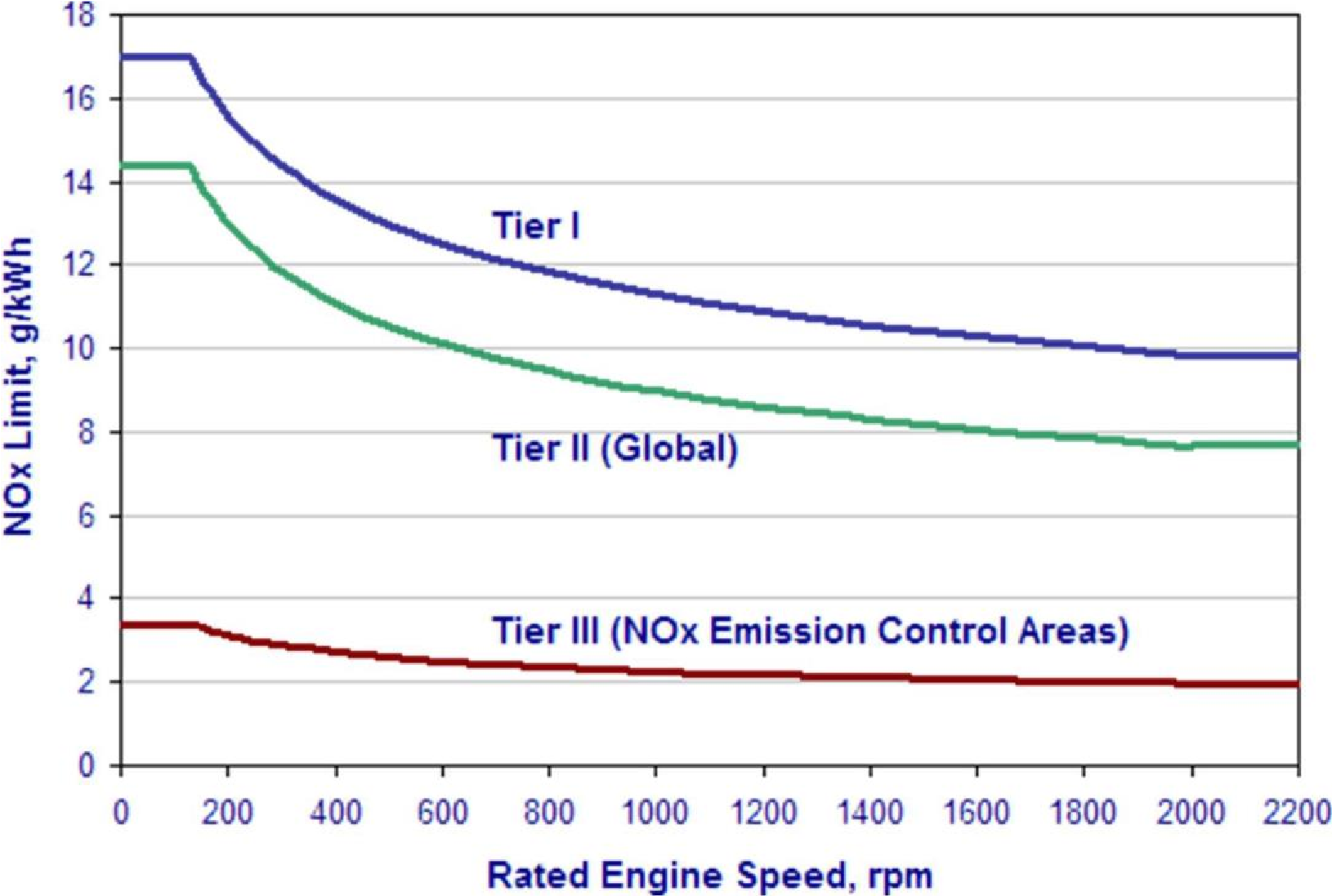
ATTACHMENT 2
MARPOL 2021 Revised Annex VI - Fuel Sulfur Limits
Date | Sulfur Limit in Fuel (% m/m) | |
SOx ECA | Global | |
2000 | 1.5% | 4.5% |
2010.07 | 1.0% | |
2012 | 3.5% | |
2015 | 0.1% | |
2020 | 0.5% | |
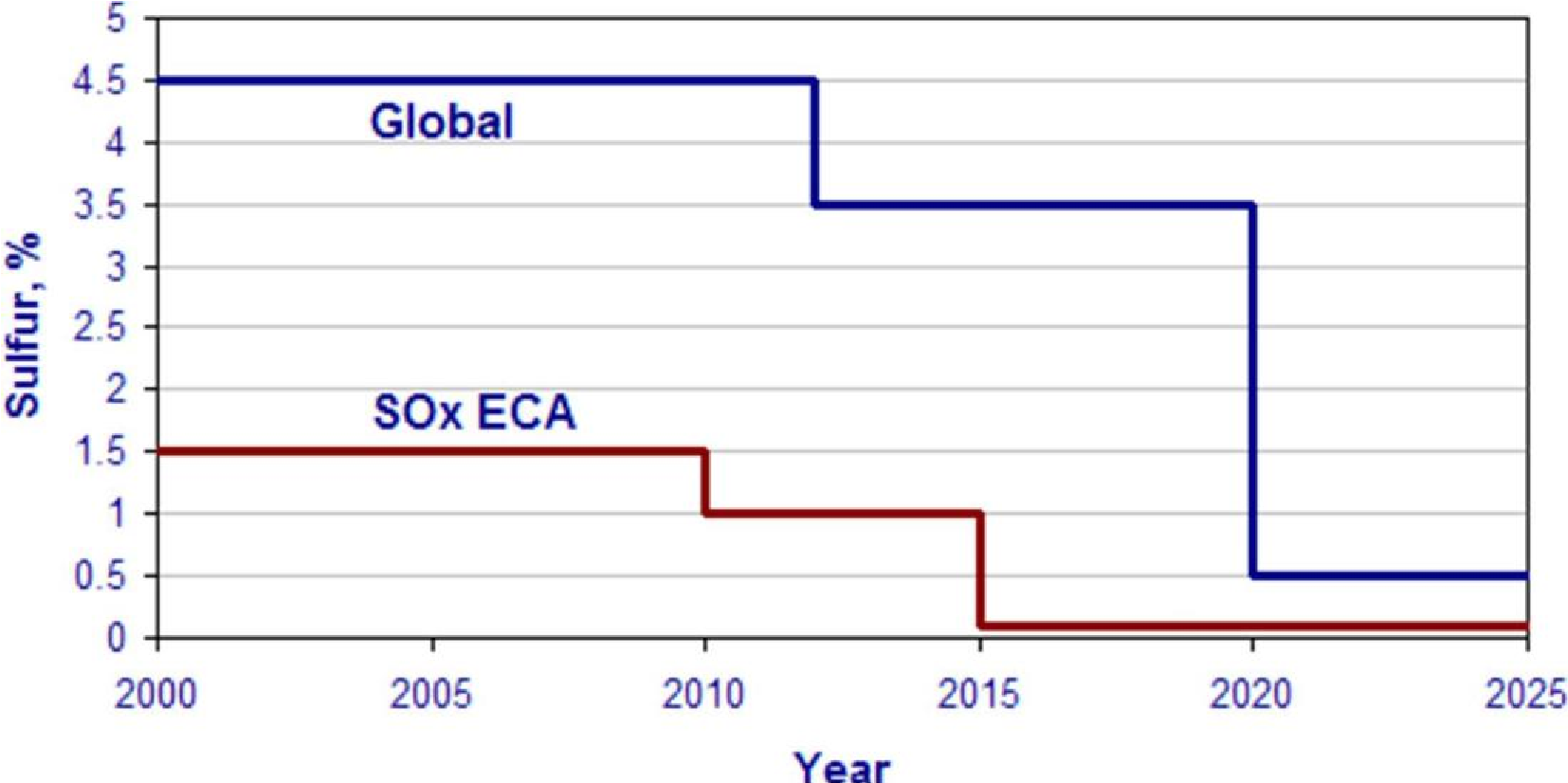
ATTACHMENT 3
A SAMPLE FORM OF A SHIP EFFICIENCY ENERGY MANAGEMENT PLAN
(Part I of SEEMP)
Name of Vessel: | GT: | ||
Vessel Type: | Capacity: | ||
IMO number: | |||
Date of Development: | Developed By: | ||
Implementation Period: | From: Until: | Implemented By: | |
Planned Date of Next Evaluation: | |||
Review and update log
Date/timeline | Updated parts | Developed by | Implemented by |
1 MEASURES
Energy Efficiency Measures | Implementation (including the starting date) | Responsible Personnel |
- MONITORING
Description of monitoring tools
- GOAL
Measurable goals
- EVALUATION
Procedures of evaluation
A SAMPLE FORM OF A SHIP FUEL OIL CONSUMPTION DATA COLLECTION PLAN
(Part II of SEEMP)
1 Review and update log
Date/timeline | Updated parts | Developed by | Implemented by |
2 Ship particulars
Name of Ship | |
IMO Number | |
Company | |
Flag | |
Ship type | |
Gross tonnage | |
NT | |
DWT | |
EEDI (If applicable) | |
Ice class |
3 Record of revision of Fuel Oil Consumption Data Collection Plan
Date of revision | Revised provision |
4 Ship engines and other fuel oil consumers and fuel oil types used
Engines or other fuel oil consumer type | Power | Fuel oil types | ||
1 | Type/model of main engine | (KW) | ||
2 | Type/model of auxiliary engine | (KW) | ||
3 | Fired Boiler | (…) | ||
4 | Inert gas generator | (…) | ||
5 | Others (specify) | (…) |
5 Emission factor
CF is a non-dimensional conversion factor between fuel oil consumption and CO2 emission in the 2022 Guidelines on the method of calculation of the attained Energy Efficiency Design Index (EEDI) for new ships (resolution MEPC.364(79) . The annual total amount of CO2 is calculated by multiplying annual fuel oil consumption and CF for the type of fuel.
Fuel oil Type | CF (t-CO2 / t-Fuel) |
Diesel/Gas oil (e.g. ISO 8217 grades DMX through DMB) | 3.206 |
Light fuel oil (LFO) (e.g. ISO 8217 grades RMA through RMD) | 3.151 |
Heavy fuel oil (HFO) (e.g. ISO 8217 grades RME through RMK) | 3.114 |
Liquefied petroleum gas (LPG) (Propane) | 3.000 |
Liquefied petroleum gas (LPG) (Butane) | 3.030 |
Liquefied natural gas (LNG) | 2.750 |
Methanol | 1.375 |
Ethanol | 1.913 |
Other ( ......... ) |
6 Method to measure fuel oil consumption
The applied methods for measurement for each consumer type of this ship are given below. The description explains the procedure for measuring data and calculating annual values, measurement equipment involved, etc.
Engines or other fuel oil consumer type | Method | Description |
Type/model of main engine | ||
Type/model of auxiliary engine | ||
Fired Boiler | ||
Others (Specify) |
7 Method to measure distance travelled including laden distance


Description
8 Method to measure hours underway


Description
9 Processes that will be used to report the data to the Administration


Description
10 Data quality


Description
SAMPLE FORM OF SHIP OPERATIONAL CARBON INTENSITY PLAN (PART III OF THE SEEMP)
1 Review and update log
Date/timeline | Updated parts | Developed by | Implemented by |
<1st time> | |||
<2nd time> | |||
Etc. | |||
2 Required CII over the next three years, attained CII and rating over three consecutive years
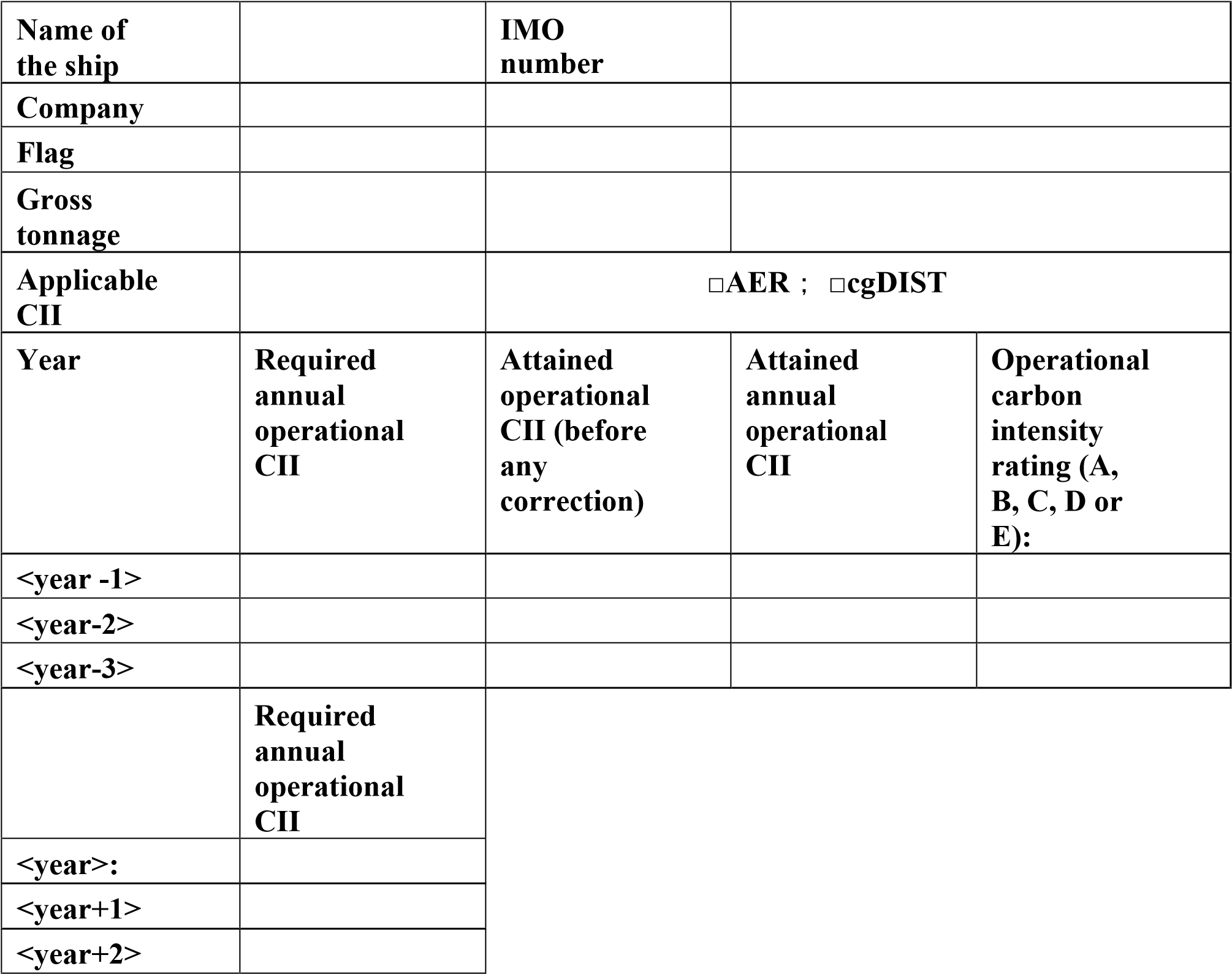
3 Calculation methodology of the ship's attained annual CII, including required data and how to obtain these data as far as not addressed in part II
 Description |
4 Three-year implementation plan
Company personnel to be responsible for the three-year implementation plan, monitoring and recording performance
List of measures to be considered and implemented
Measure | Impact on CII | Time and method of implementation and responsible personnel | Impediments and contingency measures | |||
Milestone | Due | Responsible | Impediment | Contingencies | ||
Milestone | Due | Responsible | Impediment | Contingencies | ||
Milestone | Due | Responsible | Impediment | Contingencies | ||
Milestone | Due | Responsible | Impediment | Contingencies | ||
Milestone | Due | Responsible | Impediment | Contingencies | ||
Calculation showing the combined effect of the measures and that the required operational CII will be achieved
Year | Required annual operational CII | Targeted operational annual CII | Targeted rating |
<year>: | |||
<year+1> | |||
(year+2> |
5 Self-evaluation and improvement
 Description |
6 Plan of corrective actions (if applicable)
 Description |
Analysis of causes for inferior CII rating
Analysis of measures in the implementation plan
Measure | Analysis of effect | Actions |
List of additional measures and revised measures to be added to the implementation plan
Measure | Impact on CII | Time and method of implementation and responsible personnel | Impediments and contingency measures | |||
Milestone | Due | Responsible | Impediment | Contingencies | ||
ATTACHMENT 4
Information to be submitted to the IMO Ship Fuel Oil Consumption Database (regulation 27)
Identity of the ship
IMO number
Period of calendar year for which the data is submitted For the purpose of regulation 27:
Start date (dd/mm/yyyy)
End date (dd/mm/yyyy)
For the purpose of regulation 28:
Start date (dd/mm/yyyy)
End date (dd/mm/yyyy)
Technical characteristics of the ship
Year of Delivery
Ship type, as defined in regulation 2 of this Annex or other (to be stated)
Gross tonnage (GT)[1]
Net tonnage (NT)[2]
Deadweight tonnage (DWT)[3]
Power output (rated power[4]) of main and auxiliary reciprocating internal combustion engines over 130 kW (to be stated in kW)
Attained EEDI[5] (if applicable)
Attained EEXI[6] (If applicable) Ice class[7]
Fuel oil consumption data
Total fuel oil consumption by fuel oil type5 in metric tonnes and methods used for collecting fuel oil consumption data:
Fuel oil consumption data:
Total fuel oil consumption by fuel oil type5 per consumer type in metric tonnes and methods used for collecting fuel oil consumption data:
Main Engine(s) ………………………….
Auxiliary Engine(s)/Generator(s) ……………………… Fired Boiler(s) …………………………..
Others (specify) …………………………
Fuel oil consumption while the ship is not underway by fuel oil type5 per consumer type in metric tonnes and methods used for collecting fuel oil consumption data:
Main Engine(s) ………………………….
Auxiliary Engine(s)/Generator(s) ……………………… Fired Boiler(s) …………………………..
Others (specify) …………………………
Total distance travelled (nm)
Laden distance travelled (nm) (on a voluntary basis)
Hours underway
Total amount of onshore power supplied (kWh)
For ships to which regulation 28 of MARPOL Annex VI applies:
Total transport work
Applicable CII[8]: □AER □ cgDIST
Required annual operational CII[9]
Attained annual operational CII before any correction10
Attained annual operational CII11
Installation of innovative technology12, if applicable: □ A □ B-1 □ B-2 □ C-1 □ C-2
Operational carbon intensity rating13: □ A □ B □ C □ D □ E
CII for trial purpose (on voluntary basis)14:
□ | EEPI (gCO2/t/nm): |
□ | cbDIST (gCO2/berth/nm): |
□ | clDIST (gCO2/m/nm): |
□ | EEOI (gCO2/t/nm or others)15 |
10
As calculated in accordance with the 2022 Guidelines on operational carbon intensity indicators and the calculation methods (CII guidelines, G1) (resolution MEPC.352(78)) before any correction using Interim guidelines on correction factors and voyage adjustments for CII calculations (G5) (resolution MEPC.355(78)).
11
As calculated in accordance with the 2022 Guidelines on operational carbon intensity indicators and the calculation methods (CII guidelines, G1) (resolution MEPC.352(78)) and having been corrected taking into account Interim guidelines on correction factors and voyage adjustments for CII calculations (G5) (resolution MEPC.355(78)).
12
Refer to the 2021 Guidance on treatment of innovative energy efficiency technologies for calculation and verification of the attained EEDI and EEXI (MEPC.1/Circ.896).
13
Refer to the 2022 Guidelines on the operational carbon intensity rating of ships (CII rating guidelines, G4) (resolution MEPC.354(78)).
14
Refer to the 2022 Guidelines on operational carbon intensity indicators and the calculation methods (CII guidelines, G1) (resolution MEPC.352(78)).
15
Refer to the Guidelines for voluntary use of the ship energy efficiency operational indicator (EEOI) (MEPC.1/Circ.684).
ATTACHMENT 5
STANDARDIZED DATA REPORTING FORMAT FOR THE DATA COLLECTION SYSTEM AND OPERATIONAL CARBON INTENSITY TO THE ADMINISTRATION
Identity of the ship
Name of the ship | |
Company | |
Flag | |
IMO number | |
Period of the calendar year for which the data is submitted | |
Start date (dd/mm/yy) | |
End date (dd/mm/yy) | |
Technical characteristics of the ship
Year of delivery | ||
Ship type, as defined in regulation 2.2 of MARPOL Annex VI or other (to be stated) | ||
Gross tonnage (GT) | ||
Net tonnage (NT) | ||
Deadweight tonnage (DWT) | ||
Power output (rated power) over 130 (kW) | Main Engine(s) | |
Auxiliary Engine(s) | ||
Attained EEDI (if applicable) | ||
Attained EEXI (if applicable) | ||
Ice class (if applicable) | ||
Fuel oil1 consumption data
Total fuel oil consumption data | |||||
Fuel oil type | Quantity in metric tonnes (t) | Method(s) used for collecting fuel oil consumption data (BDN / Flow meters / bunker FO tank monitoring / LNG cargo tank monitoring / Cargo tank monitoring other than LNG) | |||
Diesel/Gas Oil (CF: 3.206) | |||||
LFO (CF: 3.151) | |||||
HFO (CF: 3.114) | |||||
LPG (Propane) (CF: 3.000) | |||||
LPG (Butane) (CF: 3.030) | |||||
Ethane (CF: 2.927) | |||||
LNG (CF: 2.750) | |||||
Methanol (CF: 1.375) | |||||
Ethanol (CF: 1.913) | |||||
Other (…….) (Cf: ……..) | |||||
Total fuel oil consumption data per consumer type | |||||
Fuel oil type | Consumer type | Quantity in metric tonnes (t) | Method used for collecting fuel oil consumption data (Flow meters / bunker FO tank monitoring / subtraction / estimated) | ||
Diesel/Gas Oil (CF: 3.206) | Main engines(s) | ||||
Auxiliary engine(s)/Generator(s) | |||||
Fired Boiler(s) | |||||
Others (specify) | |||||
LFO (CF: 3.151) | Main engines(s) | ||||
Auxiliary engine(s)/Generator(s) | |||||
Fired Boiler(s) | |||||
Others (specify) | |||||
HFO (CF: 3.114) | Main engines(s) | ||||
Auxiliary engine(s)/Generator(s) | |||||
Fired Boiler(s) | |||||
Others (specify) | |||||
LPG (Propane) (CF: 3.000) | Main engines(s) | ||||
Auxiliary engine(s)/Generator(s) | |||||
Fired Boiler(s) | |||||
Others (specify) | |||||
LPG (Butane) (CF: 3.030) | Main engines(s) | ||||
Auxiliary engine(s)/Generator(s) | |||||
Fired Boiler(s) | |||||
Others (specify) | |||||
Ethane (CF: 2.927) | Main engines(s) | ||||
Auxiliary engine(s)/Generator(s) | |||||
Fired Boiler(s) | |||||
Others (specify) | |||||
LNG (CF: 2.750) | Main engines(s) | ||||
Auxiliary engine(s)/Generator(s) | |||||
Fired Boiler(s) | |||||
Others (specify) | |||||
Methanol (CF: 1.375) | Main engines(s) | ||||
Auxiliary engine(s)/Generator(s) | |||||
Fired Boiler(s) | |||||
Others (specify) | |||||
Ethanol (CF: 1.913) | Main engines(s) | ||||
Auxiliary engine(s)/Generator(s) | |||||
Fired Boiler(s) | |||||
Others (specify) | |||||
Other(…….) (Cf: ……..) | Main engines(s) | ||||
Auxiliary engine(s)/Generator(s) | |||||
Fired Boiler(s) | |||||
Others (specify) | |||||
Fuel | oil consumption data while the ship is not under way, per consumer type | ||
Fuel oil type | Consumer type | Quantity in metric tonnes (t) | Method used for collecting fuel oil consumption data |
Diesel/Gas Oil (CF: 3.206) | Main engines(s) | ||
Auxiliary engine(s)/Generator(s) | |||
Fired Boiler(s) | |||
Others (specify) | |||
LFO (CF: 3.151) | Main engines(s) | ||
Auxiliary | |||
engine(s)/Generator(s) | |||
Fired Boiler(s) | |||
Others (specify) | |||
HFO (CF: 3.114) | Main engines(s) | ||
Auxiliary engine(s)/Generator(s) | |||
Fired Boiler(s) | |||
Others (specify) | |||
LPG (Propane) (CF: 3.000) | Main engines(s) | ||
Auxiliary engine(s)/Generator(s) | |||
Fired Boiler(s) | |||
Others (specify) | |||
LPG (Butane) (CF: 3.030) | Main engines(s) | ||
Auxiliary engine(s)/Generator(s) | |||
Fired Boiler(s) | |||
Others (specify) | |||
Ethane (CF: 2.927) | Main engines(s) | ||
Auxiliary engine(s)/Generator(s) | |||
Fired Boiler(s) | |||
Others (specify) | |||
LNG (CF: 2.750) | Main engines(s) | ||
Auxiliary engine(s)/Generator(s) | |||
Fired Boiler(s) | |||
Others (specify) | |||
Methanol (CF: 1.375) | Main engines(s) | ||
Auxiliary engine(s)/Generator(s) | |||
Fired Boiler(s) | |||
Others (specify) | |||
Ethanol (CF: 1.913) | Main engines(s) | ||
Auxiliary engine(s)/Generator(s) | |||
Fired Boiler(s) | |||
Others (specify) | |||
Other (…….) (Cf: ……..) | Main engines(s) | ||
Auxiliary engine(s)/Generator(s) | |||
Fired Boiler(s) | |||
Others (specify) | |||
Total Distance Travelled (nm) | |
Laden distance travelled (nm) (on a voluntary basis) | |
Hours underway (h) | |
Total amount of onshore power supplied (kWh) |
For ships to which regulation 28 of MARPOL Annex VI applies:
Total transport work | |
Applicable CII | □AER; □cgDIST |
Required annual operational CII | |
Start date for annual CII (dd/mm/yy)2 | |
End date for annual CII (dd/mm/yy)3 | |
Attained annual operational CII before any correction (AER in g CO2/dwt.nm or cgDIST in g CO2/gt.nm) | |
Attained annual operational CII (AER in g CO2/dwt.nm or cgDIST in g CO2/gt.nm) | |
Installation of innovative technology, if applicable (refer to MEPC.1/Circ.896) | □A; □B-1; □B-2; □C-1; □C-2 |
Operational carbon intensity rating | □A; □B; □C; □D; □E |
CII for trial purpose (none, one or more on voluntary basis) | □EEPI; □cbDIST; □clDIST; □EEOI |
EEPI (gCO2/dwt.nm) | |
cbDIST (gCO2/berth.nm) | |
clDIST (gCO2/m.nm) | |
EEOI (gCO2/t.nm or others) |
1 Regulation 2.1.14 of MARPOL Annex VI defines "fuel oil" as any fuel delivered to and intended for combustion purposes for propulsion or operation on board a ship, including gas, distillate and residual fuels.
2,3 In the event of any transfer of a ship addressed in regulations 27.4, 27.5 or 27.6, these dates should be completed consistent with regulation 28.3 of MARPOL Annex VI (i.e. a full 12-month period from 1 January to 31 December in the calendar year during which the transfer took place).
ATTACHMENT 5 – Add.1
STANDARDIZED DATA REPORTING FORMAT FOR THE PARAMETERS TO CALCULATE THE TRIAL CARBON INTENSITY INDICATORS ON VOLUNTARY BASIS*
Metric of Cargo Mass Carried or Work Done in EEOI calculation (gCO2/t.nm or others)***** | |
Transport work***** | |
Attained annual EEPI (gCO2/dwt.nm) | |
Laden distance travelled (n.m) | |
Attained annual clDIST (gCO2/m.nm) **** | |
Length of lanes (metre) **** | |
Attained annual cbDIST(gCO2/berth.nm) *** | |
Available lower berths*** | |
End date for trial CII (dd/mm/yy)** | |
Start date for trial CII (dd/mm/yy)** | |
IMO number** | |
End date for DCS (dd/mm/yy)** | |
Start date for DCS (dd/mm/yy)** |
* For reporting a trial CII, the data should be reported as applicable taking into account the information already provided in appendix 3.
** Consistent with appendix 3.
*** Only applicable to cruise passenger ships.
**** Only applicable to ro-ro ships.
***** As defined in section 3 of Guidelines for voluntary use of the ship energy efficiency operational indicator (EEOI) circulated by MEPC.1/Circ.684. The distance travelled shall be determined from berth of the port of departure to berth of the port of arrival and shall be expressed in nautical miles.
ATTACHMENT 6
SAMPLE OF THE BDN SUMMARIES
Date of Operations (dd/mm/yyyy) | Fuel Oil Type/Mass(MT) | Descriptions | ||||||
DO/GO | LFO | HFO | LPG(P) | LPG(G) | LNG | Others(CF) | ||
① BDN | ||||||||
09/01/2019 | ||||||||
02/05/2019 | 150 | |||||||
08/07/2019 | ||||||||
09/10/2019 | ||||||||
10/12/2019 | 300 | |||||||
①Annual Supply Amount | 0 | 0 | 450 | 0 | 0 | 0 | 0 | |
② Correction for the tank oil remainings | ||||||||
01/01/2019 | 400 | |||||||
31/12/2019 | 200 | |||||||
②Correction for the tank oil remainings | 0 | 0 | 200 | 0 | 0 | 0 | 0 | The difference in the amount of the remaining tank oil at the beginning/end of the data collection period. |
③ Other corrections | ||||||||
30/03/2019 | ||||||||
15/09/2019 | ||||||||
31/12/2019 | ||||||||
③Annual other corrections | 0 | 0 | 0 | 0 | 0 | 0 | 0 | |
Annual Fuel Consumption | ||||||||
Annual Fuel Consumption (①+②+③) | 0 | 0 | 650 | 0 | 0 | 0 | 0 | |
Explanatory remarks;
If bunker supply /correction data have been recorded in a Comp any’s electronic reporting system, the data is acceptable to be submitted in the existing format instead of submitting the data by this format.
ATTACHMENT 7
SAMPLE OF THE COLLECTED DATA SUMMARIES
Date and time from (dd/mm/yyyy; hh:mm UTC) | * Date and time to (dd/mm/yyyy; hh:mm UTC) | Distance travelled (nm) | Hours under way (hh:mm) **** | Cargo carried (metric tons) | Cargo carried (TEU) | Cargo carried (Passen ger) | (voluntary basis) Laden voyage (Y/N) | **exceptional conditions Specified in regulation 3.1 of MARPOL Annex VI (Y/N) | **Sailing in ice condition (Y/N) | **STS Operation (Y/N) ……. | Fuel consumption (metric tons) | |||
Main engine(s) | ||||||||||||||
HFO | LFO | MGO | Etc. | |||||||||||
01/01/2023 00:00 | 01/01/2023 13:20 | 150 | 13:20 | 1,500 | Y | N | N | N | ||||||
…… | …… | …… | …… | ……. | ……. | ……. | ……. | |||||||
31/12/2023 00:00 | 31/12/2023 24:00 | 290 | 24:00 | 1,500 | Y | N | N | N | ||||||
Annual Total | ||||||||||||||
(continued from the table above)
Fuel consumption (metric tons) | |||||||||||||||||||||||
Auxiliary engine(s) | Boiler(s) | Others (Specify) | **mass to be deducted from the total | ||||||||||||||||||||
consumed for production of electrical power(𝑭𝑪𝒆𝒍𝒆𝒄𝒕𝒓𝒊𝒄𝒂𝒍) | consumed by oil-fired boiler for cargo heating/discharge on tankers (𝑭𝑪𝒃𝒐𝒊𝒍𝒆𝒓) | consumed by standalone engine driven cargo pumps during discharge operations on tankers(𝑭𝑪𝒐𝒕𝒉𝒆𝒓𝒔) | |||||||||||||||||||||
HFO | LFO | MGO | etc. | HFO | LFO | MGO | etc | HFO | LFO | MGO | etc | HFO | LFO | MGO | etc | HFO | LFO | MGO | etc | HFO | LFO | MGO | etc |
* In the case of daily underlying data, this column would be left blank.
** Refer to the 2022 Interim guidelines on correction factors and voyage adjustments for CII calculations (G5), adopted by resolution MEPC.355(78). Supporting documentation may be additionally submitted to facilitate verification when necessary, such as Baplie files where the number of in-use reefer containers on board are recorded. Note that voyages in different sailing or operational conditions should be recorded in separate rows so that the correction factors and voyage adjustments can be duly calculated and verified.
*** Refer to fuel types specified in the 2018 Guidelines on the method of calculation of the attained Energy Efficiency Design Index (EEDI) for new ships (resolution MEPC.308(73), as may be amended)
**** Hours underway should be equal to the time between the start and end date and time. In case the segment is not underway, it should be left blank
Explanatory remarks: If bunker supply/correction data have been recorded in a company's electronic reporting system, the data is acceptable to be submitted in the existing format instead of submitting the data by this format.
ATTACHMENT 7-Add.1
STANDARDIZED DATA REPORTING FORMAT FOR OPERATIONAL CARBON INTENSITY TO THE ADMINISTRATION
SAMPLE OF THE COLLECTED DATA SUMMARIES TO CALCULATE TRIAL CII ON A VOLUNTARY BASIS
The following aggregated data should be additionally included in the table in Attachment 7, if one or more trial CII metrics have been applied on a voluntary basis:
Date from (dd/mm/yyyy) | *Date to (dd/mm/yyyy) | Laden distance travelled (N.M) | ****Transport work (metric of transport work) |
01/01/2023 | |||
02/01/2023 | |||
03/01/2023 | |||
31/12/2023 | |||
Annual total |
* In the case of daily underlying data, this column would be left blank.
**** As defined in section 3 of the Guidelines for voluntary use of the ship energy efficiency operational indicator (EEOI) circulated by MEPC.1/Circ.684.
Explanatory remarks: If bunker supply/correction data have been recorded in a Company's electronic reporting system, the data is acceptable to be submitted in the existing format instead of submitting the data by this format.
ATTACHMENT 8
FORMAT FOR REPORTING TO THE ORGANIZATION USE OF A POWER RESERVE BY UN-LIMITING THE SHAFT / ENGINE POWER LIMITATION
Ship type:
IMO number:
DWT:
GT:
Maximum unlimited shaft/engine power (kW): Limited shaft/engine power (kW):
Table 1
Date (dd/mm/yyyy) | Time (UTC) | Position when the power reserved was used | Override activation/Reactivation | Reason for using the power reserve[10] | Beaufort number[11] | Wave height2 | Ice condition2 | |
Longitude | Latitude | |||||||
ATTACHMENT 9
Template for Information to be provided to the Organization by the Administration which accepts that the installation of a Tier III non-identical replacement engine was not feasible and accordingly a Tier II engine has been installed.
Information to be submitted by the Administration:
1 Particulars of ship
Name of ship:
IMO Number:
2 Replacement of a marine diesel engine or a steam system*
Propulsion or non-propulsion*
If non-propulsion: Usage
- Replaced marine diesel engine details (if applicable):
Number of engines:
Rated power & rated speed:
NOx certification Tier: pre-2000, I or II* Test cycle(s):
- Non-identical replacement marine diesel engine details:
Number of engines:
Rated power & rated speed: Time of replacement**:
- Summary of why the installation of Tier III non-identical replacement marine diesel engine(s) was not feasible:
* Delete as applicable.
** Refer to the Unified interpretations to MARPOL Annex (MEPC.1/Circ.795, as amended).
ATTACHMENT 10
FUEL OIL CONSUMPTION DATA, CII and SEEMP IMPLEMENTATION SCHEDULE
YEAR | DATE | ACTION |
2022 | 31/DEC | Initial Verification: Issuance of the SEEMP Part III Confirmation of Compliance (CoC) |
2023 | 01/JAN | Start of fuel oil consumption data collection and CII Year 2023 (Updated SEEMP in place; Confirmation of Compliance (CoC) in place) |
31/MAR | Deadline for submission of 2022 fuel oil consumption for verification | |
31/MAY | Deadline for issuance of SoC for 2022 (valid until 31 May 2024) | |
30/JUN | Deadline for transfer of 2022 data to DCS | |
30/NOV | Deadline for Company audits, if conducted | |
31/DEC | End of fuel oil consumption data collection and CII Year 2023 | |
2024 | 01/JAN | Start of fuel oil consumption data and CII Year 2024 |
31/MAR | Deadline for submission of 2023 fuel oil consumption data and CII for verification | |
30/APR | For ships rated E in 2023, only Deadline for submission of Corrective Action Plan to be implemented in 2024 and 2025 | |
31/MAY | Additional verification, if applicable Deadline for issuance of SoC for 2023 (valid until 31 May 2025) | |
30/JUN | Deadline for transfer of 2023 data to DCS | |
30/NOV | Deadline for Company audits, if conducted | |
31/DEC | End of fuel oil consumption data collection and CII Year 2024 | |
2025 | 01/JAN | Start of fuel oil consumption data and CII Year 2025 |
31/MAR | Deadline for submission of 2024 fuel oil consumption data and CII for verification | |
30/APR | For ships rated E in 2024, only Deadline for submission of Corrective Action Plan to be implemented in 2025 and 2026 (at the discretion of the Administration to require a new Corrective Action Plan or previous one can be continuously implemented) | |
31/MAY | Deadline for issuance of SoC for 2024 (valid until 31 May 2026) | |
30/JUN | Deadline for transfer of 2024 data to DCS | |
30/NOV | Deadline for Company audits, if conducted | |
31/DEC | Periodical verification: Issuance of the Confirmation of Compliance (CoC) for updated SEEMP related to upcoming three-year period. End of fuel oil consumption data collection and CII Year 2025 | |
2026 | 01/JAN | Start of fuel oil consumption data and CII Year 2026 |
31/MAR | Deadline for submission of 2025 fuel oil consumption data and CII for verification | |
30/APR | For ships rated D in 2023-2025 or E in 2025, only Deadline for submission of Corrective Action Plan to be implemented in 2026 and 2027 (at the discretion of the Administration to require a new Corrective Action Plan or previous one can be continuously implemented) | |
31/MAY | Deadline for issuance of SoC for 2025 (valid until 31 May 2027) | |
30/JUN | Deadline for transfer of 2025 data to DCS | |
30/NOV | Deadline for Company audits, if conducted | |
31/DEC | Periodical verification: Issuance of the Confirmation of Compliance (CoC) for updated SEEMP related to upcoming three-year period. End of fuel oil consumption data collection and CII Year 2026 |
ANNEX 1
Form of IAPP CERTIFICATE (Regulation 8)

THE REPUBLIC OF LIBERIA
LIBERIA MARITIME AUTHORITY
Office of
Deputy Commissioner of Maritime Affairs
INTERNATIONAL AIR POLLUTION PREVENTION CERTIFICATE
Issued under the provisions of the Protocol of 1997, as amended by resolution MEPC.176(58) in 2008, to amend the International Convention for the Prevention of Pollution from Ships, 1973, as modified by the Protocol of 1978 related thereto (hereinafter referred to as “the Convention”) under the authority of the Government of:
THE REPUBLIC OF LIBERIA
(full designation of the country)
by 
(full designation of the competent person or organization authorized under the provisions of the Convention)
Name of ship | Distinctive number or letters | IMO number | Port of registry | Gross tonnage |
THIS IS TO CERTIFY:
- That the ship has been surveyed in accordance with regulation 5 of Annex VI of the Convention; and
- That the survey shows that the equipment, systems, fittings, arrangements and materials fully comply with the applicable requirements of Annex VI of the Convention.
This certificate is valid until .............................................. subject to surveys in accordance with regulation 5 of
Annex VI of the Convention.
Completion date of the survey on which this Certificate is based: .................................................
Issued at .............................................................................................................................................
(Place of issue of certificate)
......................... .........................................................
(Date of issue) (signature of duly authorized official issuing the certificate)
(Seal or stamp of the authority, as appropriate)
ENDORSEMENT FOR ANNUAL AND INTERMEDIATE SURVEYS
THIS IS TO CERTIFY that at a survey required by regulation 5 of Annex VI of the Convention, the ship was found to comply with the relevant provisions of that Annex.
Annual survey: Signed: ...................................................................................
(Signature of duly authorized official)
Place: ....................................................................................
Date: ......................................................................................
(Seal or stamp of the authority, as appropriate)
Annual */Intermediate* survey: Signed: ..................................................................................
(Signature of duly authorized official)
Place: ....................................................................................
Date: ......................................................................................
(Seal or stamp of the authority, as appropriate)
Annual survey: Signed: ...................................................................................
(Signature of duly authorized official)
Place: ....................................................................................
Date: ......................................................................................
(Seal or stamp of the authority, as appropriate)
* Delete as appropriate
Annual/intermediate survey in accordance with regulation 9.8.3
*
THIS IS TO CERTIFY that, at an annual/intermediate survey in accordance with regulation 9.8.3 of Annex VI of the Convention, the ship was found to comply with the relevant provisions of that Annex:
Signed: .......................................................
(Signature of authorized official)
Place: .........................................................
Date (dd/mm/yyyy):...................................
(Seal or stamp of the authority, as appropriate)
Endorsement to extend the certificate if valid for less than 5 years where regulation 9.3 applies
The ship complies with the relevant provisions of the Annex, and this certificate shall, in accordance with regulation 9.3 of Annex VI of the Convention, be accepted as valid until
(dd/mm/yyyy): ……………………………………………………………………………………..
Signed: .......................................................
(Signature of authorized official)
Place: ...........................................................
Date (dd/mm/yyyy):....................................
(Seal or stamp of the authority, as appropriate)
Endorsement where the renewal survey has been completed and regulation 9.4 applies
The ship complies with the relevant provisions of the Annex, and this certificate shall, in
accordance with regulation 9.4 of Annex VI of the Convention, be accepted as valid until
(dd/mm/yyyy): ……………………………………………………………………………………..
Signed: .......................................................
(Signature of authorized official)
Place: ...........................................................
Date (dd/mm/yyyy): ....................................
(Seal or stamp of the authority, as appropriate)
* Delete as appropriate.
Endorsement to extend the validity of the certificate until reaching the port of survey or for a period of grace where regulation 9.5 or 9.6 applies
*
This certificate shall, in accordance with regulation 9.5 or 9.6 of Annex VI of the Convention, be accepted as valid until (dd/mm/yyyy): ………………………………………………………….
Signed: ........................................................
(Signature of authorized official)
Place: ...........................................................
Date (dd/mm/yyyy): ....................................
(Seal or stamp of the authority, as appropriate)
Endorsement for advancement of anniversary date where regulation 9.8 applies
In accordance with regulation 9.8 of Annex VI of the Convention, the new anniversary date is
(dd/mm/yyyy): …..…………………………………………………………………………………
Signed: ........................................................
(Signature of authorized official)
Place: ...........................................................
Date (dd/mm/yyyy): ....................................
(Seal or stamp of the authority, as appropriate)
In accordance with regulation 9.8 of Annex VI of the Convention, the new anniversary date is
(dd/mm/yyyy): ………….…………………..………………………………………………………
Signed: .........................................................
(Signature of authorized official)
Place: ........................................................... Date (dd/mm/yyyy): ....................................
(Seal or stamp of the authority, as appropriate)
* Delete as appropriate.
SUPPLEMENT TO INTERNATIONAL AIR POLLUTION PREVENTION CERTIFICATE (IAPP CERTIFICATE)
RECORD OF CONSTRUCTION AND EQUIPMENT
Notes:
This Record shall be permanently attached to the IAPP Certificate. The IAPP Certificate shall be available on board the ship at all times.
If the language of the original Record is not English, French or Spanish, the text shall include a translation into one of these languages.
Entries In boxes shall be made by inserting either a cross (x) for the answer “yes” and “applicable” or a (-) for the answers “no” and “not applicable” as appropriate.
Unless otherwise stated, regulations mentioned in this Record refer to regulation of Annex VI of the Convention and resolutions or circulars refer to those adopted by the International Maritime Organization.

1 Particulars of ship
1.1 Name of Ship ……………………………………………………………………………………......
1.1 IMO Number………………………………………………………………………………………...
1.2 Date on which keel was laid or ship was at a similar stage of construction (dd/mm/yyyy)…………
1.4 Length (L)* metres…………………………………………………………………………………..
2 Control of emissions from ships
2.1 Ozone-depleting substances (regulation 12)
2.1.1 The following fire-extinguishing systems, other systems and equipment containing ozone-depleting substances, other hydrochlorofluorocarbons (HCFCs), installed before 19 May 2005 may continue in service:
System equipment | Location on board | Substance |
2.1.2 The following fire-extinguis continue in service: | hing systems containing HCFCs installed before 11 January 2020 may | |
System equipment | Location on board | Substance |
- Completed only in respect of ships constructed on or after 1 January 2016 that are specially designed, and used solely for recreational purposes and to which, in accordance with regulation 13.5.2.1 or regulation 13.5.2.3, the NOx emission limit as given by regulation 13.5.1.1 will not apply.
2.2 Nitrogen oxides (NOx) (regulation 13)
2.2.1 The following marine diesel engines installed on this ship are in accordance with the requirements of regulation 13, as indicated:
Applicable regulation of MARPOL Annex VI (NTC = NOX Technical Code 2008) | Engine #1 | Engine #2 | Engine #3 | Engine #4 | Engine #5 | Engine #6 | |||
| Manufacturer and model | ||||||||
Serial number | |||||||||
Use (applicable application cycle(s) – NTC 3.2) | |||||||||
Rated power (kW) (NTC 1.3.11) | |||||||||
Rated speed (RPM) (NTC 1.3.12) | |||||||||
6 | Identical engine installed ≥ 1/1/2000 exempted by 13.1.1.2 | □ | □ | □ | □ | □ | □ | ||
7 | Identical engine installation date (dd/mm/yyyy) as per 13.1.1.2 | ||||||||
8a | Major Conversion (dd/mm/yyyy) | 13.2.1.1 & 13.2.2 | |||||||
8b | 13.2.1.2 & 13.2.3 | ||||||||
8c | 13.2.1.3 & 13.2.3 | ||||||||
9a | Tier I | 13.3 | □ | □ | □ | □ | □ | □ | |
9b | 13.2.2 | □ | □ | □ | □ | □ | □ | ||
9c | 13.2.3.1 | □ | □ | □ | □ | □ | □ | ||
9d | 13.2.3.2 | □ | □ | □ | □ | □ | □ | ||
9e | 13.7.1.2 | □ | □ | □ | □ | □ | □ | ||
10a | Tier II | 13.4 | □ | □ | □ | □ | □ | □ | |
10b | 13.2.2 | □ | □ | □ | □ | □ | □ | ||
10c | 13.2.2 (Tier III not possible) | □ | □ | □ | □ | □ | □ | ||
10d | 13.2.3.2 | □ | □ | □ | □ | □ | □ | ||
10e | 13.5.2 (Exemptions) | □ | □ | □ | □ | □ | □ | ||
10f | 13.7.1.2 | □ | □ | □ | □ | □ | □ | ||
11a | Tier III (ECA-NOx only) | 13.5.1.1 | □ | □ | □ | □ | □ | □ | |
11b | 13.2.2 | □ | □ | □ | □ | □ | □ | ||
11c | 13.2.3.2 | □ | □ | □ | □ | □ | □ | ||
11d | 13.7.1.2 | □ | □ | □ | □ | □ | □ | ||
12 | AM* | installed | □ | □ | □ | □ | □ | □ | |
13 | not commercially available at this survey | □ | □ | □ | □ | □ | □ | ||
14 | not applicable | □ | □ | □ | □ | □ | □ | ||

- Refer to the 2014 Guidelines on the approved method process (resolution MEPC.243(66)
2.3 Sulphur oxides (SOx) and particulate matter (regulation 14)
- When the ship operates outside of an Emission Control Area specified in regulation 14.3, the ship uses:
.1 fuel oil with a sulphur content as documented by bunker delivery notes that does not exceed the limit value of 0.50% m/m, and/or
…………..................................................................................................................

.2 an equivalent arrangement approved in accordance with regulation 4.1 as listed in 2.6 that is at least as effective in terms of SOx emission reductions as compared to using a fuel oil with a sulphur content limit value of 0.50% m/m ....................................................................... 
- When the ship operates inside an Emission Control Area specified in regulation 14.3, the ship uses:
.1 fuel oil with a sulphur content as documented by bunker delivery notes that does not exceed the limit value of 0.10% m/m, and/or:
…………………………………………………………………………….

.2 an equivalent arrangement approved in accordance with regulation 4.1 as listed in 2.6 that is at least as effective in terms of SOx emission reductions as compared to using a fuel oil with a sulphur content limit value of 0.10% m/m:
………………………………………………………………………………

- For a ship without an equivalent arrangement approved in accordance with regulation 4.1 as
listed in paragraph 2.6, the sulphur content of fuel oil carried for use on board the ship shall not exceed 0.50% m/m as documented by bunker delivery notes
………………………………………………………………………………

- The ship is fitted with designated sampling point(s) in accordance with regulation 14.10 or
14.11 ........................................................................................................................ 
2.3.5 In accordance with regulation 14.12, the requirement for fitting or designating sampling point(s) in accordance with regulation 14.10 or 14.11 is not applicable for a fuel oil service system used for a low-flashpoint fuel or gas fuel .......................................................... 
2.4 Volatile organic compounds (VOCs) (regulation 15)
2.4.1 The tanker has a vapour collection system installed and approved in accordance with
MSC/Circ.585. …………………………………………………………………….

- For a tanker carrying crude oil, there is an approved VOC Management Plan ….


- VOC Management Plan approval reference: ......................................................
2.5 Shipboard incineration (regulation 16)
The ship has an incinerator:
.1 installed on or after 1 January 2000 which complies with
.1 resolution MEPC.76(40), as amended*.. 
.2 resolution MEPC.244(66) 
.2 installed before 1 January 2000 which complies with:
.1 resolution MEPC.59(33), as amended** 
.2 resolution MEPC.76(40), as amended* 
*As amended by MEPC.93(45)
** As amended by MEPC.92(45)
2.6 Equivalents (regulation 4)
The ship has been allowed to use the following fitting, material, appliance or apparatus to be fitted in a ship or other procedures, alternative fuel oils, or compliance methods used as an alternative to that required by this Annex:
System equipment | Equivalent used | Approval reference |
THIS IS TO CERTIFY that this Record is correct in all respects.
Issued at ............................................................................................................
(Place of issue of the Record)
......................... .........................................................
(Date of issue) (signature of duly authorized official issuing the Record)
(Seal or stamp of the authority, as appropriate)
ANNEX II
Form of International Energy Efficiency (IEE) Certificate
 THE REPUBLIC OF LIBERIA
LIBERIA MARITIME AUTHORITY
Office of
Deputy Commissioner of Maritime Affairs
INTERNATIONAL ENERGY EFFICIENCY CERTIFICATE
Issued under the provisions of the Protocol of 1997, as amended, to amend the International
Convention for the Prevention of Pollution by Ships, 1973, as modified by the Protocol of 1978 related thereto (hereinafter referred to as "the Convention") under the authority of the Government of:
THE REPUBLIC OFLIBERIA
(full designation of the country)
by 
(full designation of the competent person or organization authorized under the provisions of the Convention)
Name of ship | Distinctive number or letters | IMO number | Port of registry | Gross tonnage |
THIS IS TO CERTIFY:
- That the ship has been surveyed in accordance with regulation 5.4 of Annex VI of the Convention; and
- That the survey shows that the ship complies with the applicable requirements in regulation 22, regulation 23 and regulation 24, regulation 25, regulation 26.
Completion date of survey on which this Certificate is based ............................... (dd/mm/yyyy)
Issued at ....................................................................................................................................
(Place of issue of certificate)
(dd/mm/yyyy): ............................................. ................................................................
(Date of issue) (Signature of duly authorized official
issuing the certificate)
(Seal or stamp of the authority, as appropriate)
Supplement to the International Energy Efficiency Certificate
(IEE Certificate)
RECORD OF CONSTRUCTION RELATING TO ENERGY EFFICIENCY
Notes:
This Record shall be permanently attached to the IEE Certificate. The IEE Certificate shall be available on board the ship at all times.
The Record shall be at least in English, French or Spanish. If an official language of the issuing Party is also used, this shall prevail in case of a dispute or discrepancy.
Entries in boxes shall be made by inserting either: a cross (x) for the answers "yes" and "applicable"; or a dash (-) for the answers "no" and "not applicable", as appropriate.
Unless otherwise stated, regulations mentioned in this Record refer to regulations in Annex VI of the Convention, and resolutions or circulars refer to those adopted by the International Maritime Organization.

1 Particulars of ship
1.1 Name of ship ...............................................................................................................
1.2 IMO number ................................................................................................................
1.3 Date of building contract ..............................................................................................
1.4 Date of major conversion (if applicable)…………………………………………….
1.5 Gross tonnage .............................................................................................................
1.6 Deadweight .................................................................................................................
*
1.7 Type of ship ................................................................................................................
2 Propulsion system
2.1 Diesel propulsion ..............................................................................................  2.2 Diesel-electric propulsion .................................................................................
 2.3 Turbine propulsion ............................................................................................

2.4 Hybrid propulsion .............................................................................................  2.5 Propulsion system other than any of the above ...............................................

3 Attained Energy Efficiency Design Index (EEDI)
3.1 The Attained EEDI in accordance with regulation 22.1 is calculated based on the information contained in the EEDI technical file which also shows the process of calculating the Attained
EEDI. …..............................................................................

The Attained EEDI is ................... grams-CO2/tonne-mile
3.2 The Attained EEDI is not calculated as:
3.2.1 the ship is exempt under regulation 22.1 as it is not a new ship as defined in regulation 2.2.18
.........................................................................................................

* Insert ship type in accordance with definitions specified in regulation 2. Ships falling into more
than one of the ship types defined in regulation 2 should be considered as being the ship type with the most stringent (the lowest) required EEDI. If ship does not fall into the ship types defined in regulation 2, insert "Ship other than any of the ship type defined in regulation 2".
3.2.2 the type of propulsion system is exempt in accordance with regulation 19.3 …. ......

3.2.3 the requirement of regulation 22 is waived by the ship's Administration in accordance with regulation 19.4 ..............................................................................

3.2.4 the type of ship is exempt in accordance with regulation 22.1 ................................

4 Required EEDI
4.1 Required EEDI is ................... grams-CO2/tonne-mile
4.2 The required EEDI is not applicable as:
4.2.1 the ship is exempt under regulation 24.1 as it is not a new ship as defined in regulation
2.2.18 .........................................................................................................

4.2.2 the type of propulsion system is exempt in accordance with regulation 19.3 …. .....

4.2.3 the requirement of regulation 24 is waived by the ship's Administration in accordance with regulation 19.4 ..............................................................................

4.2.4 the type of ship is exempt in accordance with regulation 24.1 ….............................

4.2.5 the ship's capacity is below the minimum capacity threshold in Table 1 of regulation
24.2 …. ....................................................................................................

5 Attained Energy Efficiency Existing Ship Index (EEXI) 5
5.1 The attained EEXI in accordance with regulation 23.1is calculated taking into account
Guidelines** developed by the Organization ........................................................................ 
The attained EEXI is .......................... grams-CO2/tonne-nautical mile
5.2 The attained EEXI is not calculated as:
5.2.1 the type of propulsion system is exempt in accordance with regulation 19.3 ....................... 
5.2.2 the type of ship is exempt in accordance with regulation 23.1 .............................................. 
6 Required EEXI
6.1 Required EEXI is:………….grams-CO2/tonne-nautical mile in accordance with regulation 25
6.2 The required EEXI is not applicable as:
6.2.1 the type of propulsion system is exempt in accordance with regulation 19.3 ........................ 
6.2.2 the type of ship is exempt in accordance with regulation 25.1 ............................................... 
6.2.3 the ship's capacity is below the minimum capacity threshold in table 3 of regulation 25.1
7 Ship Energy Efficiency Management Plan
7.1 The ship is provided with a Ship Energy Efficiency Management Plan (SEEMP) in compliance with regulation 26 .................................................................................

** Guidelines on the method of calculation of the Energy Efficiency Existing Ship Index MEPC.350(78)
EEDI technical file
7.2 The IEE Certificate is accompanied by the EEDI technical file in compliance with regulation
22.1 .........................................................................................................

7.2.1 The EEDI technical file identification/verification number ............................................
8.1.2 The EEDI technical file verification date ......................................................................
9 EEXI technical file
9.1 The IEE Certificate is accompanied by the EEXI technical file in compliance with regulation 23.1 ....................................................................................................................... 
9.1.1 The EEXI technical file identification/verification number..………………………………
9..1.2 The EEXI technical file verification date...……………………………………..................
9.2 The IEE Certificate is not accompanied by the EEXI technical file as the attained EEDI is used as an alternative to the attained EEXI ........................................................................ 
THIS IS TO CERTIFY that this Record is correct in all respects.
Issued at ....................................................................................................................................
(Place of issue of the Record)
(dd/mm/yyyy): ....................................... .........................................................................
(Date of issue) (Signature of duly authorized official issuing the Record)
(Seal or stamp of the authority, as appropriate)
ANNEX III
Form of Statement of Compliance – Fuel Oil Consumption Reporting
STATEMENT OF COMPLIANCE – FUEL OIL CONSUMPTION REPORTING
AND OPERATIONAL CARBON INTENSITY RATING
Issued under the provisions of the Protocol of 1997, as amended, to amend the International
Convention for the Prevention of Pollution by Ships, 1973, as modified by the Protocol of 1978 related thereto (hereinafter referred to as "the Convention") under the authority of the Government of:
REPUBLIC OF LIBERIA
----------------------------------------------------------------------------------------------------------------------------------
(full designation of the country)
By ---------------------------------------------------------------------------------------------------------------------------
(full designation of the competent person or organization authorized under the provisions of the Convention)
Particulars of ship1
Name of ship …………………………………………………………………………………………………..
Distinctive number or letters …………………………………………………………………………………
IMO Number2
Port of registry ………………………………………………………………………………………………… Gross tonnage ………………………………………………………………………………………………….
Deadweight ………………………………………………………………………………………………………..
Type of ship ………………………………………………………………………………………………………..
THIS IS TO DECLARE:
- That the ship has submitted to this Administration the data required by regulation 27of Annex VI of the Convention, covering ship operations from (dd/mm/yyyy) through (dd/mm/yyyy); and
- The data was collected and reported in accordance with the methodology and processes set out in the ship's SEEMP that was in effect over the period from (dd/mm/yyyy) through (dd/mm/yyyy).
- The attained annual operational CII of the ship from (dd/mm/yyyy) through
(dd/mm/yyyy) was: …… pursuant to regulations 28.1 and 28.2 of Annex VI of the Convention, for ships to which regulation 28 applies;*
- The annual operational carbon intensity of the ship in this period is rated as
□A □B □C □D □E,
in accordance with regulation 28 of Annex VI to the Convention, for a ship to which regulation 28
applies;* and
5 A corrective action plan has been developed and included in the SEEMP (for a ship to which regulation 28 applies, rated as D for 3 consecutive years or rated as E)*
* In the event of any transfer of a ship addressed in regulations 27.4, 27.5 or 27.6, these sections should be completed consistent with regulation 28.3 of MARPOL Annex VI.
This Statement of Compliance is valid until (dd/mm/yyyy)…………………………………………………
Issued at …………………………………………………………………………………………………………
(place of issue of Statement)
Date (dd/mm/yyyy) ………………………….. | …………………………………………………….. |
(date of issue) | (signature of duly authorized official |
issuing the Statement)
(seal or stamp of the authority, as appropriate)
- Alternatively, the particulars of the ship may be placed horizontally in boxes.
- In accordance with the IMO Ship Identification Number Scheme, adopted by the Organization by resolution A.1078(28).
CONFIRMATION OF COMPLIANCE - SEEMP PART II
Issued under the provisions of the Protocol of 1997, as amended, to amend the International Convention for the Prevention of Pollution by Ships, 1973, as modified by the Protocol of 1978 related thereto (hereinafter referred to as "the Convention") under the authority of the Government of:
REPUBLIC OF LIBERIA
-------------------------------------------------------------------------------------------------------
(full designation of the country)
By ----------------------------------------------------------------------------------------------------
Particulars of ship
Name of ship
Distinctive number or letters
IMO Number
Port of registry
Gross tonnage
SEEMP part II date of revision, as applicable THIS IS TO CONFIRM:
Taking into account 2022/2024 Guidelines for the Development of a Ship Energy Efficiency Management Plan (SEEMP) adopted by resolution MEPC 395(82) as amended, the ship's SEEMP has been developed and complies with regulation 26.2.2 of Annex VI of the Convention.
Issued at
………………………………………………………………………………………………………
(place of issue of Statement)
Date (dd/mm/yyyy) …………………………..……………………………………………………..
(date of issue) (signature of duly authorized official
issuing the Statement)
(seal or stamp of the authority, as appropriate)
CONFIRMATION OF COMPLIANCE - SEEMP PART III
Issued under the provisions of the Protocol of 1997, as amended, to amend the International Convention for the Prevention of Pollution by Ships, 1973, as modified by the Protocol of 1978 related thereto (hereinafter referred to as "the Convention") under the authority of the Government of:
REPUBLIC OF LIBERIA
-------------------------------------------------------------------------------------------------------
(full designation of the country)
By ----------------------------------------------------------------------------------------------------
Particulars of ship
Name of ship
Distinctive number or letters
IMO Number
Port of registry
Gross tonnage
SEEMP part III date of revision, as applicable THIS IS TO CONFIRM:
Taking into account 2022/2024 Guidelines for the Development of a Ship Energy Efficiency Management Plan (SEEMP) adopted by resolution MEPC 395(82) as amended, the ship's SEEMP has been developed and complies with regulation 26.3.1 of Annex VI of the Convention.
Issued at
………………………………………………………………………………………………………
(place of issue of Statement)
Date (dd/mm/yyyy) …………………………..……………………………………………………..
(date of issue) (signature of duly authorized official
issuing the Statement)
(seal or stamp of the authority, as appropriate)
Form of Exemption Certificate for UNSP Barges
INTERNATIONAL AIR POLLUTION PREVENTION EXEMPTION CERTIFICATE FOR UNMANNED NON-SELF-PROPELLED (UNSP) BARGES
Issued under the provisions of the Protocol of 1997, as amended, to amend the International Convention for the Prevention of Pollution from Ships, 1973, as modified by the Protocol of 1978 relating thereto, (hereinafter referred to as "the Convention") under the authority of the Government of:
(full designation of the country)
by
(full designation of the competent person or organization authorized under the provisions of the Convention)
Name of ship | Distinctive number or letters | Port of registry | Gross tonnage |
THIS IS TO CERTIFY:
- That the UNSP barge has been surveyed in accordance with regulation 3.4 of Annex VI to the Convention;
- That the survey shows, the UNSP barge:
.1 is not propelled by mechanical means;
.2 has no system, equipment and/or machinery fitted that may generate emissions controlled Annex VI to the Convention; and
.3 has neither persons nor living animals on board; and
- That the UNSP barge is exempted, under regulation 3.4 of Annex VI to the Convention from the certification and related survey requirements of regulations 5.1 and 6.1 of Annex VI to the Convention.
This Certificate is valid until (dd/mm/yyyy) …………………………………………. subject to the exemption conditions being maintained.
Completion date of the survey on which this certificate is based (dd/mm/yyyy)
Issued at ....................................................................................................................................
(Place of issue of certificate)
(dd/mm/yyyy): ............................................. ................................................................
(Date of issue) (Signature of duly authorized official
issuing the certificate)
(Seal or stamp of the authority, as appropriate)
Gross tonnage should be calculated in accordance with the International Convention on Tonnage Measurement of Ships, 1969. ↑
Net tonnage should be calculated in accordance with the International Convention on Tonnage Measurement of Ships, 1969. If not applicable, note "N/A". ↑
DWT means the difference in tonnes between the displacement of a ship in water of relative density of 1025 kg/m3 at the summer load draught and the lightweight of the ship. The summer load draught should be taken as the maximum summer draught as certified in the stability booklet approved by the Administration or an organization recognized by it. If not applicable, note “N/A”. Rated power means the maximum continuous rated power as specified on the nameplate of the engine. ↑
Rated power means the maximum continuous rated power as specified on the nameplate of the engine. ↑
Refer to the 2022 Guidelines on the method of calculation of the attained Energy Efficiency Design Index (EEDI) for new ships (resolution MEPC.364(79)),. ↑
Refer to the 2022 Guidelines on the method of calculation of the attained Energy Efficiency Existing Ship Index (EEXI) (resolution MEPC.350(78)). ↑
Ice class should be consistent with the definition set out in the International Code for ships operating in polar waters (Polar Code), (resolutions MEPC.264(68) and MSC.385(94)). If not applicable, note "N/A". ↑
Refer to the 2022 Guidelines on operational carbon intensity indicators and the calculation methods (CII) guidelines, G1) (resolution MEPC.352(78)). ↑
Refer to the 2022 Guidelines on the reference lines for use with operational carbon intensity indicators (CII reference lines guidelines, G2) (resolution MEPC.353(78)) and 2021 Guidelines on the operational carbon intensity reduction factors relative to reference lines (CII reduction factors guidelines, G3) (resolution MEPC.338(76)). ↑
Reason for override (select at least one option):
.1
operating in adverse weather
.2
operating in ice-infested waters
.3
participation in search and rescue operations
.4
avoidance of pirates
.5
engine maintenance
.6
description of other reasons consistent with regulation 3.1 of MARPOL Annex VI
Beaufort number and wave height or ice condition, as applicable, to be entered in case of using the power reserve under adverse weather condition.


