
Marine Security Advisory: 02/2012 - Mombasa, Kenya – Designated Security Zone and Handling of Armed Security Personnel, Firearms and Ammunition.
29 March 2012
Marine Security Advisory 02/2012
March 29, 2012
MARITIME SECURITY ADVISORY: 02/2012
Subject: Mombasa, Kenya – Designated Security Zone and Handling of Armed Security Personnel, Firearms and Ammunition.
Dear Shipowner/Operator/Master;
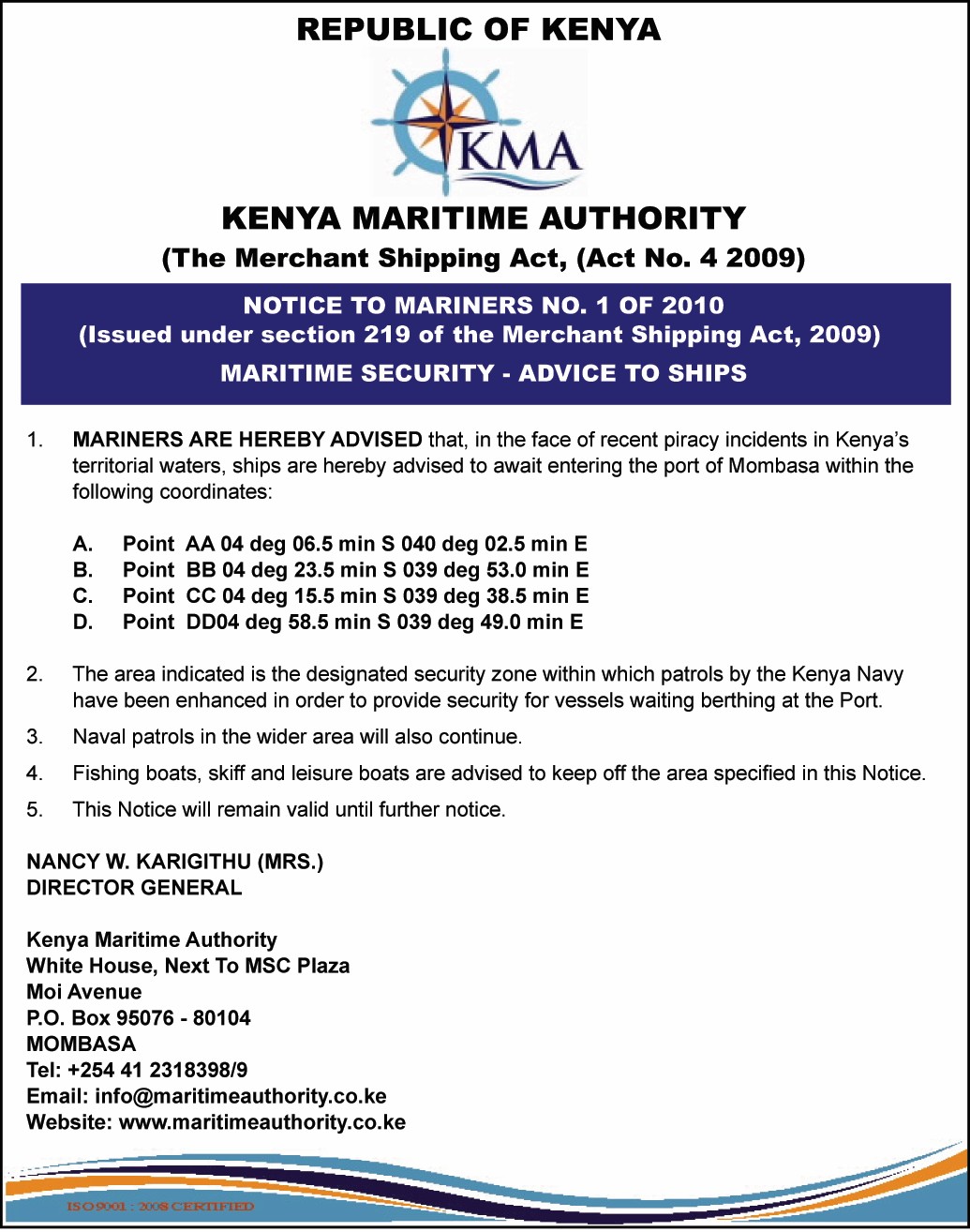
As noted in the attached Notice to Mariners no.1, 2010, Kenya Maritime Authority, the Republic of Kenya, advise that, in face of recent piracy incidents in Kenya’s territorial waters, ships are advised to await entering the Port of Mombasa within the following coordinates:
A. Point AA 04 DEG 06.5 MIN S – 040 DEG 02.5 MIN E B. Point BB 04 DEG 23.5 MIN S – 039 DEG 53.0 MIN E C. Point CC 04 DEG 15.5 MIN S – 039 DEG 38.5 MIN E D. Point DD 04 DEG 58.5 MIN S – 039 DEG 49.0 MIN E
The Regional Maritime Rescue Center is the focal point with all security organs in the country and also has contacts with other similar regional centers and naval forces as need arise.
Contacts for the 24 hour Regional Maritime Rescue Center:
Telephone Numbers: Satellite Phone:
Land/Line….. 041-2131100 / 2 / 3 / 4 Fleet 77 ID No...... 00870-764626657 (IOR) Wireless -…....020-8007776 Fax-…………… 00870-764626658 Safaricom -….0721368313 INMARSAT – C 463400070 (AOR- E) Zain ...……….0737719414 463400071 (IOR)
MRCM (Capt. Dave Muli).......................................................................0729403588 / EXT. 107 MRCO (Mr. Levis Malova)….................................................................0723745487 / EXT. 105
VHF Channel 16
E-Mail: rmrcc@kma.go.ke
Masters of Liberian flagged vessels scheduled to call at Port of Mombasa are encouraged to get in touch with the center for all their inquiries and distress calls while within Kenya’s territorial waters.
As per attached Kenya Government Guidelines on the Requirements related to handling of Privately Contracted Armed Security Personnel (PCASP), Weapons and Security Related Equipment, vessels making Port Calls with armed security personnel, firearms and ammunition or vessels planning to Disembark or Embark armed security personnel, firearms and ammunition must notify Kenya Maritime Authority (KMA) 14 days in advance of the activity via the Shipping Line or appointed Agents and possess pre-requisite authorization from the Flag state.
Owners and operators are requested to provide a copy of this Advisory to their Masters and to inform the Administration when their vessels are making a port call to the Port of Mombasa with armed security personnel, firearms and ammunition.
For more information please contact the Security Department at telephone + 1 703 251 3434; email security@liscr.com; LISCR Duty Officer + 1 703 963 6216 email: dutyofficer@liscr.com
* * * * *
KENYA GOVERNMENT GUIDELINES ON THE REQUIREMENTS RELATED TO HANDLING OF PRIVATELY CONTRACTED ARMED SECURITY PERSONNEL (PCASP), WEAPONS AND SECURITY RELATED EQUIPMENT |

These following guidelines will henceforth apply for all vessels that call at the Port of Mombasa with Privately Contracted Armed Security Personnel (PCASP), weapons and security related equipment on board.
1.0 DISEMBARKATION
1.1 Notification to KMA will be made within 14 days prior to disembarkation and pre–requisite authorizations from their flag state by the shipping line or appointed agents.
- The shipping company shall apply for temporary permits for all weapons at the time of notification for approval by the Chief Licensing Officer/Central Firearms Bureau.
- There should be proof that consultation of flag states early enough of the ship owner’s decision to place PCASPs aboard ships.
- Verification of the PMSC in relation to adequate training procedures will be provided to
KMA.
- Details of the maritime security company will include a valid registration certificate, written internal policies and procedures for determining suitability of the PCASPs, proof of risk assessment and assurance that all other practical means of self protection have been employed. Risk assessment to include: vessel and crew security, safety and protection, potential misuse of firearms resulting in bodily injury and/or death, liability issues, inquiry of the proposed PCASP to include maritime experience, written procedures on managements, chain of authority, change in command, responsibility in life saving, understanding of the flag state, port state and Coastal state with respect to carriage and usage of firearms, written testimonials from other previous clients and a detailed graduated response plan to a pirate attack.
- Documentary evidence from PCASP will include criminal background, employment history, military and law enforcement background, medical, physical and mental fitness including drug and substance use, relevant experience and certification in the use and carriage of firearms, travel documents and visas.
- License from the flag State to carry a firearm or its equivalent per personnel will be provided.
- Security clearance/Certificate of good conduct by the Interpol/Police1
- Details of the arms/ accessories on board shall include; calibre, type, serial numbers, quantity of ammunition.
- Operations of other security related equipment to be coordinated with Kenya Ports Authority (KPA) Port Facility Security Officer (PFSO).
- Information will be sent to Kenya Maritime Authority (KMA) who will distribute to relevant government agencies for appropriate action (rmrcc@kma.co.ke and/or info@kma.go.ke)
- Security incidents at sea will be reported as per the Merchant Shipping (Maritime Security) Regulations and will include details of type of weapon and quantity of ammunition used.
- All vessels should have a mandatory standard armoury on board.
- Reinforced bulkheads, doors, hatches
- Secure locks – key/ combination safe type recommended and not latches/ padlocks
- Adequate lighting
- Fire fighting sprinklers, smoke detectors
- Designated handlers (competent weapon and ammunition handler) NB: Non compliance of the above requirements may result in confiscation of arms and ammunition for storage at the port police armoury, detention of the ship until compliance, denial of entry in future callings unless standard is met.
- All vessels should have a mandatory standard armoury on board.
1.5 The standard measures for storage of arms and ammunition to be adhered to include:
- Distance/Proximity from potential hazards; fuel, galley, machinery spaces,
- Compatibility of ammunition/Mixing Rule; alphabet coding. Ammunition not stored with grenades and RPG rounds.
1.6 Receiving of arms and ammunition must comply with the Customs and security requirements to include taking into custody of the weapons for safe keeping in the Police armoury.
EMBARKATION
2.1 Notification within 14 days prior to disembarkation and pre–requisite authorizations from their flag state by the shipping line or appointed agents.
- The shipping company shall apply for temporary permits for all weapons at the time of notification for approval by the Chief Licensing Officer/Central Firearms Bureau.
- Proof of consultation of flag states early enough of the ship owner’s decision to place PCASPs aboard ships.
- Verification of the PMSC in relation to adequate training procedures.
- Details of the maritime security company to include a valid registration certificate, written internal policies and procedures for determining suitability of the PCASPs, proof of risk assessment and assurance that all other practical means of self protection have been employed. Risk assessment to include: vessel and crew security, safety and protection, potential misuse of firearms resulting in bodily injury and/or death, liability issues, inquiry of the proposed PCASP to include maritime experience, written procedures on managements, chain of authority, change in command, responsibility in life saving, understanding of the flag state, port state and Coastal state with respect to carriage and usage of firearms, written testimonials from other previous clients and a detailed graduated response plan to a pirate attack.
- Documentary evidence from PCASP to include criminal background, employment history, military and law enforcement background, medical, physical and mental fitness including using drug and substance use, relevant experience and certification in the use and carriage of firearms, travel documents and visas.
- License to carry a firearm or its equivalent per personnel
- Clearance by the Police/Interpol/Certificate of good conduct
- Details of the arms/ accessories on board to include: calibre, type, serial numbers, ammunitions.
- Operations of other security related equipment to be coordinated with PFSO
- Registration and stay of PCASPs must be in compliance with the Customs, Immigration and Labour Laws and regulations2
- All vessels to have a standard mandatory armoury onboard.
- Reinforced bulkheads, doors, hatches
- Secure locks – key/ combination safe type recommended and not latches/ padlocks
- Adequate lighting
- Fire fighting sprinklers, smoke detectors
- Designated handlers (competent weapon and ammunition handler) NB: Non compliance of the above requirements may result in confiscation of arms and ammunition for storage at the port police armoury, detention of the ship until compliance, denial of entry in future callings unless standard is met.
- All vessels to have a standard mandatory armoury onboard.
2.4 The standard measure for storage of arms and ammunition to be adhered to
- Distance/Proximity from potential hazards; fuel, galley, machinery spaces,
- Compatibility of ammunition/Mixing Rule; alphabet coding. Ammunition not stored with grenades and RPG rounds.
2.5 Receiving and movement of arms and ammunition must comply with the customs and security requirements.
VESSEL CALLING
3.1 Notification within 14 days prior to disembarkation and pre–requisite authorizations from their flag state by the shipping line or appointed agents.
- The shipping company shall apply for temporary permits for all weapons at the time of notification for approval by the Chief Licensing Officer/Central Firearms Bureau.
- Proof of consultation of flag states early enough of the ship owner’s decision to place PCASPs aboard ships.
- Verification of the PMSC in relation to adequate training procedures.
- Details of the maritime security company to include a valid registration certificate. Written internal policies and procedures for determining suitability of the PCASPs, proof of risk assessment and assurance that all other practical means of self protection have been employed. Risk assessment to include: vessel and crew security, safety and protection, potential misuse of firearms resulting in bodily injury and/or death, liability issues, inquiry of the proposed PCASP to include maritime experience, written procedures on managements, chain of authority, change in command, responsibility in life saving, understanding of the flag state, port state and Coastal state with respect to carriage and usage of firearms, written testimonials from other previous clients and a detailed graduated response plan to a pirate attack.
- Documentary evidence from PCASP to include criminal background, employment history, military and law enforcement background, medical, physical and mental fitness including drug and substance use, relevant experience and certification in the use and carriage of firearms, travel documents and visas.
- License to carry a firearm or its equivalent per personnel
- Clearance by the Police/Interpol/Certificate of good conduct
- Details of the arms / accessories on board to include: calibre, type, serial numbers, ammunitions.
- Operations of other security related equipment to be coordinated with PFSO
- Send information to KMA who then distributes to relevant government agencies for appropriate action (rmrcc@kma.co.ke and/or info@kma.go.ke)
- Security incidents at sea to be reported as per the Merchant Shipping (Merchant Security) Regulations, 2004 to include details of ammunition used
- All vessels to have a mandatory standard armoury on board
- Reinforced bulkheads, doors, hatches
- Secure locks – key/ combination safe type recommended and not latches/ padlocks
- Adequate lighting
- Fire fighting sprinklers, smoke detectors
- Designated handlers (competent weapon and ammunition handler) NB: Non compliance of the above requirements may result in confiscation of arms and ammunition for storage at the port police armoury, detention of the ship until compliance, denial of entry in future callings unless standard is met.
- All vessels to have a mandatory standard armoury on board
3.5 The standard measure of storage of arms and ammunition be adhered to
- Minimum Distance/Proximity from potential hazards; fuel, galley, machinery spaces,
- Compatibility of ammunition/Mixing Rule; alphabet coding. Ammunition not stored with grenades and RPG rounds.
3.6 Receiving and movement of arms and ammunition must comply with the Customs and security requirements
TRANSIT VESSELS
4.1 Notification within 14 days prior to transit through Kenya’s territorial waters and pre– requisite authorizations from their flag state by the shipping line or appointed agents.
1. Proof of authorisation of flag states of the ship owner’s decision to place PCASPs aboard ships.
4.2 Transit must be continuous and expeditious observing the right of innocent passage. While in territorial waters the vessel may be subjected to boarding/searches if in Kenya’s view, the passage has become or is suspected of being prejudicial to peace, good order or security of Kenya.
4.3 Security incidents should be reported as per the ISPS Code regulations and to include details of arms/ammunitions expended
ACTION TO BE TAKEN AGAINST DEFAULTERS OF THE GUIDELINES
Administrative measures
Vessel will not to be allowed to embark and/or disembark.

Nancy Karigithu